

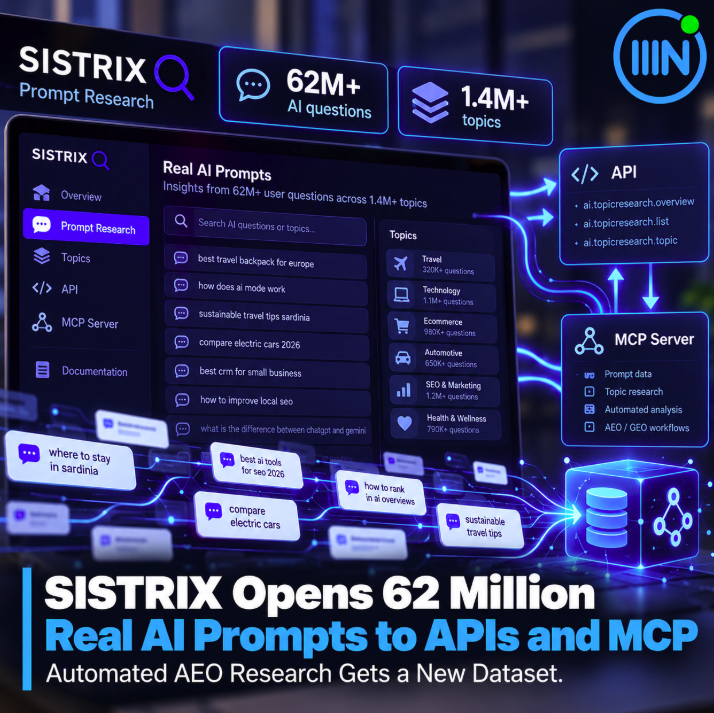

SISTRIX has opened one of its most interesting AI-search datasets to automation. Prompt Research data—built from more than 62 million real user questions grouped into over 1.4 million topics—can now be queried through both the SISTRIX API and its MCP Server.
The capability is part of the official SISTRIX Prompt Research release and was highlighted again in the company's October 5 Q3 2026 product review. It turns a dataset previously explored primarily inside the SISTRIX interface into something that can feed automated AEO, GEO, content-research and reporting workflows.
These are prompts, not conventional keywords
The premise behind Prompt Research is that demand in AI search behaves differently from traditional keyword search. Users frequently describe situations, constraints and goals in full natural-language questions instead of repeatedly entering an identical short query.
SISTRIX therefore groups differently worded prompts that represent the same underlying need into topics. Its current dataset contains more than 62 million user questions across more than 1.4 million such topics.
Each topic can include metrics and strategic context such as search volume, dialogue length, intent, customer-journey stage, buyer persona, emotional driver and real prompts associated with different AI platforms.
Three functions expose the dataset
The new ai.topicresearch area provides three functions that move from broad demand analysis to individual prompt detail.
ai.topicresearch.overview returns the aggregated picture for a keyword, including the number of topics, average dialogue length and distributions across customer-journey stages and intent groups.
ai.topicresearch.list returns the individual topics and their metrics, creating a dataset that can be sorted, filtered, clustered and prioritized.
ai.topicresearch.topic retrieves a single topic in depth, including fields such as buyer persona, emotional driver, next best action and the prompt library by AI model.
The API enables automated AEO research
For teams working directly with the API, the three calls can be chained into a research pipeline. A system can begin with a broad subject, identify its topic universe, filter the topics by intent or journey stage, rank opportunities and then retrieve the underlying prompts for the most valuable clusters.
That workflow can feed internal dashboards, editorial systems, content briefs or automated opportunity reports without manually exporting Prompt Research data from the SISTRIX interface.
MCP removes much of the orchestration
The MCP implementation changes the interaction again. Instead of explicitly constructing each API request, a user can ask a connected AI assistant to research a topic and the assistant can retrieve the appropriate SISTRIX functions as required.
SISTRIX describes workflows in which the model moves from topic overview to lists, clustering and detailed topic analysis directly in chat. Its MCP Server supports ChatGPT and Claude and, following its 2026 move to OAuth, is available to active SISTRIX users without requiring API credits for OAuth-based MCP usage.
Why the 62-million-prompt dataset matters
AEO research frequently suffers from synthetic-prompt bias. Teams invent the questions they believe users might ask an AI system and then optimize around that manually constructed set.
A dataset based on observed user questions provides a different starting point. It can reveal language, needs and conversational patterns that a marketer may not have predicted.
That does not eliminate the need for interpretation. A large prompt corpus can contain many topics irrelevant to a particular business. The value comes from filtering the dataset against actual products, audiences and commercial goals.
From topic discovery to a content brief
The topic endpoint is particularly relevant for editorial automation because it goes beyond a topic label. SISTRIX says the detailed view can expose buyer persona, emotional driver, next best action and prompt libraries for individual AI models.
That means a content system can potentially move from “this topic has demand” to a much richer briefing: who is asking, what motivates the question, where the user sits in the journey and how the need is phrased across AI environments.
Search volume is being reinterpreted for AI search
Traditional SEO research relies heavily on keyword-level monthly search volume. Conversational AI makes that unit less useful because semantically equivalent demand can be distributed across huge numbers of unique formulations.
SISTRIX's topic model attempts to aggregate that fragmented language into measurable demand clusters.
For AEO and GEO teams, this may be more useful than tracking individual prompts in isolation. The optimization target becomes the underlying user need rather than one exact sentence.
API access and MCP access are not identical
SISTRIX states that ai.topicresearch is available through the API to accounts with API access. Through the MCP Server, the Prompt Research functionality is available to active SISTRIX users.
The MCP Server uses OAuth and can expose SISTRIX data conversationally without requiring the user to manually handle each endpoint. API access remains the more direct route for teams building their own software, pipelines and reporting infrastructure.
The NetContentSEO takeaway
The important development is not simply that SISTRIX added three more API functions. It is that a large dataset of real conversational demand can now become an input to automated research systems.
A workflow can discover AI-search topics, classify them by intent, prioritize them, retrieve authentic prompt formulations and turn the resulting data into content briefs—all without treating traditional keyword lists as the only representation of demand.
Prompt research is becoming machine-accessible. For AEO and GEO workflows, that means the research layer itself can now be automated through APIs or delegated to AI agents through MCP.