

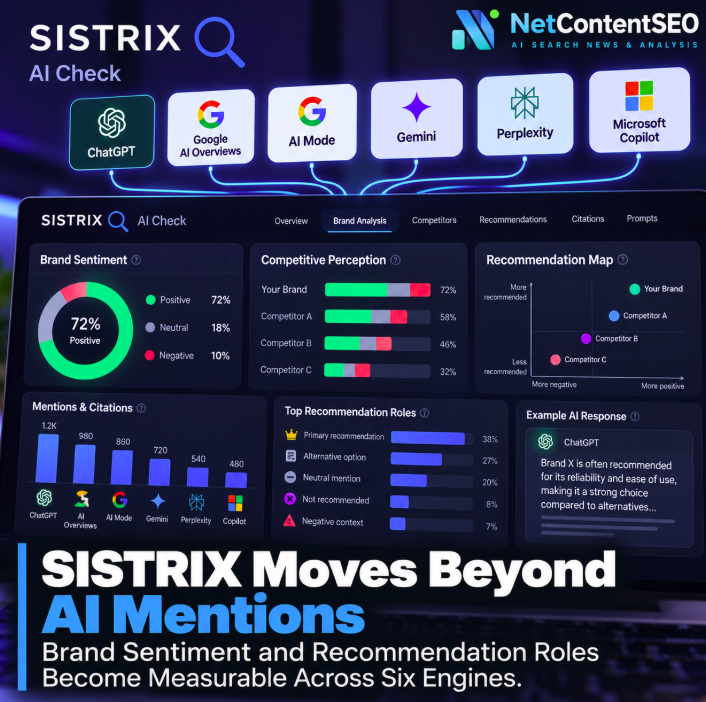

SISTRIX is expanding AI visibility measurement beyond a basic question—whether a brand appears in an AI answer. Its AI Check now measures brand sentiment, competitive perception and recommendation roles across six major AI systems.
The update was detailed by SISTRIX on October 5, 2026 in its official Q3 product review. The six covered environments are ChatGPT, Google AI Overviews, Google AI Mode, Gemini, Perplexity and Microsoft Copilot. SISTRIX Q3 2026 changelog
AI visibility is becoming a perception problem
Counting mentions or citations answers only part of the GEO measurement problem. A brand can appear frequently in AI answers and still be described negatively, positioned below competitors or consistently presented as an alternative rather than the preferred choice.
SISTRIX's new analyses attempt to expose those differences. Instead of reducing AI visibility to presence or absence, AI Check can now examine how systems characterize a brand and when they recommend it.
Three new brand analyses
The first addition is sentiment analysis. SISTRIX says it calculates the balance between praise and criticism across AI answers in which a brand appears. Results can be broken down by platform and topic and include a benchmark classification.
The second is competitive perception. This places strengths and weaknesses attributed to competing brands side by side, making it possible to compare how AI systems frame different companies within the same market.
The third is the recommendation map. This records which brand is recommended for a particular purchase situation and what role it receives: first choice, one of several alternatives, not recommended, or even explicitly advised against.
Six AI systems are now covered
SISTRIX says AI Check previously covered three systems and has now added Gemini, Perplexity and Microsoft Copilot.
Those join ChatGPT, Google AI Overviews and Google AI Mode, bringing the same brand analyses and competitor comparisons across six different AI environments.
Cross-platform coverage matters because there is no reason to assume that a brand's representation will be consistent between models. A company may be strongly recommended in ChatGPT while receiving a weaker role in Gemini or Perplexity.
SISTRIX says the measurements use real AI answers
A particularly important methodological detail is how the data is generated. According to SISTRIX, the evaluative statements do not come from asking another model to invent an assessment of the brand.
Instead, the system evaluates real AI answers to real user questions, extracts evaluative statements and calculates the results deterministically. Users can inspect the original statement and the prompt behind each result.
That auditability is significant for AI visibility reporting. A sentiment score without access to the underlying answer can be difficult to validate; retaining the prompt and original evidence makes the metric much more actionable.
Recommendation roles may be more valuable than raw mentions
Consider two competing travel brands. Both may appear in 500 AI answers. If Brand A is repeatedly presented as the primary recommendation while Brand B appears mainly as an alternative, their mention counts look similar even though the commercial outcome is very different.
Recommendation-role tracking attempts to capture that difference.
This is especially relevant as consumers increasingly ask AI systems comparative or transactional questions: which software to buy, which hotel to book, which bank to use, or which product best matches a specific need.
Sentiment can expose an invisible visibility problem
Traditional rank tracking generally treats visibility as positive: ranking higher means more exposure. Generative systems complicate that assumption.
A brand may receive extensive exposure because AI answers repeatedly mention a weakness, warning or controversy. Measuring only the number of mentions could mistakenly report that as improved AI visibility.
Sentiment and contextual analysis therefore add a necessary second dimension: not just whether the brand appears, but what the system says when it appears.
Original prompts and citations remain accessible
SISTRIX retains access to the underlying prompts and source material associated with the analyses. That gives SEO and GEO teams a path from an aggregate metric back to the actual AI answer.
For example, a company discovering weak sentiment around customer support can inspect the prompts that generated those assessments, identify recurring sources or themes and decide whether the problem comes from reputation, content gaps, outdated information or competitive positioning.
What GEO teams can measure now
The practical AI visibility dashboard is becoming more complex. A mature measurement framework can include mentions, citations, sentiment, competitive strengths and weaknesses, recommendation frequency and recommendation role.
These metrics answer different questions. Citations indicate which sources AI systems rely on. Mentions show whether the brand enters the answer. Sentiment shows how it is characterized. Recommendation roles show whether that representation translates into preference.
The NetContentSEO takeaway
The most important shift is conceptual. AI visibility cannot be reduced to an AI share-of-voice score.
A brand that is mentioned frequently but rarely recommended—or regularly associated with negative attributes—does not have the same generative-search position as a brand that is consistently framed as the best choice.
With AI Check now spanning ChatGPT, Google AI Overviews, AI Mode, Gemini, Perplexity and Copilot, SISTRIX is making that distinction measurable across several of the systems that increasingly mediate brand discovery.
The next phase of GEO analytics is not simply “Did the AI mention us?” It is “What does the AI think we are good for—and does it recommend us?”