
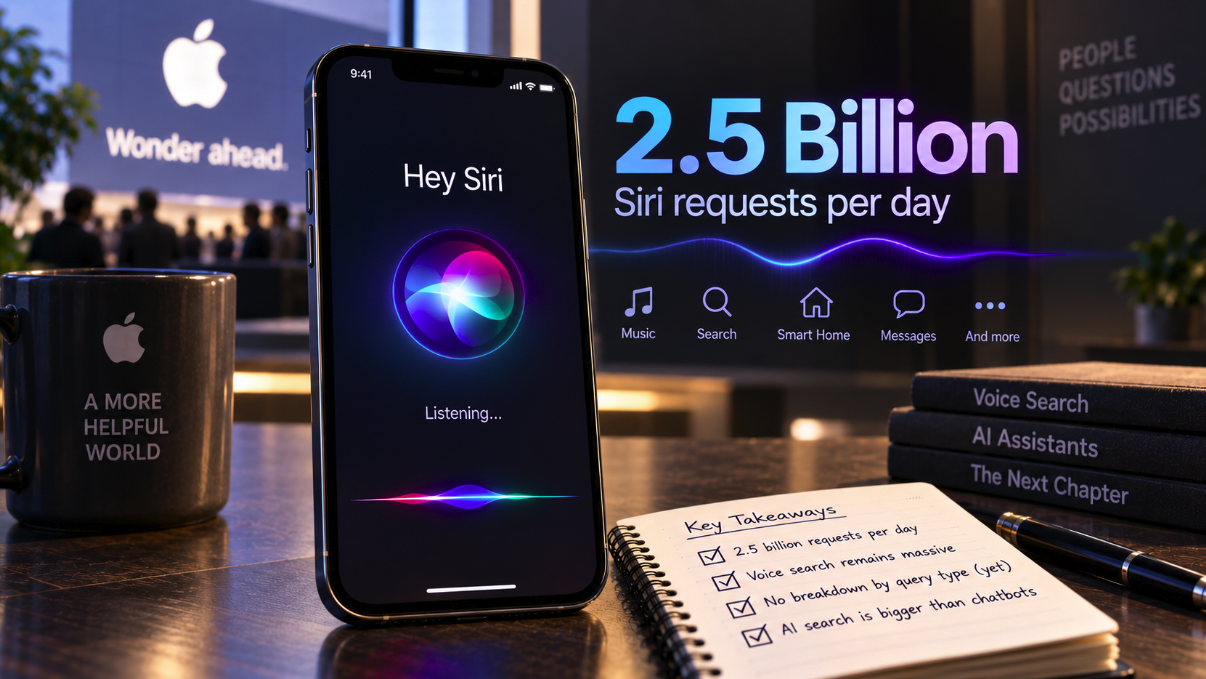
The AI search market is easy to picture as a collection of chatbot windows: a user opens ChatGPT, Gemini or Perplexity, types a question and receives a synthesized answer. Apple has just supplied a reminder that this picture leaves out an enormous layer of assistant behavior already embedded in consumer devices. During its September 9 event, the company said Siri users make more than 2.5 billion requests every day.
Search Engine Roundtable highlighted the figure on September 10, citing Lilian Rincon, Apple’s Vice President of Product Management/Product Marketing for Artificial Intelligence. During the keynote, Rincon described Siri as one of the world’s most widely used assistants before stating that Apple users make more than 2.5 billion Siri requests each day. A separate MacStories event recap also recorded the same daily figure, making the number a direct Apple claim rather than an outside estimate.
The scale is significant, but its meaning needs a strict boundary. Apple did not publish a request-type distribution alongside the number in the material reviewed. A Siri request can be a timer, a message, a music command, a smart-home action, navigation, a question about something on screen or a request for information from the web. The 2.5 billion figure therefore cannot be translated into 2.5 billion daily searches, AI answers or commercial discovery queries.
Siri increasingly overlaps with search without becoming a search box
That caveat does not make the number irrelevant to search. Apple’s official Siri AI announcement from June describes the redesigned assistant as capable of drawing on the web to answer questions across a broad range of topics, while also finding information inside a user’s messages, email, photos and other personal content. Siri is consequently positioned across several information environments that used to require separate actions: opening a browser, searching an app, locating a message or manually navigating through a service.
For marketers and publishers, that makes assistant scale more important than the narrower question of how many people deliberately visit an AI chatbot. Search behavior increasingly starts from an interface that may not look like search at all. A spoken question from an iPhone, a request based on what is visible on screen or an instruction that combines personal context with web knowledge can satisfy an informational or discovery need before a conventional search-results page ever appears.
Yet the missing category data prevents stronger claims. We do not know what percentage of Siri’s 2.5 billion daily requests requires external knowledge, how many involve local businesses, products or websites, or how often a web-derived response produces a citation or outbound visit. Even a very small share of 2.5 billion would represent substantial query volume, but without Apple’s breakdown that remains arithmetic possibility rather than measured search traffic.
The strategic signal is the size of the assistant layer
The useful takeaway is therefore not that Siri has suddenly become a 2.5-billion-query search engine. It is that conversational and agentic interfaces already operate at consumer scale far beyond the audiences visible in standalone chatbot analytics. Siri is integrated into devices and everyday workflows where users can express intent without consciously choosing an “AI search” product first. That changes the competitive surface for information retrieval: the assistant can sit upstream of the browser and, increasingly, upstream of individual apps.
This also complicates attempts to measure the AI-search market through referral traffic alone. A request that ends with Siri setting a reminder has no publisher implication, while a request answered from the web may satisfy an information need without producing a click. Another request could trigger an action inside an app rather than visit a website. Those outcomes are economically and behaviorally different even though Apple can count all of them under the same broad unit: a Siri request.
For SEO and GEO teams, the distinction suggests a measurement discipline similar to the one emerging around generative citations. Visibility, answer inclusion, referral traffic and business outcomes should remain separate metrics. Siri’s aggregate request count demonstrates reach, but it does not tell a publisher how frequently its information appears, whether its brand is named, which underlying sources are used or whether a customer moves from an assistant response to a commercial action.
Voice search never disappeared; it is being absorbed into AI assistants
The 2.5 billion figure also reframes an older search-marketing category. “Voice search” was often treated as a distinct optimization channel built around spoken queries and smart speakers. Modern assistants blur that boundary. Siri can still receive a simple voice command, but Apple is simultaneously expanding it toward personal context, screen awareness, broader world knowledge and cross-app actions. The interface is becoming less about voice as an input method and more about an assistant mediating between a user’s intent and multiple information sources.
That makes the most interesting future data the data Apple has not yet supplied. A breakdown separating device commands from information seeking, local discovery, navigation, commerce and web questions would make it possible to estimate how much of Siri’s extraordinary volume genuinely competes with traditional search and newer answer engines. Reporting on sources, citations or downstream actions would be even more valuable for publishers trying to understand whether assistant visibility can become measurable traffic or demand.
Until then, Apple’s number should be used for what it actually establishes: Siri operates at massive daily scale. It does not establish that billions of Google-like searches are migrating to Apple, nor does it prove that Siri is larger than any specific chatbot on a directly comparable usage metric. What it does show is that the future of AI-mediated discovery cannot be measured only by counting visits to chatbot websites and apps.
The search market is increasingly an intent market, and assistants are becoming one of its front doors. Apple’s 2.5 billion daily Siri requests include many actions that have nothing to do with search, but they reveal the size of the interface through which future search, discovery and agentic tasks can flow. For anyone tracking AI visibility, that is the more consequential number behind the headline.