

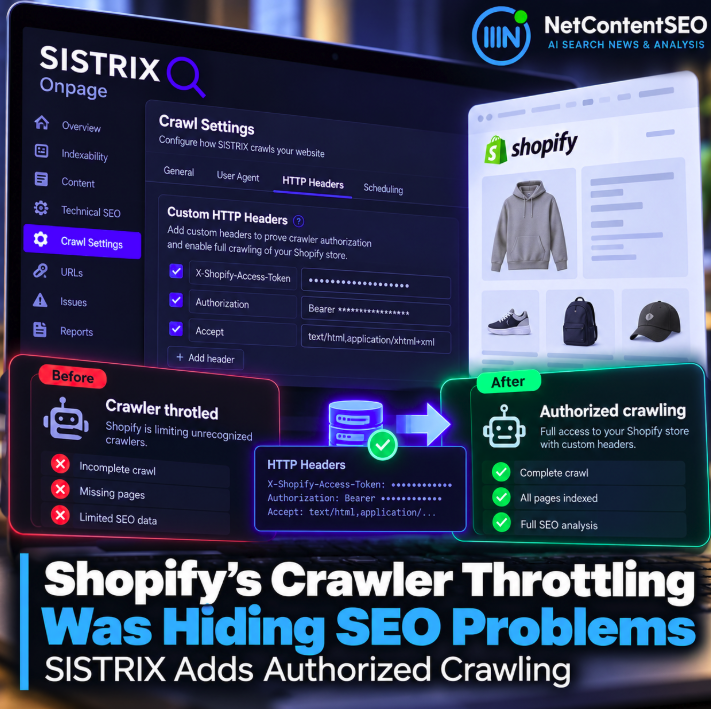

SISTRIX has added a practical workaround for a Shopify change that was making technical SEO audits look incomplete—or even completely empty. Onpage projects can now send custom HTTP headers that prove the crawler is authorized to access a Shopify store.
SISTRIX documented the solution in its official Q3 2026 review published on October 5. According to the company, Shopify has been slowing crawlers it does not recognize since May, including the SISTRIX crawler. SISTRIX Q3 2026 changelog
The problem was not necessarily the website
This is an important distinction for technical SEO teams. When an audit crawler returns only part of a Shopify site—or almost nothing—it can look like a serious accessibility, linking or indexability problem.
But SISTRIX says affected Onpage projects could produce incomplete or entirely empty crawls without an explanatory error message. The underlying cause was Shopify's crawler handling rather than missing pages.
That creates a dangerous diagnostic problem: incomplete crawl data can hide genuine SEO issues while simultaneously making healthy pages appear unreachable to the auditing tool.
Shopify now expects proof that a crawler is authorized
SISTRIX explains that Shopify requires unrecognized crawlers to demonstrate authorization. Requests without that proof may be rejected or delayed.
The solution is to generate Shopify's crawler-access credentials and have the SEO crawler send them with every request.
SISTRIX adds custom HTTP headers
SISTRIX Onpage projects now provide a Custom HTTP headers option in the crawler's Expert Settings. The crawler sends the configured headers with each request to the site.
SISTRIX's documentation specifically identifies the Shopify headers as Signature-Input, Signature and Signature-Agent. These are generated from Shopify's administration interface under Online Store → Preferences → Crawler access. SISTRIX Onpage Project Settings
Why authorization matters for SEO audits
A technical crawler is useful only if it can see enough of the site to represent its structure accurately. If requests are silently throttled, metrics based on the crawl can become misleading.
Pages may disappear from the crawl graph. Internal-link relationships can look incomplete. Broken-link checks can miss URLs. Duplicate-content analysis, metadata checks and loading-time analysis can all operate on a distorted sample.
Authorized crawling restores the conditions needed for a more complete audit.
This is different from bypassing crawl controls
The new setting should not be interpreted as a way to evade Shopify's protections. The mechanism is explicitly based on proving that the crawler has permission from the store owner.
The authorization information is generated inside the Shopify admin and then configured in the SISTRIX project. In other words, the site owner is deliberately allowing the external crawler to perform the audit.
How to configure it
For an affected Shopify store, generate the authorized crawler headers in Shopify's crawler-access settings. Then open the relevant SISTRIX Onpage project, enable the Expert Settings and add the generated header names and values under Custom HTTP headers.
Once configured, SISTRIX sends those values with every crawl request. Teams should then run a fresh crawl rather than assuming previous incomplete data has automatically become valid.
Compare the new crawl with the old one carefully
If earlier Shopify crawls were affected by throttling, a newly authorized crawl may suddenly discover substantially more URLs. That can create dramatic changes in issue counts and crawl metrics.
Those differences should not automatically be interpreted as a sudden deterioration or improvement in the website. Part of the change may simply reflect better crawler access.
Technical SEO teams should annotate the date on which authorization was enabled before comparing historical crawl trends.
A broader lesson for third-party SEO crawlers
The Shopify case illustrates a growing complication in technical SEO measurement. A crawler can be blocked, challenged or throttled even when the website remains perfectly accessible to users and major search engines.
That means an audit failure is not always evidence of a site failure.
When crawl coverage changes unexpectedly, teams increasingly need to examine the relationship between the auditing bot and the hosting or security platform: user agents, rate limits, firewalls, bot protection and authorization mechanisms can all affect what the tool sees.
The NetContentSEO takeaway
SISTRIX's custom-header support solves a specific Shopify problem, but the larger lesson is about data quality.
If a crawler cannot reliably access the site, every SEO conclusion built on that crawl becomes questionable. Shopify's throttling could therefore hide real technical problems behind incomplete datasets—or create apparent problems that were actually crawler-access failures.
Before diagnosing a Shopify SEO issue from an incomplete crawl, verify that the auditing crawler is authorized and actually seeing the store. SISTRIX now gives Onpage projects a direct way to prove that authorization.