

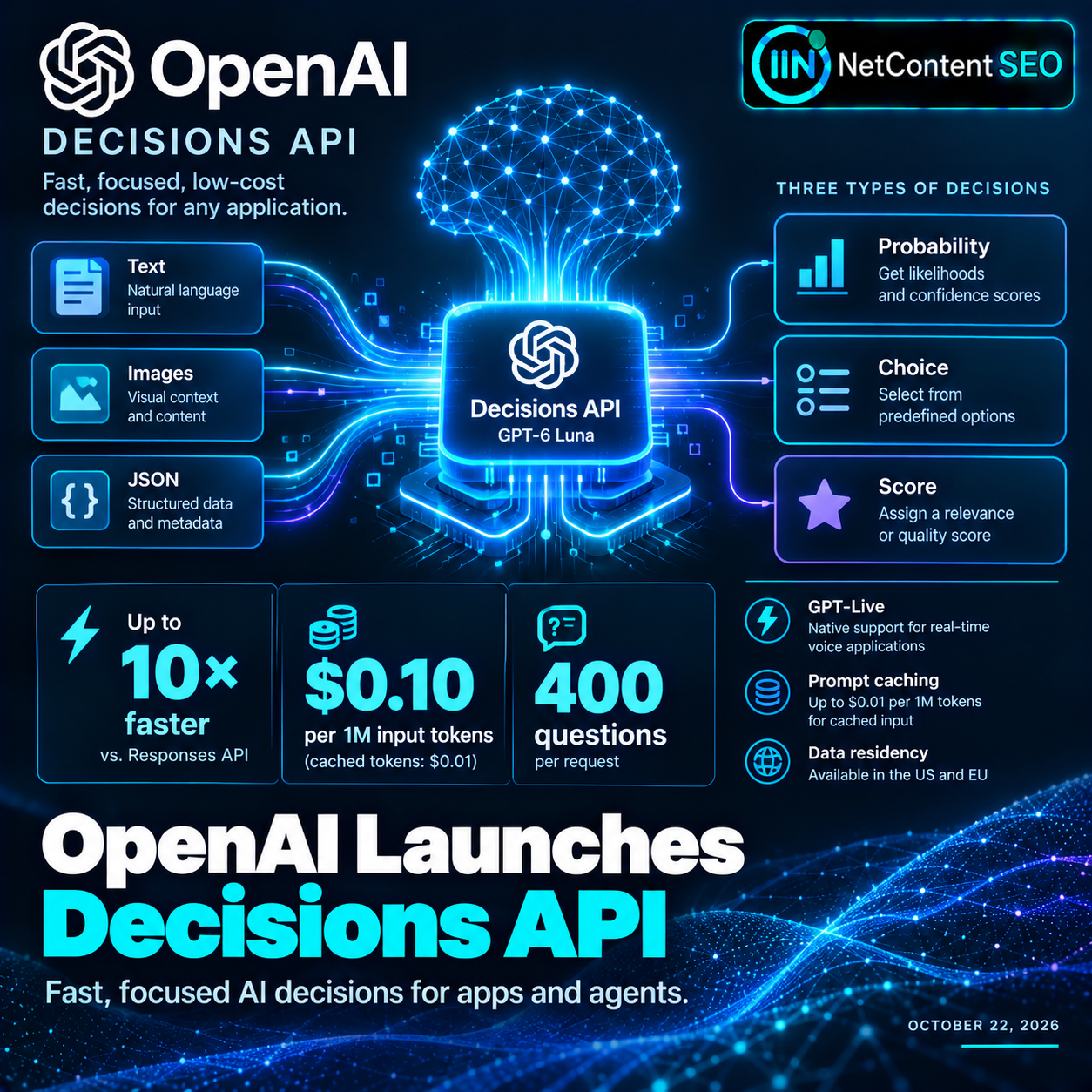

OpenAI has made its Decisions API generally available, introducing a dedicated way for applications and AI agents to make fast, structured choices. Announced on October 22, 2026, the service uses GPT-6 Luna to answer bounded questions with predefined response formats. OpenAI says it can deliver decisions up to ten times faster than using GPT-6 Luna through the Responses API, at a listed price of $0.10 per million input tokens.
The new endpoint targets a common bottleneck in software built around AI: many workflows do not need a long generated answer. They need a reliable yes-or-no judgment, a choice among known options or a score that determines the next step. OpenAI’s launch announcement positions the API as a lightweight decision layer for products, agents and real-time interactions.
What is the Decisions API?
The Decisions API accepts a developer-defined question, instructions, permitted answers and contextual information. Inputs can include text, images and native structured JSON. Rather than generating open-ended prose, it returns a structured result designed for programmatic use.
For example, an application could decide whether a support ticket needs escalation, classify an incoming document or determine which tool an agent should call next. These are tasks where output constraints, predictable formatting and low latency matter more than elaborate natural-language responses.
OpenAI says the service is built on GPT-6 Luna and is generally available through a dedicated Decisions endpoint. Its claimed speed improvement is relative to GPT-6 Luna accessed through the Responses API; actual gains depend on the workload and should not be interpreted as a guaranteed tenfold acceleration for every application.
Three supported decision types: predicate, choice and score
The API supports three types of questions, each with a different result shape.
Predicate: estimate a probability
A predicate asks whether a condition is true and returns an estimated probability between zero and one. A visual inspection workflow, for instance, could estimate whether a product photograph shows damage.
Choice: select from predefined options
A choice question selects one value from a developer-supplied set. An agent might choose whether to continue, retry, escalate or ask for clarification. The response also provides probabilities and confidence information, allowing developers to build thresholds or human-review rules around uncertain cases.
Score: apply an ordered rubric
A score question evaluates an input against ordered levels. The returned value is a probability-weighted average of the level indices. This can help categorize severity, relevance or quality against a consistent rubric, though developers still need to test calibration and accuracy against their own labeled examples.
Pricing: $0.10 per million input tokens
OpenAI lists the Decisions API at $0.10 per million input tokens, with cached input priced at $0.01 per million tokens. The service has no output-token charge. The company also documents separate pricing details for cached writes with 30-minute and 12-hour retention, so the headline cached-input rate should not be confused with every caching-related cost.
These economics could matter for high-volume classification and routing, where a single decision may be inexpensive but repeated calls accumulate. Teams should still measure total costs, including any preprocessing, storage, orchestration and downstream model calls.
Up to 400 questions in a request
Developers can now submit up to 400 questions per request, twice the limit available in the earlier public beta. The API supports images inside question instructions, native JSON inputs and prompt caching for reused context.
OpenAI also says inference residency is available in the United States and European Union, while Zero Data Retention is available to eligible customers. Those features can be important when evaluating where workloads are processed and how data is handled, but specific organizational compliance requirements still need to be checked against the current documentation.
GPT-Live integration for real-time voice applications
A significant addition since the beta is native integration with GPT-Live. Decisions can run in response to live conversation events, helping voice interfaces select actions without adding the delay of a separate long-form generation step.
OpenAI illustrates the feature with a virtual avatar that selects expressions based on transcript updates. More practical examples include deciding whether a support agent should ask a follow-up question, route a caller or escalate a problem.
In customer examples shared by OpenAI, Speak reported reducing the time to a next action from 1.4 seconds to 0.13 seconds in its GPT-Live testing. That is a customer-reported result for a particular integration, not a universal latency benchmark.
Early users report faster workflows
OpenAI describes several early adopters. Box reported approximately five-times faster route selection on a 30-case insurance-certificate evaluation with the same accuracy as its Responses API baseline. Datadog said the service helped assess risks in agent-generated shell commands and reported a fortyfold improvement in p95 latency compared with available frontier models at comparable accuracy.
Ramp reported four-times faster and 30% cheaper AI-cost attribution than its GPT-6 Luna baseline. Sierra reported decision latency below 280 milliseconds at p95 for parts of live customer-conversation orchestration, with lower cost per call than its prior approach. These are company-provided examples from distinct tasks and baselines, so their figures should not be combined into one general performance claim.
Potential applications for SEO teams and AI Search workflows
Although the launch is not a search-engine algorithm update, it creates interesting possibilities for SEO operations and AI-driven publishing systems. An editorial platform could classify incoming articles by topic, route submissions to the appropriate reviewer, flag content for further fact-checking or score whether a draft meets a documented checklist.
For technical SEO, a decision layer might categorize crawl-log events, prioritize alerts or identify which pages require human investigation. In AI Search research, teams could use structured decisions to classify prompts, organize observed citations or triage large collections of answer samples before deeper analysis.
These are potential applications proposed by NetContentSEO, not capabilities OpenAI says it has deployed specifically for SEO. Any relevance or quality scores produced by the API would be internal workflow signals, not Google ranking scores or evidence of how ChatGPT selects sources.
How developers should evaluate the API
OpenAI recommends beginning with a recurring decision that the application already makes. Developers should define the question, allowed answers and context, then test the endpoint against examples representative of real production inputs.
Evaluation should compare latency, accuracy, calibration, cost and failure behavior against existing methods. Teams handling consequential decisions should also define confidence thresholds and human escalation paths rather than assuming that a fast structured answer is automatically correct.
Developers can consult the official launch post for links to the Decisions Playground, developer guide and pricing documentation.
Does Decisions API change AI Search rankings or citations?
No direct change has been announced. Decisions API is a developer product for bounded judgments inside applications. OpenAI has not said that it changes ChatGPT Search crawling, retrieval, source selection or citation policies, and it is not a new ranking factor for Google or Bing.
The practical opportunity for SEO professionals is operational: faster, lower-cost classification and routing may help teams analyze more material and act on it sooner. Those workflow improvements should be evaluated independently from search visibility outcomes.
NetContentSEO assessment
The Decisions API illustrates a useful distinction in AI application design: not every task needs a full generative response. By separating small, constrained decisions from open-ended generation, developers may reduce latency and cost in workflows with many repeated judgments.
Its strongest appeal is the combination of structured outputs, low input-token pricing, support for 400 questions per request and native real-time voice integration. For SEO teams building internal automation or AI Search monitoring systems, it is worth testing—but claims about ranking or citation effects would go beyond the announcement.
Primary source: OpenAI, “Build more responsive apps with the Decisions API,” October 22, 2026.