

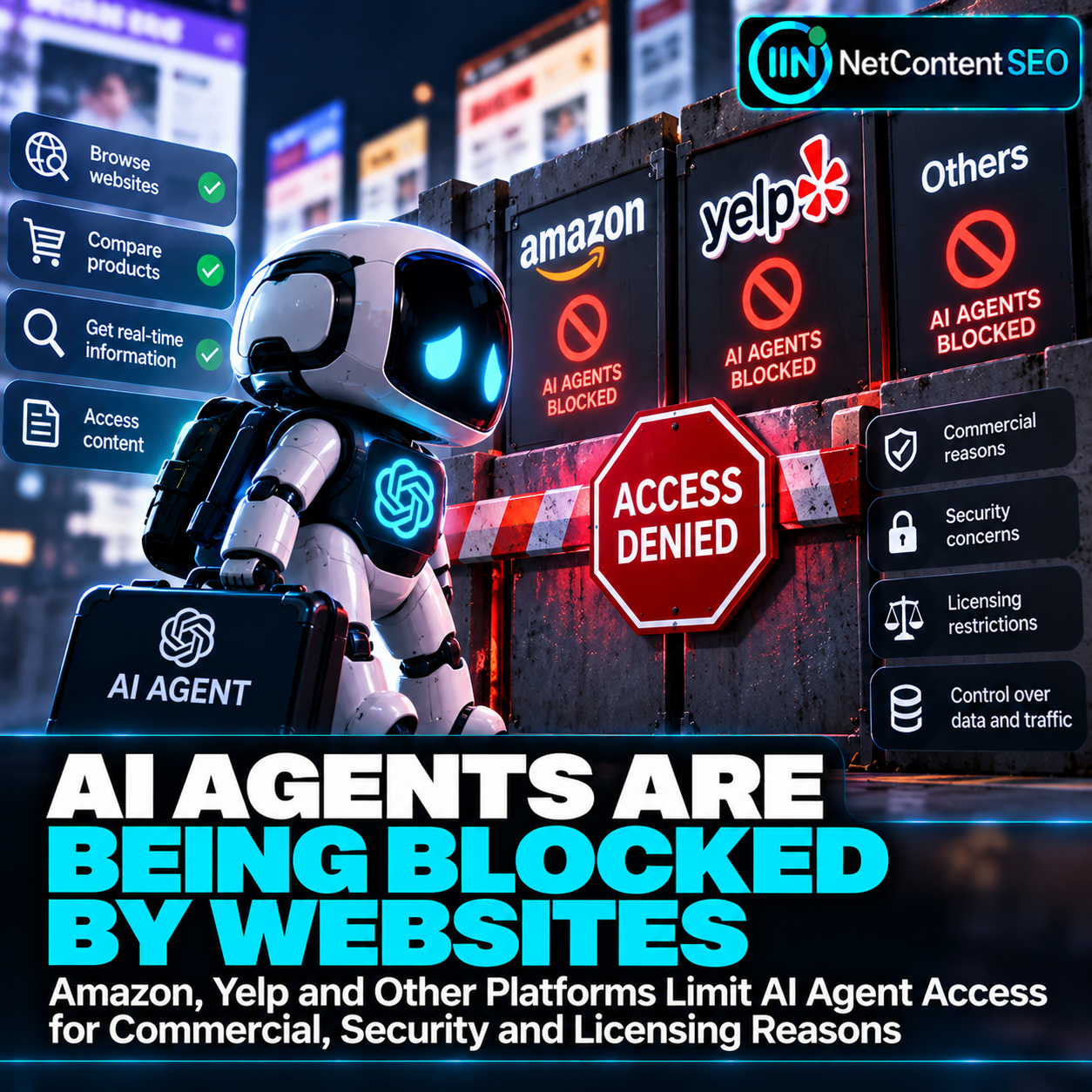

AI companies are promising assistants that can shop, book travel, compare services and manage tasks across the web. But a growing obstacle is emerging: many websites do not want unauthorized AI agents interacting with their platforms.
In an October 17, 2026 report, The Verge examined restrictions involving major retailers, review platforms, airlines and financial institutions. The resulting conflict is not simply about bots reading public pages. It concerns who controls customer interactions, access to data, account security and the commercial value of an online transaction.
Amazon: the dispute over AI shopping agents
Amazon has challenged third-party agents shopping on its platform without authorization. In September, Amazon said it blocked Meta's Muse shopping assistant, arguing that the agent's continued access violated its policies. Amazon raised concerns about identification of automated traffic and the handling of account credentials, according to GeekWire's reporting.
Amazon has also litigated against Perplexity over agentic shopping. The legal position is contested: an August 2026 US appellate decision overturned an earlier preliminary restriction, according to Reuters. That decision should not be described as a final universal ruling that all shopping agents have unrestricted access to Amazon.
The underlying commercial issue is significant. A retailer may want to control how products are presented, how advertising appears, how customer sessions are secured and which partners can automate purchases.
Yelp: access tied to data licensing
Yelp's position is more explicit. As TechCrunch reported on October 6, Yelp says it does not allow non-human traffic unless an agent has paid for access through its data licensing program. An assistant trying to retrieve business information or complete a task on Yelp without an agreement may therefore fail.
That is not necessarily a ban on every AI integration. It is a distinction between licensed access and unauthorized automated use, and it highlights the emerging market for paid data and transaction partnerships.
Airlines and banks emphasize security
The Verge also reported restrictions involving Delta Air Lines, JPMorgan Chase and Charles Schwab. In financial services, the concern is particularly acute: agents acting inside authenticated accounts can introduce risks involving credentials, sensitive information and transactions. A customer authorizing an assistant does not automatically mean every website or financial institution authorizes that assistant's access method.
Reported failures on other websites should be treated carefully. A user's agent being blocked once does not establish a permanent company-wide policy; anti-bot detection, rate limits, session behavior and temporary security controls can produce similar symptoms.
AI agents and search crawlers are not the same thing
For SEO professionals, one distinction is essential: search indexing, AI training crawlers and interactive browsing agents are different categories of automated access. A website may permit Googlebot to crawl product pages while blocking an assistant that attempts to sign in, scrape prices or submit a purchase. Conversely, a site may support agent access through a licensed API without permitting unrestricted crawling.
That means a site's appearance in Google Search or an AI-generated answer does not guarantee an AI agent can complete an action on it. Robots directives, authentication, CDN protections, bot management rules, application permissions and contractual terms all influence different parts of the journey.
Cloudflare and verified agent traffic
Some restrictions arise from broad anti-automation defenses rather than a deliberate policy against a named AI company. This creates a risk of blocking legitimate user-directed activity alongside malicious bots.
One technical response is authenticated agent traffic. OpenAI's Cloud Browser allowlisting guide explains how websites can verify signed requests through Web Bot Auth and configure supported CDNs or security tools to allow legitimate ChatGPT browser traffic. Such mechanisms do not override a site's policies or confer permission to perform restricted transactions; they help website operators identify traffic and apply deliberate access rules.
Agentic commerce may increasingly depend on partnerships
If autonomous shopping and booking become mainstream, AI providers may need agreements with retailers, marketplaces and payment or travel services. Partnerships can offer stable APIs, explicit permissions, auditable transactions and agreed commercial terms. Without them, a technically capable agent can still fail at the final step because the destination platform refuses the interaction.
That creates competing incentives. AI providers want broad, user-directed access; platforms want to protect customer relationships, advertising models, licensed data and security. The balance is still being negotiated through product integrations, policies and litigation.
What SEO teams and site owners should do
Businesses should audit their automation policies rather than treating every bot alike. Decide which content should be discoverable, which machine-readable data may be licensed, which agents can access public pages, and which account or transaction actions require authenticated integrations. Test legitimate customer journeys with accessibility tools and approved agents, review CDN false positives, and document security boundaries.
For measurement, avoid assuming that blocked agent activity is visible in traditional search analytics. Agent requests may not resemble ordinary organic sessions, and no evidence here establishes a new search ranking factor or a measurable shift in SEO traffic.
NetContentSEO assessment
The next stage of AI Search is not only about which websites models can cite. It is also about which websites agents are permitted to use. Amazon and Yelp illustrate different responses—platform control and licensing—while financial institutions foreground security. The opportunity for site owners is to build intentional, secure agent-access policies instead of choosing between indiscriminately blocking all automation and allowing it all.
Sources: The Verge, October 17, 2026; TechCrunch, October 6, 2026; GeekWire on Amazon and Meta; OpenAI allowlisting documentation.