

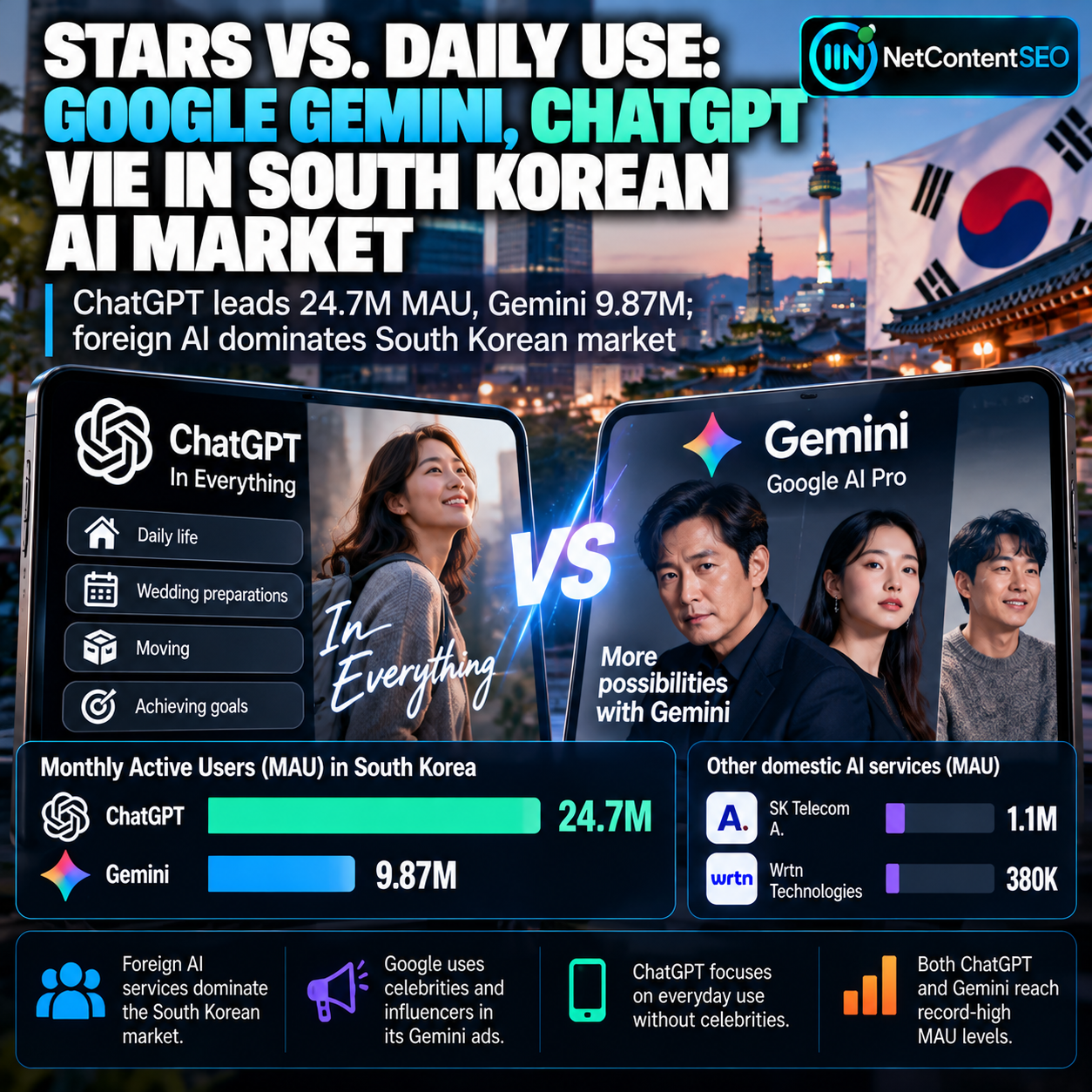

ChatGPT and Google Gemini have both reached record monthly active user levels in South Korea, but ChatGPT remains the clear leader in the latest figures cited by Chosun. Data from app and payment analytics firm Wiseapp·Retail put ChatGPT at 24.7 million monthly active users (MAU) last month, compared with 9.87 million for Gemini. The figures, updated on 15 October 2026, count smartphone users and exclude PC usage.
The user gap comes as OpenAI and Google promote their products with different advertising approaches. Google's Gemini campaign uses well-known Korean actors and an influencer, while ChatGPT's “In Everything” campaign focuses on everyday situations such as wedding planning, moving house and achieving personal goals.
ChatGPT leads, while Gemini continues to grow
According to the Wiseapp·Retail data cited by Chosun, ChatGPT recorded 24.7 million MAU in South Korea last month, while Gemini reached 9.87 million. Both were described as record highs for their respective services.
The same report lists SK Telecom's A. at 1.1 million MAU and AI startup Wrtn Technologies' Wrtn at 380,000. Among the top 10 services in the cited ranking, those were the only domestic services to make the list, reinforcing the article's conclusion that foreign AI platforms dominate the South Korean consumer market.
These figures are not a complete count of every person using generative AI in the country. The report notes that the data covers smartphone users and excludes people using the services on PCs, so actual usage patterns may differ.
Two different advertising strategies
Google Gemini: use familiar faces to make AI accessible
Google's Google AI Pro advertisement features actor Lee Byung-hun, actor Kim Go-eun and economic YouTuber Shuka. Chosun reports that the video had surpassed 10 million views at the time of publication.
An industry source quoted by the newspaper interprets the campaign as an effort to make AI technology more familiar to the general public by using well-known personalities. The report suggests that Google's brand recognition and advertising resources may help it compete with ChatGPT for users who are open to trying new technology.
ChatGPT: make the product part of everyday life
OpenAI's “In Everything” advertisement takes a different approach, without relying on celebrity appearances. Instead, it presents ChatGPT as useful for everyday activities, including wedding preparations, moving and working toward personal goals.
A professor quoted by Chosun interprets this as a brand-led strategy: rather than borrowing the attention of famous personalities, ChatGPT promotes the product itself and its place in daily life. These are expert interpretations reported by the newspaper, not proof that one advertising style is inherently more effective than the other.
Did advertising drive the user numbers?
The timing of the campaigns and the record MAU figures make advertising an important part of the story, but the reported numbers alone do not prove that the ads caused the growth. The article presents the campaigns alongside the usage data and quotes industry observers about the companies' strategies; it does not isolate advertising's effect from product quality, distribution, existing brand awareness or other factors.
The report's broader conclusion is that, in a market where consumers are quick to explore new technology, sustained success ultimately depends on the product experience as well as promotion. Advertising can attract attention, but users need reasons to keep returning.
What the South Korean market says about AI competition
South Korea is a competitive market for consumer technology, and the figures cited by Chosun show a substantial lead for ChatGPT over Gemini in smartphone MAU. At the same time, Gemini's 9.87 million users represent a sizeable audience, and its reported record high suggests that competition remains active.
The limited presence of domestic services in the cited top 10 also points to the strength of global platforms. However, MAU measures activity, not user satisfaction, paid subscriptions, revenue, time spent or the quality of answers. It should not be treated as a complete measure of market share across every dimension.
Implications for SEO and AI Search
This is a market and advertising report, not an announcement of a Google or OpenAI search-ranking change. For SEO and AI Search professionals, its value lies in understanding adoption, brand positioning and the growing role of AI assistants in everyday consumer behaviour.
1. Track adoption separately from search visibility
A platform's growing user base can make it more important to monitor as a discovery and referral channel, but MAU does not tell publishers whether their content is cited in AI answers. Track referrals, mentions and citations where measurement is available, and do not infer site visibility from an app's popularity alone.
2. Understand local market differences
AI usage varies by country, language, product availability and consumer habits. For brands targeting South Korea, local-language content and locally relevant information remain important for serving users well. The Chosun figures provide market context, but they do not establish a particular content or ranking tactic that will work in Korea.
3. Brand familiarity and product usefulness play different roles
The reported campaigns illustrate two positioning choices: celebrity-led promotion to make a product more familiar, and everyday-use storytelling to show where it fits into people's lives. For publishers and businesses, the broader lesson is to communicate concrete use cases and build a recognisable brand, while measuring actual audience response rather than assuming that impressions translate into sustained use.
4. Avoid treating MAU as a ranking signal
The data reported here does not show that ChatGPT's or Gemini's user numbers directly influence organic rankings, AI citations or a website's visibility. SEO decisions should continue to be based on observable search performance and evidence about how people find and use content.
What the data does—and does not—show
The figures come from Wiseapp·Retail as reported by Chosun and refer to monthly active smartphone users. PC users are excluded. The article does not provide enough detail to calculate total national AI usage, paid-user share, advertising return on investment or the precise contribution of each campaign to new users.
The 24.7 million and 9.87 million figures should therefore be cited with their source, period and smartphone-only limitation. They are a useful snapshot of relative app usage, not a complete census of AI adoption or a causal study of advertising effectiveness.
The takeaway
ChatGPT leads South Korea's reported generative AI app rankings with 24.7 million monthly active smartphone users, compared with Gemini's 9.87 million. Both reached record highs, while the campaigns reflect different approaches to winning attention: Google uses familiar celebrities and influencers, while ChatGPT emphasises everyday utility. For SEO and AI Search teams, the story is a useful signal of consumer adoption and brand positioning—but not evidence of a ranking change or proof that advertising alone caused user growth.
Source
Chosun — Stars vs. Daily Use: Google Gemini, ChatGPT Vie in South Korean AI Market