

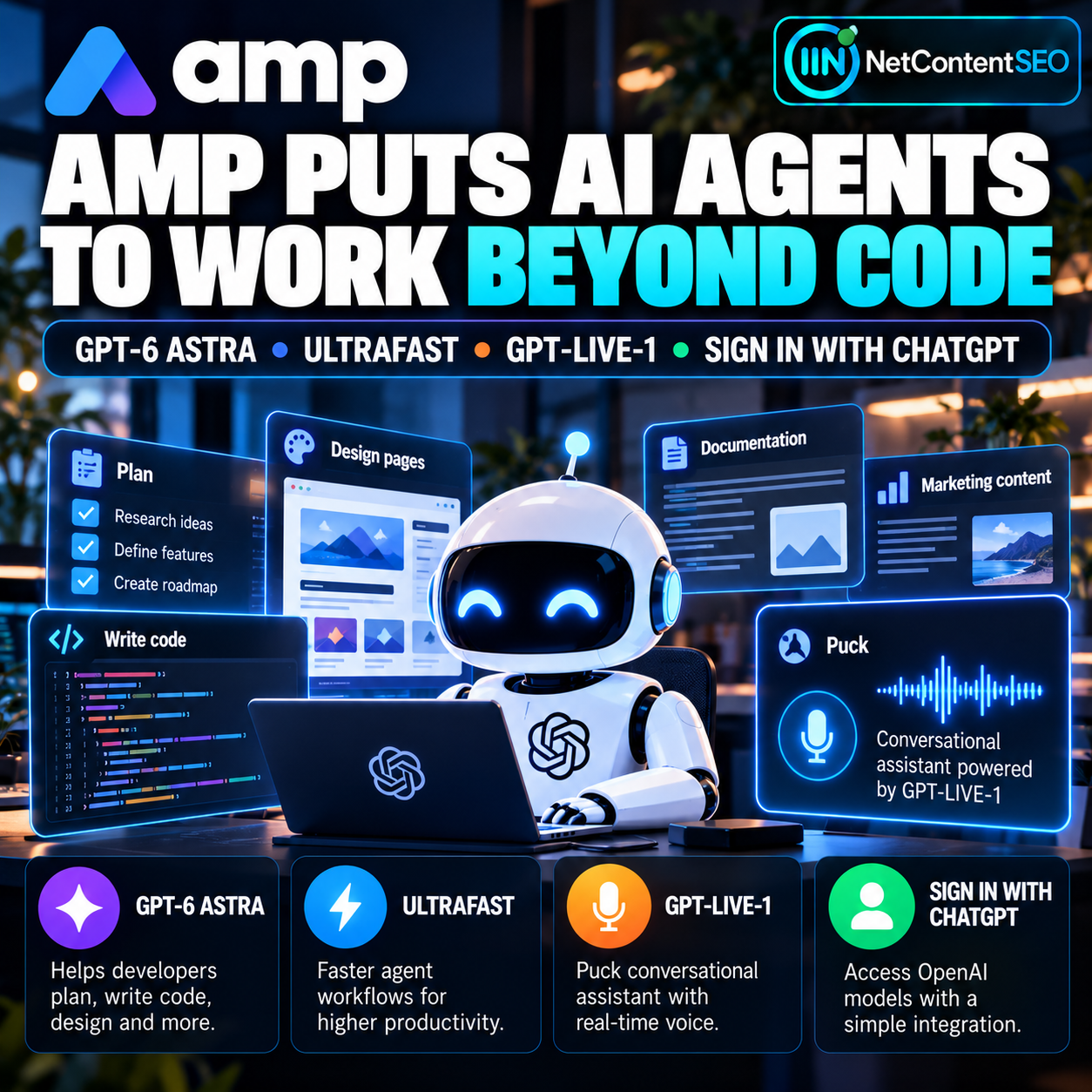

Amp is expanding its AI agent beyond writing code, using OpenAI models to help developers plan products, make decisions, design pages, create documentation and work on marketing. In an OpenAI customer story published on 14 October 2026, Amp CEO Quinn Slack describes how GPT-6 Astra, Ultrafast, GPT-Live-1 and Sign in with ChatGPT are changing the range of tasks the company's agent can take on.
Amp builds an AI agent for developers, but the company sees software creation as more than the act of coding. Agents can help decide what to build before implementation and support the work that follows shipping a product. The goal is to let people carry an idea further without manually handling every step.
From coding assistant to broader product agent
Amp recommends models based on what works best for its users, and Slack says OpenAI models account for the majority of tokens used in Amp. The company says improvements in model quality have allowed it to expand its agent's capabilities while maintaining the writing and design standards it expects.
Amp's own 20-person team uses agents for work beyond engineering, including improving the experience for new users and helping more people discover the product through search and other channels. Slack says GPT-6 Astra helps the team produce documentation and design pages that fit Amp's distinctive style.
Sign in with ChatGPT helps reduce friction around usage
As developers delegate larger tasks to agents, token consumption can become a constraint. Slack says some Amp users consume as many as 10 billion tokens a week, and he argues that closely watching every increment of usage can discourage people from exploring what an agent can do.
Amp introduced Sign in with ChatGPT to give users access to more tokens and OpenAI models, including GPT-6 Astra. According to Slack, this makes users more willing to let an agent work on a larger task rather than interrupting it because of usage concerns. The story frames the integration as a way to reduce friction, not as a claim that agent usage is unlimited or free.
GPT-6 Astra supports writing, design and creative work
Amp uses GPT-6 Astra for work that demands both technical capability and attention to presentation. That includes documentation and web pages, where consistency of language and visual design matters. The company's stated experience is that the model can meet its demanding standards for writing and design.
Slack also describes an experiment in which he gave GPT-6 Astra plans for his house and used it to create a 3D model in Blender. He and his children then turned the model into playful games by adding imaginative features to the virtual house. The example illustrates how Amp sees capable agents extending beyond conventional software tasks into creative prototyping.
Ultrafast changes how developers work with agents
Amp has been testing Ultrafast mode with GPT-6 Astra. Slack says faster responses could change the way developers organise their work: rather than switching repeatedly between several agents while they wait, users may be able to focus on fewer agents or allow an agent more time to check its own work before returning a result.
Speed is not only about saving seconds. In an interactive workflow, faster feedback can change how often people experiment, how they manage parallel tasks and how much review they can fit into the same working session. The benefits will depend on the task and on whether the faster workflow maintains the quality needed for the result.
GPT-Live-1 brings real-time voice to Puck
Amp has also introduced Puck, a conversational assistant built into Amp that helps users launch and manage other agents. A user can ask Puck to investigate a bug, coordinate multiple agents or retrieve an earlier conversation about a technical issue.
Calling Puck, powered by GPT-Live-1, allows users to talk to the assistant in real time, including from a watch. Slack imagines developers being able to keep agents working while away from their computers, such as during a run. This points toward a more flexible interaction model in which agent management is not tied to sitting in front of a coding interface.
Why working beyond code matters
Building and growing a product involves research, planning, design, documentation, customer experience and marketing as well as implementation. If agents can reliably help across these stages, they may reduce the handoffs between tools and people that make small teams feel stretched.
That does not mean every task should be delegated. Teams still need to set goals, review important outputs and make decisions that require product judgement or knowledge of customers. Amp's examples instead show how an agent can become a broader collaborator when the models, tools and workflow are suited to the task.
What the OpenAI story establishes
The source is an OpenAI customer story based on Amp's experience and statements from its CEO. It describes the company's use of GPT-6 Astra for writing and design, testing of Ultrafast, Calling Puck with GPT-Live-1, and the Sign in with ChatGPT integration. These examples are company-reported experiences rather than an independent benchmark comparing every agent platform.
The story also does not establish that all Amp users will see identical productivity gains, or that every feature is available to every user under the same conditions. Outcomes depend on the workflow, configuration and tasks being delegated.
The takeaway
Amp is using OpenAI models to push its agent beyond code into planning, design, documentation, marketing and voice-driven agent management. GPT-6 Astra supports broader creative and product work, Ultrafast is intended to make agent workflows more responsive, GPT-Live-1 powers real-time conversations with Puck, and Sign in with ChatGPT gives users a simpler way to access OpenAI models. The larger shift is from agents that mainly write code toward agents that can support more of the work surrounding a product.
Source
OpenAI — Amp puts AI agents to work beyond code with OpenAI models