

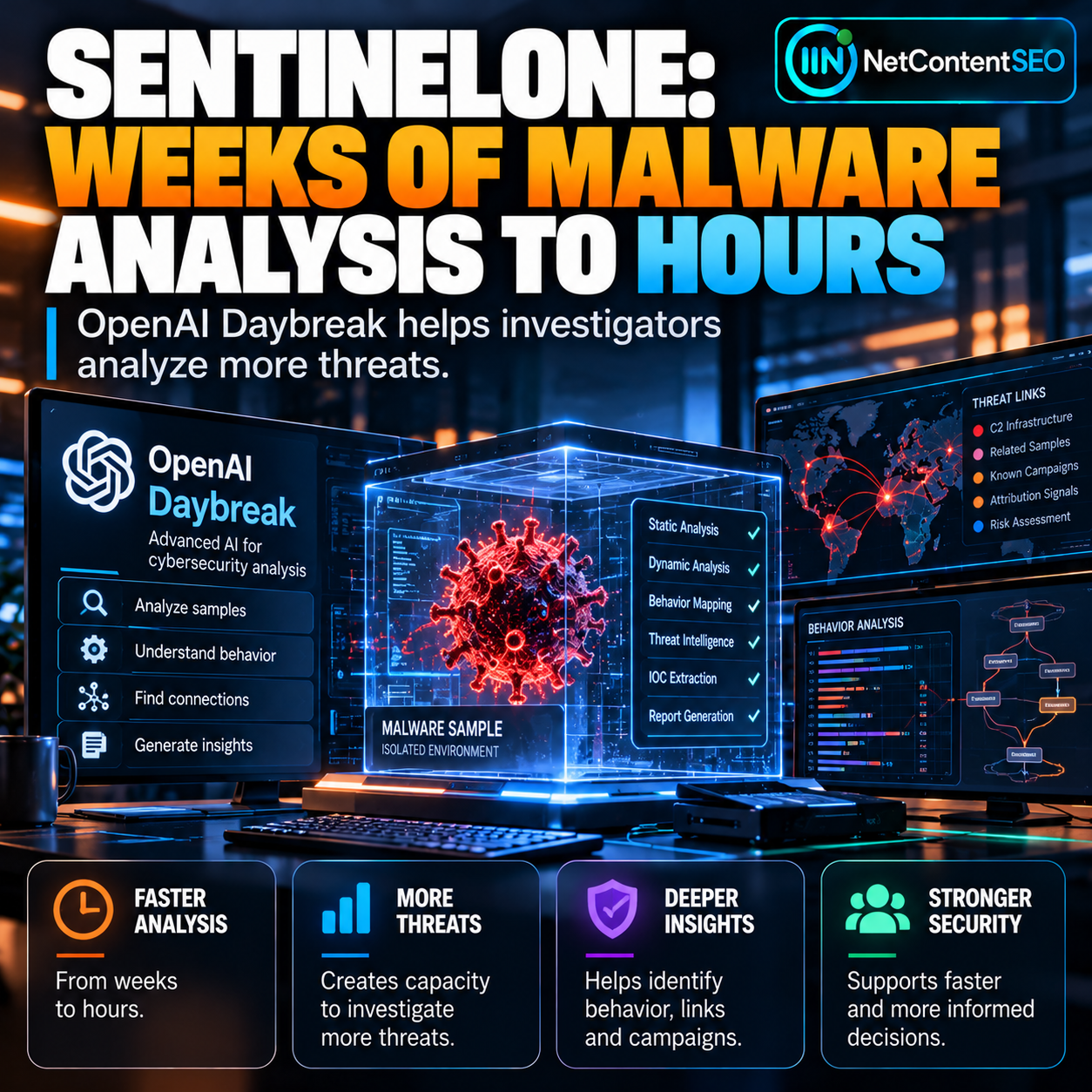

SentinelOne says OpenAI Daybreak has reduced the time needed to reverse-engineer a sophisticated piece of malware from four to six weeks to roughly eight hours. The result, described in an OpenAI customer story published on 14 October 2026, gives SentinelOne's researchers more capacity to investigate additional samples and compare findings across threats.
Reverse engineering malware means examining software to understand how it works, what it does and how it may be connected to other malicious activity. Traditionally, this work can require sustained effort from highly specialised researchers. SentinelOne's Chief AI Officer, Gregor Stewart, says Daybreak can now produce human-level reverse-engineering output in around eight hours for work that previously took a top researcher weeks.
From weeks of analysis to hours
According to SentinelOne, a sophisticated malware sample can take a top security researcher four to six weeks to reverse-engineer. Stewart says OpenAI Daybreak can deliver output at a human level in approximately eight hours.
The shorter turnaround does not simply mean a single investigation finishes sooner. It can give researchers capacity to examine more samples, compare behaviours and follow relationships that might otherwise remain hidden because only a small number of samples could receive deep analysis.
The eight-hour figure is reported by SentinelOne in an OpenAI customer story, not an independently controlled benchmark covering every malware family or investigation. Actual time and quality will depend on the sample, the question being investigated and the need for expert review.
How SentinelOne uses OpenAI Daybreak
SentinelOne uses Daybreak's cyber capabilities to reverse-engineer malware and understand its behaviour. The work helps researchers inspect software, identify meaningful components and develop a clearer view of how threats may relate to one another.
Stewart says the team historically had to reserve deep investigations for a small number of especially interesting or important threats. Faster analysis makes it more practical to investigate a broader range of samples and compare the results.
Why analysing more samples matters
Malware investigations can reveal more than the behaviour of a single file. A component discovered in two apparently unrelated samples may provide a lead that connects them, helps explain a campaign or gives an incident-response team another avenue to investigate.
By increasing the number of samples researchers can study, faster reverse engineering can expand the evidence available for these comparisons. SentinelOne says the resulting view of relationships between threats can help its researchers understand how the threat landscape changes and support more proactive defence.
That is a potential operational benefit, not a guarantee that every additional sample will reveal a useful connection. Researchers still need to validate findings and interpret them in the context of other evidence.
AI expands who can contribute to security work
SentinelOne also says OpenAI's cyber capabilities are allowing more people inside the company to take on security work, rather than routing every complex question through a small group of specialists. Stewart describes a shift in which more team members can investigate issues themselves and contribute to the organisation's security efforts.
The company wants to bring these capabilities into code creation as well, so developers can address security issues as they build. This reflects a wider direction in defensive AI: putting specialised analysis closer to the people who need it, while retaining controls around consequential decisions.
Human accountability remains essential
SentinelOne does not describe the goal as removing researchers from the process. Stewart emphasises that accountability cannot be automated away. He says decisions that fundamentally change software architecture should still receive human review, while more contained fixes may be suitable for automation.
For malware analysis, that means AI-generated findings should be checked before they are used to make high-impact decisions. Security teams need to evaluate evidence, confirm interpretations and decide how results should affect detections, incident response or product changes.
What this means for cybersecurity teams
- Increase investigation capacity: use faster analysis to review more samples instead of focusing only on the most obvious threats.
- Compare evidence across cases: look for shared components and behaviours that may connect seemingly unrelated samples.
- Keep expert review in the loop: validate important findings and preserve human accountability for consequential changes.
- Bring security earlier into development: explore ways to make analysis available to more developers, with appropriate permissions and controls.
- Measure quality as well as speed: track the usefulness and accuracy of findings, not only the time taken to produce them.
Implications for SEO and AI Search
This is a cybersecurity customer story, not an SEO or search-ranking announcement. It does not describe changes to Google or Bing ranking systems, web crawlers or AI citation rules. Its relevance to digital teams is indirect: AI-assisted security analysis may help organisations investigate threats and strengthen the systems that support their websites and digital services.
For website operators, the practical takeaway is to treat AI as a way to increase defensive capacity while maintaining verification, permissions and human oversight. The SentinelOne example does not establish that adopting Daybreak will improve search visibility or that malware analysis speed is a ranking factor.
The takeaway
SentinelOne reports that OpenAI Daybreak can reduce a sophisticated malware reverse-engineering task from four to six weeks to around eight hours. The company says faster analysis allows researchers to examine more threats, connect findings across samples and make specialised security expertise available to more teams. The claim comes from an OpenAI customer story, and SentinelOne stresses that human accountability remains essential for consequential decisions.
Source
OpenAI — SentinelOne cuts malware analysis from weeks to hours