

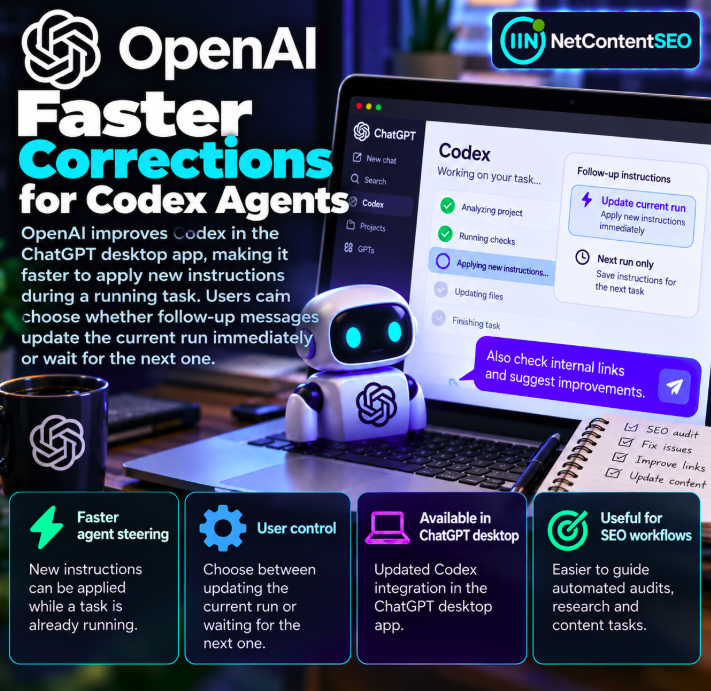

OpenAI updated the Codex integration in the ChatGPT desktop app on October 8, 2026, making it faster to incorporate additional instructions while an agent task is already running. Users can configure whether follow-up messages should affect the current execution or wait for a subsequent run.
This is a product-workflow improvement, not a newly announced SEO-specific feature. Nevertheless, it has clear potential applications for teams using coding agents to inspect websites, analyze technical data and iterate on research workflows.
Primary source: OpenAI — ChatGPT Release Notes.
What changed in the Codex desktop experience?
The release notes describe an improvement to the way follow-up instructions are handled during ongoing Codex tasks. Rather than treating every new message as something that must wait until an existing activity is complete, the updated integration can incorporate additional direction sooner when the relevant mode is selected.
Users also have control over the behavior of subsequent messages: they can steer the active run or queue guidance for the next execution. This matters because some corrections are time-sensitive, while other requests are better handled after the current task reaches a stable stopping point.
Two modes: update the current run or wait
| Follow-up behavior | Practical purpose |
|---|---|
| Apply to current run | Redirect an agent while its task is in progress, such as clarifying scope or correcting a mistaken assumption |
| Wait for next run | Preserve the current task's direction and apply a new request later |
The exact labels and placement of these controls may vary by desktop app version. The announcement does not provide a universal performance benchmark or guarantee that every correction takes effect instantaneously at every execution stage.
Why live steering matters for autonomous workflows
Longer-running agent tasks can involve multiple steps: examining files, reasoning about a problem, editing code, checking results and reporting findings. During that process, a user may discover that an assumption is wrong or that the task should focus on a different component.
Faster steering reduces the friction of sending corrective context while the agent is active. It can also help avoid completing work against an outdated brief. However, whether a particular correction is applied before a file change or external action depends on the execution state and product safeguards.
Potential SEO use case: technical site audits
Consider a coding agent inspecting a site's technical SEO implementation. The initial task might be to review sitemap generation and canonical tags. Midway through, the user realizes that the audit should exclude staging URLs or should prioritize pages that are already indexed.
With live steering, the user could supply that clarification while the task is underway rather than waiting for a full report based on the earlier scope. This is an illustrative workflow; OpenAI did not announce a dedicated SEO audit feature in the release.
Potential SEO use case: log and crawl analysis
An agent processing server logs or crawler exports may need revised filtering rules. For example, the analyst might want to exclude static asset requests, isolate Googlebot traffic or compare a narrower date range. Being able to update instructions during execution may reduce repeated work.
Reliable bot identification, log completeness and correct date handling still require independent checks. Faster instruction delivery does not automatically make an agent's technical conclusions accurate.
Potential SEO use case: content and research workflows
Editorial teams may use agents to collect source material, draft technical summaries or inspect structured data. A researcher could correct the list of sources, ask for stricter primary-source attribution or clarify that a particular metric is unverified while the agent is working.
These examples show where live steering could help, not a promise that Codex automatically conducts SEO research or verifies external sources.
When should a correction apply immediately?
Immediate steering is most useful when the current direction is clearly wrong: a task is examining the wrong repository, working against an outdated requirement or preparing an unnecessary change. In these situations, intervening sooner may save time and reduce rework.
By contrast, queueing a follow-up can be preferable when the active task is correct and the new request is a separate enhancement. Clear task boundaries help reviewers understand which changes belong to which instruction.
Why human review remains essential
Live agent steering does not remove the need for code review, testing, access controls and approval before consequential actions. An agent that can change direction quickly can still misunderstand a requirement or produce an incomplete fix.
For website operations, teams should review generated patches, verify changes in a staging environment where practical and maintain rollback procedures. SEO-impacting changes to robots rules, canonicals, redirects or structured data deserve particular care.
What the release does not announce
- No new Google Search ranking factor or indexing behavior.
- No Codex feature specifically marketed as an SEO auditor.
- No guaranteed reduction in end-to-end SEO audit time.
- No promise that every active tool action can be interrupted or reversed.
- No evidence that live steering directly changes AI search citations or brand visibility.
How to evaluate the improvement
- Choose a representative task. Use a reproducible coding or research workflow.
- Record the initial instruction. Document the requested scope and expected outputs.
- Introduce a controlled correction. Send a follow-up at a known stage of execution.
- Check what changed. Review the agent's actions and outputs to confirm that the new direction was incorporated.
- Compare queueing behavior. Test when it is preferable to defer instructions until the next run.
- Review safety and accuracy. Validate files, scripts and reports rather than assuming a faster workflow is a better one.
FAQ
What did OpenAI update on October 8, 2026?
The Codex integration in the ChatGPT desktop app, with faster handling of follow-up instructions during running agent tasks.
Can users change a task while it is running?
The update supports applying follow-up guidance to the current run, depending on the selected behavior.
Can follow-up instructions wait?
Yes. Users can choose to defer subsequent messages to a later run.
Is this a dedicated SEO automation feature?
No. Technical SEO audits and research are potential applications of a general agent-workflow improvement.
Does it guarantee instant interruption of every action?
No such universal guarantee is established by the announcement.
NetContentSEO analysis
The operational value of AI agents increasingly depends on how easily users can correct their course, not only on how much work they can perform autonomously. OpenAI's Codex update addresses that interaction problem by improving live steering and giving users control over when follow-up instructions take effect. For SEO teams, the opportunity is to test whether this reduces unnecessary iterations in audits, development and research—while retaining careful human validation of the results.
Primary source: ChatGPT Release Notes, October 8, 2026.