

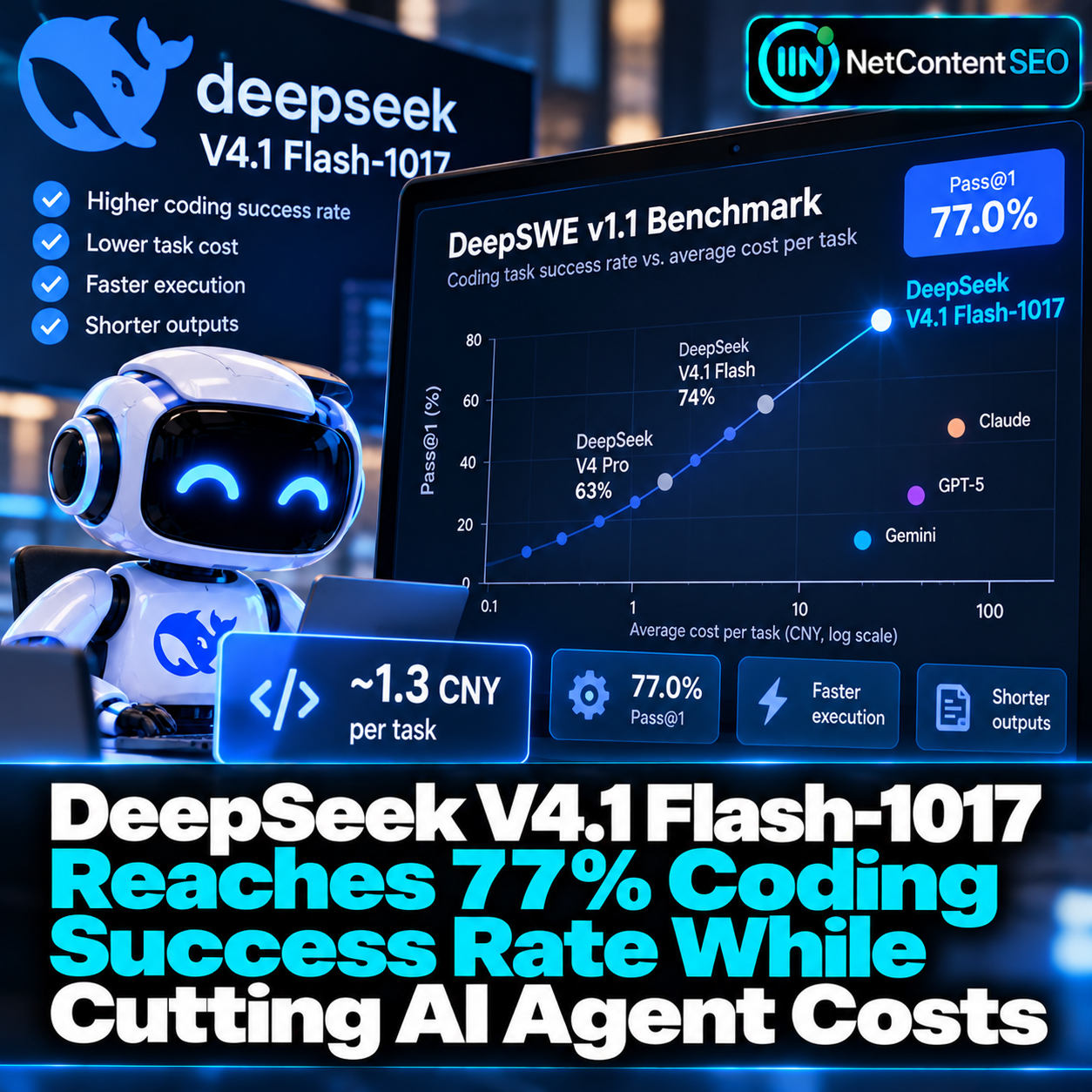

DeepSeek is pushing the economics of AI coding agents into the spotlight. According to an October 19, 2026 Phoenix Technology report republished by 36Kr, the company's DeepSeek V4.1 Flash-1017 reaches a reported 77.0% Pass@1 in a DeepSWE v1.1 evaluation at an average cost of approximately 1.3 Chinese yuan per task at the highlighted operating point.
Those numbers come from a company-presented benchmark chart, as described by the publication. They are not an independently verified guarantee of performance or price for every development workflow.
DeepSWE v1.1: 77% Pass@1 at a low reported task cost
The report describes a performance-versus-cost chart with average cost per task on the horizontal axis and Pass@1—the proportion of tasks passed on a single attempt under the benchmark conditions—on the vertical axis. DeepSeek V4.1 Flash-1017 reportedly reaches 77.0% at its highest plotted point, compared with approximately 74% for the previous V4.1 Flash version. The same article cites a plotted DeepSeek V4 Pro point near 63%.
The comparison is specific to the displayed benchmark and configurations. Different reasoning budgets, agent frameworks, task mixes and evaluation conditions can change both success rates and costs. A chart like this cannot establish that one model is cheaper or better for all users.
Why cost per completed task matters more than token price alone
Traditional model pricing often emphasizes the cost of input and output tokens. Software-development agents, however, may need to inspect repositories, call tools, execute code, run tests and retry after failures. The economic unit is increasingly the finished task, not a single model response.
For teams deploying coding agents, a low token price is only useful if the agent can complete work reliably without excessive retries or supervision. A model that costs less per attempt but repeatedly fails can become expensive in practice. Conversely, a modest improvement in task success, runtime and output efficiency can change the total cost of delivery.
What DeepSeek V4.1 Flash-1017 is designed to do
According to the report, the update emphasizes better performance in complex programming workflows, shorter execution times and output lengths, and compatibility with agent environments including DeepSeek Harness, Tencent CodeBuddy and WorkBuddy. DeepSeek reportedly recommends upgrading to DeepSeek Harness version 0.2.1-rc.1 or newer for the adapted experience.
Examples described in the report include a three-dimensional Forbidden City model, a browser-based racing game, a Portal 2-inspired project using Godot, and a historical 3D visualization. These are demonstrations of the intended development workflow, not independent evidence that arbitrary production projects can be completed without engineering review.
From answering coding questions to delivering working projects
There is a significant difference between generating a code snippet and producing an interactive application. A working project can require requirements analysis, file changes, dependencies, tests, debugging and repeated revisions. The report frames DeepSeek's progress around these longer-running tasks and the orchestration systems—often called harnesses—that connect a model to tools and execution environments.
This distinction matters because benchmark scores measured without a realistic agent environment may not predict real-world delivery. Tool reliability, context management, permissions, test coverage and human oversight all affect outcomes.
Search and Fetch APIs are part of the wider strategy
The same 36Kr article also discusses DeepSeek's Search and Fetch APIs, reporting pricing of 5 yuan per 1,000 successful requests. Those interfaces are relevant to the cost of multi-step agents, which may need to retrieve web information while working. NetContentSEO has covered the search API development separately; the focus here is the economics of coding and task completion rather than search infrastructure.
What developers should verify before switching models
Teams considering a new coding model should benchmark their own repositories and tasks. Track successful completions, elapsed time, token usage, tool calls, retries, human intervention, and the full cost of each accepted result. Evaluate security, code quality and maintenance needs alongside price. A vendor's strongest plotted point is not necessarily the best setting for a specific workload.
NetContentSEO analysis
DeepSeek V4.1 Flash-1017 illustrates a broader change in AI competition: vendors are being judged not only by benchmark rankings or token prices, but by how much useful work their systems can complete within a budget. The reported 77% Pass@1 and roughly 1.3-yuan task cost are noteworthy signals of that direction, while remaining company-reported, configuration-specific results requiring independent evaluation.