

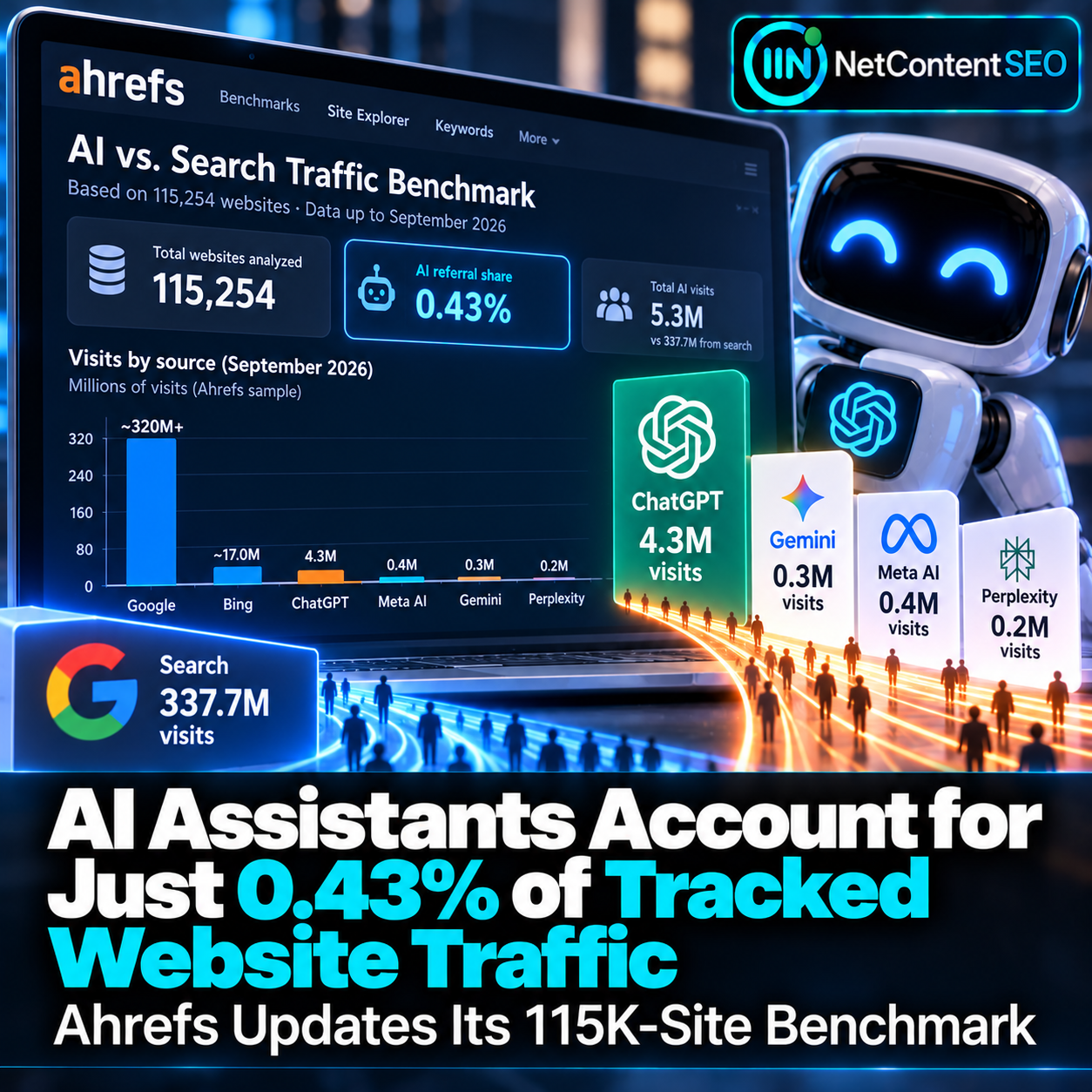

AI assistants are reshaping how people find information, but their measurable contribution to website referral traffic remains small in a large sample tracked by Ahrefs. In its updated AI vs. Search Traffic Benchmark, covering 115,254 websites and data through September 2026, Ahrefs reports that AI assistants account for 0.43% of tracked website traffic.
The dataset records approximately 5.3 million visits from AI assistants, compared with 337.7 million visits from traditional search in September. ChatGPT accounts for roughly 4.3 million of the AI assistant visits in the sample.
Ahrefs' September 2026 benchmark at a glance
| Metric | Reported figure |
|---|---|
| Websites analyzed | 115,254 |
| AI referral share of tracked website traffic | 0.43% |
| Visits attributed to AI assistants | 5.3 million |
| Visits attributed to traditional search | 337.7 million |
| ChatGPT referral visits | Approximately 4.3 million |
These figures describe Ahrefs' proprietary sample, not the entire web. The 0.43% figure should also not be confused with the share of visits from AI among AI-plus-search referrals: the metrics use different denominators.
Search still sends far more visitors than AI assistants
In this sample, traditional search delivers roughly 64 times as many visits as AI assistants: 337.7 million versus 5.3 million. That gap is substantial even as AI products receive considerable attention from marketers, publishers and investors.
However, referral visits are only one way to assess AI search. An assistant may answer a question without generating a click, influence a purchase completed elsewhere, or introduce a brand that a user later searches for directly. Such activity may not appear as an AI referral in website analytics.
ChatGPT dominates the tracked AI referral category
Of the approximately 5.3 million AI assistant visits recorded, ChatGPT contributes around 4.3 million—roughly 81% of the AI category in this sample. That does not mean ChatGPT holds 81% of all AI usage or AI search activity globally. It measures visits reaching the websites in Ahrefs' dataset that were attributed to the relevant sources.
Other AI assistants also appear in the benchmark, but the central takeaway is the same: current AI referral traffic is concentrated in a small number of sources and remains modest compared with established search engines.
Why AI visibility and AI traffic are different metrics
For SEO teams, the benchmark highlights the importance of distinguishing visibility inside an AI answer from traffic generated by that answer. A brand can be cited, recommended or summarized without the user clicking through to its website. Conversely, a referral may occur without providing clear evidence of how the assistant selected or described the source.
A useful measurement framework therefore separates AI mentions, citations, attributed referral sessions, engaged visits, assisted conversions and direct conversions. No single metric fully captures the effect of AI discovery on demand.
What publishers and businesses should do
The numbers do not justify abandoning traditional SEO. Search continues to be the larger measurable referral channel by a wide margin in this dataset. Publishers should maintain strong technical SEO, indexability, content quality, useful internal linking and accurate structured data where appropriate.
At the same time, AI visibility deserves disciplined experimentation. Businesses can track assistant referrals in analytics, examine which pages earn citations and compare the engagement and commercial value of AI-origin sessions with other channels. Small traffic volume does not automatically mean low business value, and the reverse is also true.
Limits of the benchmark
Ahrefs' findings reflect a proprietary set of 115,254 websites and its methods of identifying referral sources. They should not be extrapolated into a universal global market-share estimate. Attribution may also be affected by applications that do not consistently pass referral information, direct visits following AI recommendations and differences between site categories.
The benchmark page has been described as updated around October 15–16, 2026, with September 2026 as the underlying data period. Because the exact page-update date is not consistently represented, the data period is more important than claiming a single publication day.
NetContentSEO analysis: a small referral channel with a wider influence question
Ahrefs' benchmark offers a valuable corrective to inflated claims that AI assistants have already replaced search as a source of website visits. They have not done so in this sample. But the benchmark cannot settle the broader question of how much AI-generated answers influence awareness, consideration or purchasing decisions without a click.
For SEO and GEO strategies, the priority is to measure traffic honestly while studying visibility separately. The most useful future benchmarks will combine referral trends with citation quality, brand exposure and downstream business outcomes.
Primary source: Ahrefs — AI vs. Search Traffic Benchmark.