

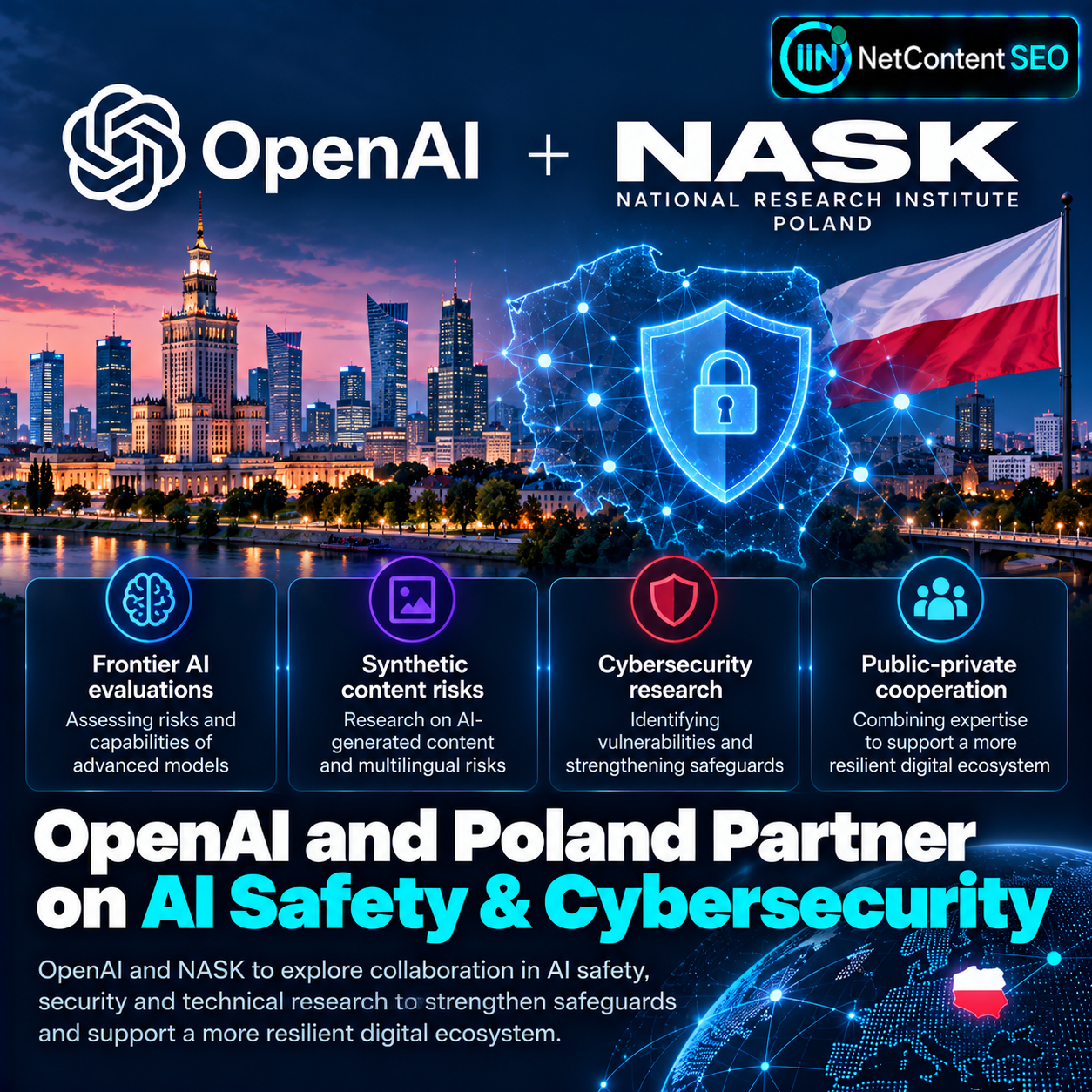

OpenAI and Poland’s NASK National Research Institute have signed an agreement to explore collaboration on artificial intelligence safety, security and technical research. Announced on October 23, 2026, the partnership brings OpenAI together with NASK’s AI Safety Research Center, which serves as the Polish Artificial Intelligence Safety Institute (AISI). The organizations intend to examine emerging risks, evaluate increasingly capable systems and develop stronger safeguards. OpenAI’s official announcement describes the initiative as a framework for joint research, rather than a completed set of safety findings or a newly deployed product.
What OpenAI and NASK have agreed to explore
The planned collaboration centers on AI safety evaluations, security research and the technical challenges associated with more capable AI models. OpenAI says the two organizations will explore ways to assess system capabilities, identify potential vulnerabilities and strengthen safeguards against misuse and unintended behavior.
NASK’s research interests also include detecting synthetic AI-generated content and understanding how malicious uses of that content differ across languages. These are increasingly important questions for public institutions, online platforms and security teams, especially as generated text, images and other media become more realistic and easier to produce at scale.
The agreement does not specify a completed joint benchmark, release a new detection tool or announce binding technical standards. Its significance lies in connecting a frontier-model developer with a national research institution that has experience in applied cybersecurity and public-interest safety research.
Poland’s AI Safety Institute and international cooperation
NASK’s AI Safety Research Center acts as Poland’s AI Safety Institute, contributing national expertise to the international discussion about how advanced AI systems should be evaluated and governed. OpenAI frames the new partnership alongside its existing work with public research institutions, including the United States’ Center for Advancing Standards and Innovation for Super Intelligence and the United Kingdom’s AI Security Institute.
The company argues that shared approaches to capability evaluations, risk assessments, safeguard testing and incident reporting can help countries compare evidence and respond to risks that cross borders. National partners also bring local knowledge about languages, public services and the digital information ecosystems in which AI is actually deployed.
NASK director Radosław Nielek emphasized that AI safety requires cooperation between public institutes and frontier developers. OpenAI’s Tom Duff Gordon, vice president and head of EMEA policy, highlighted Poland’s research talent and the value of independent expertise in challenging assumptions and testing AI systems.
Cybersecurity precedent: CERT Polska and MikroTik vulnerabilities
The agreement builds on an existing relationship between OpenAI and Polish cyber defenders. In July 2026, CERT Polska, which operates within NASK, received access to OpenAI’s cyber-capable models through the company’s Daybreak program.
Using those models, CERT Polska researchers helped discover six vulnerabilities in MikroTik RouterOS. OpenAI says some of the flaws could be chained to compromise affected devices without authentication. MikroTik released fixes, and CERT Polska confirmed that the patches blocked the attack paths it had observed.
These discoveries are an example of earlier collaboration, not results produced by the newly announced October agreement. They nevertheless demonstrate how capable AI systems can assist defensive security teams in identifying vulnerabilities and validating remediation.
Synthetic content and multilingual risks
Another notable element is NASK’s interest in synthetic media and multilingual misuse. Detecting AI-generated content is not simply a matter of identifying a generic writing style or image artifact. Threats can involve impersonation, misleading narratives and material tailored to particular languages or social contexts.
Public research institutions can help evaluate such risks across languages and communities that may be underrepresented in mainstream AI safety benchmarks. However, OpenAI has not announced a specific joint detector, a universal labeling system or a measured improvement in synthetic-content detection as part of this agreement.
What the partnership means for AI governance
As AI models become more capable, safety work increasingly combines technical testing with institutional cooperation. Independent researchers can challenge developer assumptions, assess failure modes and contribute to common methods for reporting incidents and comparing safeguards.
The OpenAI–NASK agreement reflects that direction. It also illustrates how AI safety research and applied cybersecurity can reinforce one another: better evaluation helps identify dangerous capabilities, while practical defensive testing can expose vulnerabilities in real-world systems.
SEO and AI Search implications
This is not an SEO algorithm update. The announcement does not change crawling, indexing, search rankings, AI-generated citation rules or publisher requirements. There is no evidence that the partnership will directly increase or decrease any website’s visibility in ChatGPT Search or other AI answer engines.
The relevance to the broader search ecosystem is indirect. Research into synthetic content, model safeguards and multilingual threats may inform future approaches to trustworthy AI systems and information integrity. That possibility should not be presented as a confirmed change to search-result quality systems or source selection.
For SEO professionals and publishers, the useful distinction is between the security of AI models, the reliability of information ecosystems and the separate mechanics that determine whether a page is retrieved or cited in an AI answer.
NetContentSEO assessment
The partnership is noteworthy because it brings together frontier-model engineering and a public institution with experience in AI safety and operational cybersecurity. The strongest concrete evidence of practical value is the earlier CERT Polska work on MikroTik RouterOS; the new agreement creates an opportunity to expand such research, but its outcomes remain to be seen.
As international AI safety efforts develop, the ability to evaluate advanced systems consistently across countries and languages may become increasingly important. For now, the OpenAI–NASK announcement should be understood as a significant research and governance initiative, not as a new AI Search feature or SEO ranking signal.
Primary source: OpenAI — OpenAI and Poland’s NASK partner to advance AI safety and security (October 23, 2026).