
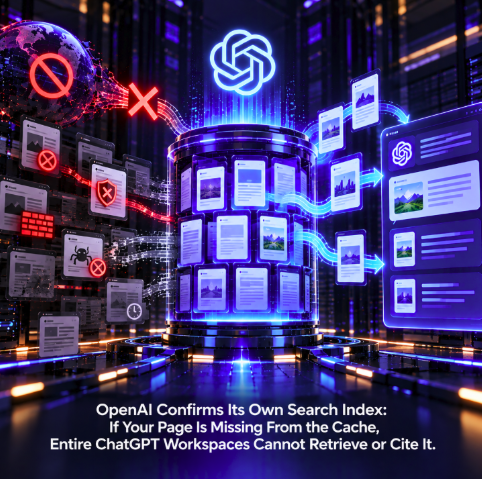
OpenAI has now documented a version of ChatGPT web search in which the open web is not queried live at request time. Instead, eligible workspaces can search only content that OpenAI has already indexed or cached. For publishers, that creates an unusually clear visibility boundary: if a page is absent from that stored evidence pool, ChatGPT cannot retrieve it through this search mode, even when the page is publicly available on the live web.
The capability is described in OpenAI’s official Offline web search for ChatGPT workspaces documentation, updated in August 2026. OpenAI says the configuration is intended for eligible organizations with stricter governance, compliance or data-handling requirements and can be available in certain Enterprise, Edu, Healthcare, Teachers, regulated and federal workspace configurations. Availability depends on the plan, contract, admin configuration and workspace settings. citeturn0search0
The important SEO and GEO implication is not that every ChatGPT search now runs exclusively on an OpenAI-owned cache. It does not. This is a specific workspace configuration. But its existence confirms that OpenAI maintains indexed and cached web content substantial enough to serve as a standalone search corpus for some ChatGPT users. citeturn0search0
Offline web search creates a hard retrieval boundary
OpenAI’s documentation is explicit about the core rule. When offline web search is enabled, ChatGPT uses OpenAI’s indexed and cached web content rather than live web search at the time of the request. If a page or URL is not available in that index or cache, ChatGPT cannot retrieve it through offline web search. citeturn0search0
That makes index inclusion a prerequisite for visibility. Relevance cannot rescue a page that never entered the searchable corpus. Strong authority cannot rescue it. Perfect answer formatting cannot rescue it. Before any ranking, retrieval or citation decision can occur, the URL first needs to exist in the index or cache available to the workspace.
This is the same fundamental distinction that traditional SEO has dealt with for decades: crawling and indexing precede ranking. What is new is seeing that distinction documented directly for a ChatGPT search configuration.
A public URL is not necessarily a retrievable URL
OpenAI specifically warns administrators that offline web search should not be treated as a guarantee that every public URL can be fetched. Even when a user gives ChatGPT the exact URL, the system can use it only if the page is already present in the index or cache. Otherwise ChatGPT may fail to retrieve the page or report that it cannot access it. citeturn0search0
This distinction matters for visibility audits. A browser test showing that a URL loads successfully does not prove that an offline-search ChatGPT workspace can access it. The live site and the workspace’s stored search corpus are different environments.
OpenAI recommends alternatives when a required page is unavailable: upload the source material, paste the relevant text, provide another URL or use live web search when the workspace permits it. citeturn0search0
OpenAI names the factors that can keep a page out
The documentation provides an unusually useful list of reasons content can be missing or stale. OpenAI names robots.txt and similar crawl controls, CDN or bot-blocking behavior, login requirements, personalization, heavy dependence on scripts or dynamic loading, low-signal or rarely accessed pages, new content and site structures that make deeper URLs difficult to discover. citeturn0search0
These factors turn familiar technical SEO issues into AI-search availability issues. A CDN rule designed to block unwanted automation can also prevent legitimate AI crawling. Deep pages with weak internal discovery can remain outside the corpus. JavaScript-heavy content may be incompletely represented. A new article can exist on the live site before it becomes available to offline ChatGPT search.
Publishers therefore need to distinguish between “the page exists” and “the page is discoverable by the systems that build the AI evidence pool.”
There is no per-URL refresh SLA
Index inclusion is only half of the problem. OpenAI also says offline-search coverage and freshness vary by site, page, language, region and content type. Some indexed content may update quickly, but there is no refresh service-level agreement for a specific URL. Refresh timing can vary according to crawl access, caching, popularity and other technical factors. citeturn0search0
That creates a second visibility state beyond present versus absent: a page can be retrievable but stale.
For evergreen explanatory content, that may be acceptable. For prices, product availability, regulations, breaking news, schedules or rapidly changing documentation, a cached representation can diverge materially from the live page.
The cache timestamp may not be visible
OpenAI also cautions that offline web search may not expose the exact time when a page was indexed or cached. The company explicitly advises against using the feature when a workflow requires guaranteed citation timestamps, audit-grade evidence of what a page said at a particular moment or proof that the source was current when the response was generated. citeturn0search0
This makes freshness difficult to diagnose from the outside. A publisher can update a page and still have no direct guarantee about when that revision will replace the stored representation available to an offline workspace.
For organizations, the corresponding lesson is equally important: a citation to the correct URL does not by itself prove that the retrieved content matched the live version at query time.
Long-tail sites face a specific coverage risk
OpenAI tells users to expect that some long-tail or niche sites may be missing, stale or only partially represented. Its documentation recommends cross-checking additional sources, uploading material or switching to live search when permitted if the workflow depends on those sites. citeturn0search0
That has direct consequences for smaller publishers. Traditional web search can theoretically discover a long-tail page at query time through a large search index or fresh crawl ecosystem. Offline ChatGPT search is constrained by what OpenAI has already stored.
The optimization problem therefore includes corpus entry and refresh frequency, not merely whether a page is a strong answer once retrieved.
Entire workspaces can share the same retrieval limitation
The scale of the effect is what makes this configuration notable. Offline web search can be applied at the workspace level, through eligible custom roles using Lockdown Mode or as part of certain regulated workspace configurations. citeturn0search0
If a relevant URL is absent from OpenAI’s indexed or cached corpus, the problem is not necessarily limited to one unlucky prompt. Users governed by that offline-search configuration cannot retrieve that page through the web-search path until the content becomes available in the corpus or they supply it through another permitted mechanism.
That makes index coverage an organizational visibility condition rather than merely a response-level ranking outcome.
Offline search exists for governance, not as an SEO product
The reason OpenAI offers this mode is security and governance. The company says it is designed to limit web search to indexed and cached content rather than using a live external search provider at request time, helping organizations reduce the chance that search queries are sent to such a provider depending on workspace configuration. citeturn0search0
This distinction is important because the documentation should not be interpreted as an announcement of a public OpenAI search-engine index for publishers to submit URLs to. OpenAI documents the behavior of a ChatGPT workspace feature. It does not provide a Search Console equivalent, a guaranteed inclusion mechanism or a URL-level refresh request in this Help Center article.
For GEO practitioners, the value of the documentation is observational: it exposes another concrete retrieval architecture through which ChatGPT can discover—or fail to discover—public content.
Robots controls can affect the evidence pool before a prompt exists
One of the most consequential details is timing. A robots.txt rule or bot-blocking configuration can affect whether content enters the stored corpus before any user asks about it. citeturn0search0
That means the visibility failure occurs upstream of the prompt. When the eventual query arrives, there may be no live request to the publisher’s server that reveals the missed opportunity. The system can only search what it already has.
This makes server logs an incomplete view of AI discovery. Absence of a request at answer time does not necessarily mean the source was irrelevant; offline retrieval can operate against previously acquired content.
AI visibility now has a cache layer that publishers cannot assume is current
NetContentSEO recently examined how ChatGPT’s web-search behavior can change the mix of sources that become visible in “ChatGPT Changed How It Searches the Web—and Reddit Lost 86% of Its Citations”. Offline search adds a different kind of variability. The evidence pool itself can differ depending on workspace configuration, and the stored version of a page can differ from the live version. citeturn0search1
This complicates cross-platform citation testing. Two people can ask similar questions in ChatGPT while operating against different retrieval conditions. One workspace may permit live search; another may be constrained to OpenAI’s indexed and cached corpus. A missing citation can therefore reflect architecture rather than a change in the publisher’s relevance.
Offline search and Cloud Browser are different discovery paths
The feature also clarifies why “ChatGPT can access the web” is becoming too broad a statement to be useful. OpenAI now has multiple web interaction paths with different access rules.
NetContentSEO’s coverage of ChatGPT Work’s Cloud Browser describes an agentic browser capable of navigating supported websites, including authenticated experiences, and performing tasks. Offline web search does something fundamentally different: it retrieves from content OpenAI has already indexed or cached and does not live-fetch arbitrary missing URLs. citeturn0search8turn0search0
Publishers and enterprise teams should therefore identify which retrieval path a workflow is actually using before drawing conclusions from accessibility tests.
Index inclusion becomes a measurable prerequisite, but not a ranking guarantee
The documentation supports one strong conclusion and one important limitation. The strong conclusion is that a URL absent from the offline index or cache cannot be retrieved through offline web search. The limitation is that presence in the corpus does not guarantee that ChatGPT will retrieve or cite the page for any particular prompt. citeturn0search0
Indexing creates eligibility. Retrieval still depends on the query and the search system’s selection process. Citation adds another selection layer after retrieval.
That hierarchy is useful for diagnosing GEO failures: first establish whether a source is accessible to the relevant search architecture, then investigate retrieval relevance, and only then analyze citation behavior.
Publishers need to optimize for retrievability before citation
OpenAI’s offline-search documentation turns an abstract GEO principle into a concrete product constraint. AI citation visibility begins before answer generation. It begins with whether the retrieval system has usable access to the page at all.
For publishers, the practical priorities are familiar but newly consequential: avoid unintentionally blocking legitimate crawling, make important pages structurally discoverable, reduce unnecessary dependence on client-side rendering for critical content, keep canonical public sources stable and recognize that new or obscure pages may take time to enter a stored corpus. None of those measures guarantees inclusion or a particular refresh schedule, because OpenAI provides no per-URL SLA. citeturn0search0
The strategic change is the number of retrieval environments that now matter. A page can be live on the public web, visible in traditional search, accessible to a browser agent and still absent from the indexed corpus used by an offline ChatGPT workspace.
That is why the existence of OpenAI’s offline web search matters beyond the regulated organizations that use it. It demonstrates that, for at least one official ChatGPT search path, AI visibility has an indexability gate every bit as real as the one publishers learned to monitor in traditional search. If the page is not in the evidence pool, no amount of downstream citation optimization can make it appear.