
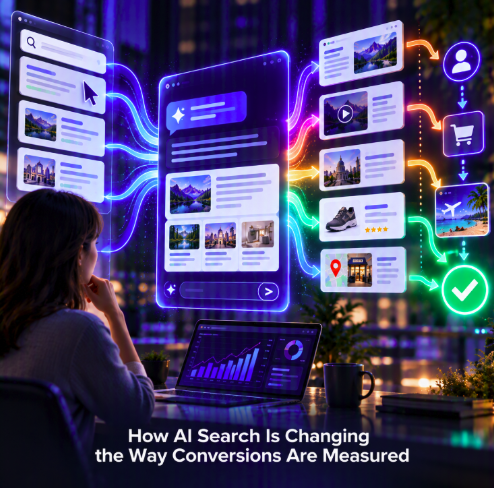
The familiar search funnel is becoming harder to measure because a growing share of research and preference formation can happen before a user reaches a website. In an official Bing Webmaster Blog article published November 20, 2025, Microsoft argues that AI-powered search compresses discovery, comparison and decision-making into conversational experiences, leaving the eventual outbound click later in the journey and potentially carrying stronger intent. Bing’s original article on AI search and conversion measurement frames impressions, placement in AI answers and citations as visibility signals that can reveal influence before a conventional visit occurs.
This is not an argument that clicks have disappeared. Microsoft’s point is more specific: users can now ask follow-up questions, compare options and resolve uncertainty inside the AI experience, so the click can arrive after more of the evaluation has already happened. For analytics teams, that creates a measurement gap. Traditional web analytics can observe the visitor once the browser reaches the site, but much of the journey that created confidence may have taken place upstream.
The conversion journey can begin before the referral
Bing illustrates the change with a dishwasher purchase. In a traditional search journey, a consumer might visit several review pages, manufacturer sites and retailers while manually comparing features. In an AI-powered experience, the system can synthesize details such as noise level, energy efficiency and smart-home compatibility, then respond to follow-up questions as the shopper narrows the decision.
By the time the shopper follows a product or retailer link, the click is no longer necessarily an early research action. It may be a lower-funnel action from someone who has already completed much of the comparison process. That changes the meaning of referral volume: fewer visits do not automatically mean proportionally less influence if the remaining visits arrive later and with clearer intent.
Microsoft reports more conversational turns and shorter journeys
Microsoft cites internal Copilot session research showing a 22% increase in unique chat turns per session in the referenced dataset, which covered August 2023 through August 2024. It interprets those additional turns as evidence that search is becoming an ongoing conversation rather than a single query.
The Bing article also cites Microsoft Advertising data reporting that Copilot-assisted customer journeys were 33% shorter on average than traditional search journeys and that high-intent conversion rates were 76% higher for the AI-powered experiences measured. Those are Microsoft-reported findings from specific datasets and should not be treated as universal conversion lifts for every website, industry or AI platform.
The useful measurement implication is independent of the exact percentages. Conversational refinement can remove intermediate website visits from the observable funnel while still moving the user toward an action.
Visibility becomes an upstream conversion signal
Bing recommends expanding measurement beyond clicks and last-touch conversions to include impressions, citations, answer inclusion and query refinements. The logic is that appearing inside a summary or comparison can shape awareness and preference even when the user does not immediately visit the source.
This is particularly important for GEO because citation and traffic are different events. A source can participate in an answer without receiving the final click, while another destination captures the transaction. NetContentSEO has explored this distinction in its analysis of citation versus actual influence inside AI answers. Conversion measurement adds a third layer: influence, visible attribution and downstream conversion may all occur at different points.
Zero-click does not necessarily mean zero value
Bing describes FAQs, product specifications, reviews and comparison information appearing directly inside AI experiences as examples of pre-click influence. A user may learn that a product has a particular feature or that a service satisfies a requirement without visiting the source immediately.
For publishers and brands, this makes zero-click visibility more complicated than a binary traffic-loss metric. An AI answer can reduce exploratory clicks while simultaneously introducing a brand, validating a product or resolving an objection that affects a later conversion.
The difficult part is attribution. Standard analytics rarely reveals that a purchase two days later was influenced by a product comparison seen inside an AI answer. Bing explicitly acknowledges that many signals generated inside AI experiences are not captured by traditional analytics today.
AI referrals may be smaller but more qualified
The Bing article assembles several 2025 datasets suggesting that AI-referred visits were still small in volume but often showed stronger conversion behavior. Amsive reported that 56% of the sites it studied had higher conversion rates from AI-driven sessions, with high-traffic sites in its analysis converting at 7.05% from AI versus 5.81% from organic. Similarweb reported an 11.4% AI-referral conversion rate versus 5.3% for organic in the global ecommerce dataset Bing cites.
Microsoft also points to Adobe Digital Insights and BrightEdge research supporting the broader pattern of growing AI referrals and higher-intent visits. These studies use different samples, definitions and methodologies, so their percentages should not be combined into one universal benchmark. They are better read as multiple observations pointing in a similar direction: AI referrals can behave differently from ordinary organic sessions.
Microsoft Clarity found a similar pattern across publishers
Bing highlights Microsoft Clarity data covering 1,200 publisher and news sites. According to the article, AI-driven referrals grew 155% over eight months and converted at up to three times the rate of traditional channels such as search and social, while AI referrals still represented less than 1% of total visits.
That combination is analytically important. A channel can be too small to dominate traffic dashboards while still producing a disproportionate share of high-value actions. For publishers, those actions can include subscriptions, registrations and deeper engagement rather than purchases.
Microsoft says Clarity distinguishes organic AI-platform referrals from paid AI placements, giving site owners a way to inspect what users do after an AI-driven visit. This downstream behavior is one half of the measurement problem; the other half is understanding how often content appeared upstream before the click.
Commercial sites and publishers need different conversion definitions
Bing explicitly separates ecommerce and lead-generation outcomes from the goals of news and information publishers. For a commercial site, meaningful actions may include purchases, demo requests, inquiries or subscriptions. For a publisher, the relevant outcomes can include read depth, article completion, recirculation, return visits, newsletter sign-ups and registrations.
This matters because AI Search can change the mix of visitors. If conversational search handles basic factual needs upstream, the people who still click through may disproportionately want deeper reporting, original evidence or a next action. Measuring only sessions can miss that qualitative change.
Bing Webmaster Tools and Clarity cover different halves of the journey
Microsoft’s proposed measurement model pairs search visibility with on-site behavior. Bing Webmaster Tools provides the search-side view, while Microsoft Clarity provides behavioral analysis after users reach the site.
That model became more concrete after the November 2025 article. In February 2026, Bing introduced AI Performance in Webmaster Tools, and by June it had expanded the preview with Intents, Topics, Citation Share and Compare. NetContentSEO has documented those newer capabilities in its analysis of Bing Webmaster Tools’ AI visibility reporting. The later product development effectively gives publishers first-party metrics for some of the upstream signals the November article argued were missing from conventional analytics.
Structured content can influence both retrieval and conversion
Bing recommends content that is easy for AI systems to interpret, pointing to schema-marked product pages, FAQs and comparison tables as examples. The claim is not that schema guarantees citation or conversion. Rather, clear structure can help retrieval and synthesis systems identify relevant facts and represent them accurately inside multi-source answers.
For conversion optimization, this creates an unusual requirement. Content has to work at two interfaces simultaneously: it must be machine-readable enough to participate in the upstream AI experience and compelling enough to satisfy the higher-intent visitor who eventually arrives.
A product page that hides compatibility, pricing conditions or specifications inside ambiguous marketing language can lose at both stages. The AI system may fail to extract the relevant fact, and the eventual visitor may have difficulty confirming the decision.
Follow-up questions become part of the funnel
Conversational search makes query refinement more important because each follow-up can reveal a stronger constraint. A broad question can evolve into a comparison, then into a specific feature requirement and finally into a transactional action.
Those intermediate turns are effectively funnel stages, even though they occur outside the publisher’s analytics environment. NetContentSEO has previously argued that the most valuable query can be a follow-up question that conventional keyword tools never observe. Bing’s conversion framework gives that idea a measurement consequence: the hidden query can be the moment when purchase intent actually crystallizes.
Last-click attribution becomes less descriptive
If an AI answer introduces the brand, another answer compares the product, a later session validates compatibility and only then does the user visit the website, the final referral captures only the end of the process. Last-click attribution can still identify the immediate traffic source, but it does not describe the full sequence of influence.
That does not mean businesses should abandon conversion tracking. Purchases, leads, registrations and subscriptions remain the outcomes that matter. The change is that teams need a second layer of metrics describing whether their content is present during the upstream decision process.
Useful reporting can therefore separate three questions: is the content visible in AI experiences, does that visibility generate qualified visits, and do those visits produce meaningful on-site outcomes? Treating those as separate stages prevents traffic volume from becoming a proxy for everything.
Barry Schwartz surfaced the Microsoft article, but the core data remains Microsoft’s
The requested Barry check finds the topic in Search Engine Roundtable’s November 21 and November 24, 2025 coverage. Barry Schwartz linked to the Bing Webmaster Blog article, and his November 24 recap noted Google’s Gary Illyes commenting that the change in search—particularly around AI—is difficult even for search professionals to absorb. Search Engine Roundtable did not replace Microsoft as the primary source for the conversion statistics; those figures remain attributable to Microsoft and the external studies cited in the Bing article.
The practical KPI is no longer traffic alone
Bing’s November article ultimately proposes a broader performance model: combine traditional KPIs with AI visibility signals such as impressions, citations, answer inclusion and query refinement, then connect those upstream signals with what users do after they arrive.
That framework avoids two opposite mistakes. The first is assuming declining clicks automatically mean declining influence. The second is treating citations or AI visibility as valuable without connecting them to business or publishing outcomes.
AI Search makes conversion a distributed journey. The engine can host discovery and comparison, the publisher can supply evidence, and the website can receive the user only when the decision is relatively mature. Measuring that journey requires more than a click counter: it requires visibility data upstream, behavioral data downstream and enough discipline to distinguish company-reported benchmarks from what a particular site actually observes.