
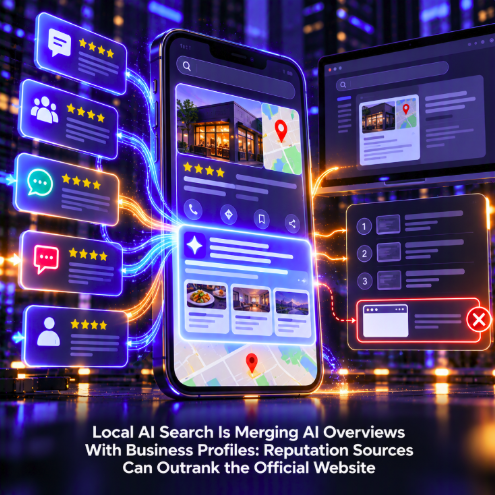
Google’s local search interface may be starting to collapse two previously distinct layers—the Business Profile and the generative answer—into a single mobile experience. An independent September 2026 study by Steady Demand tested 100 local businesses and found that 26% produced an AI Overview when the researcher searched only the business name on mobile. When an AI Overview appeared, 80% of those responses were fused directly into the business listing rather than displayed as a clearly separate module. Steady Demand’s field study describes the findings as a snapshot rather than a universal benchmark.
The desktop comparison was dramatically different: only 6% of the same business-name searches produced an AI Overview. The study was run from New York across 100 real businesses in ten categories, including plumbers, dentists, barbershops, movers, tire shops, gyms and restaurants, with a mix of chains and single-location companies. Each business was tested against four query patterns: its name, its name plus “reviews,” “is [business] legit,” and “what does [business] do.”
The more consequential finding, however, concerns where Google’s AI went for evidence. Among businesses already ranking in Google’s traditional top ten for their own names, 74% were still not cited by AI Mode when it answered about them. Across the study’s four query types, social and review sources outranked the company’s own website about 59% of the time after the researcher adjusted the raw data for ambiguous business names.
Ranking for your own brand does not guarantee AI citation
Traditional local SEO creates an intuitive expectation: if Google clearly recognizes an entity and its official website ranks prominently for the business name, that website should be the natural source for an answer about the business. The study shows why that assumption is becoming unreliable in AI Search.
The 74% figure is particularly useful because it separates conventional ranking from generative sourcing. These businesses were already visible in the normal top ten for their own names, yet AI Mode often selected other sources when constructing an answer.
Google itself says AI Mode and AI Overviews can use query fan-out, issuing multiple related searches across subtopics and data sources before generating an answer. Google also states that AI Mode and AI Overviews can use different models and techniques, so their answers and supporting links can differ. Google Search Central’s AI features documentation therefore supports the broader idea that an AI answer is not simply a restatement of the conventional result ranking.
Yelp, Google reviews, Reddit and Trustpilot were major evidence sources
Steady Demand counted the sources appearing across the four query patterns. Yelp generated 118 citations across 72 of the tested brands, Google reviews and Maps produced 109 citations across 60 brands, Reddit appeared 91 times across 58 brands and Trustpilot appeared 77 times across 52 brands. Better Business Bureau and Wikipedia also appeared frequently.
Those figures do not prove that any one platform has a universal ranking advantage. The sample is small, U.S.-based and intentionally limited to a specific set of businesses and queries. They do show that the AI’s representation of a local company can depend heavily on information the company does not publish on its own domain.
That is especially logical for reputation-oriented questions. A company website is an authoritative source for its opening hours, services, address or official policies. It is inherently less independent when the question is whether customers trust the company or how people describe their experiences with it. For those questions, reviews, forums and third-party reputation platforms supply a different class of evidence.
The local entity is becoming a distributed evidence graph
Local SEO has long required consistency across the web, but generative search changes the reason that consistency matters. The goal is no longer only to help Google reconcile a name, address and phone number. An AI answer may synthesize claims about service quality, legitimacy, specialties and customer sentiment from multiple independent sources.
Google’s own documentation says its algorithms find publicly available information across the web, including site names, business contact information and social profiles, while verified representatives can provide or correct official information. Google also advises businesses to keep Business Profile information current for visibility in AI features.
This creates a distributed reputation layer around the official entity. The website remains important, but it is one node among Business Profile data, Google reviews, directories, specialist platforms, social discussions and community sources.
The Business Profile and AI answer are visually converging on mobile
The 80% fused-layout figure is significant because it changes how users may perceive the source of information. In the observed mobile results, the generative answer was often incorporated directly into the business listing rather than presented as an obviously separate AI block.
That interface can make the business entity and Google’s synthesis feel like one object. A user searching a brand name may see contact information, maps, ratings, reviews and generated explanatory content in a continuous local panel.
Google has not announced that all Business Profiles will evolve into AI Overview containers, and the study cannot establish such a product direction. It does, however, document a real interface pattern that local businesses should monitor, particularly on mobile.
The mobile-desktop gap is too large to ignore—but too small a study to universalize
The study found AI Overviews on 26% of mobile brand-name searches but only 6% on desktop. That fourfold difference is striking, yet it should not be converted into a general prediction that every local market will show the same split.
The researcher explicitly describes the project as field notes. The completed dataset covers 100 businesses in New York, while a Phoenix comparison remained unfinished at publication. The study also found that results could change over time, including one national moving company that showed a fused result one day, no AI Overview the next and a plain AI Overview on the third.
For measurement, that instability matters as much as the headline percentages. One screenshot is evidence of an interface state, not proof of permanent visibility.
The API and the real phone did not always agree
Most of Steady Demand’s dataset was gathered through an API, and the researcher then manually checked subsets on an iPhone. Among 23 API classifications indicating no AI Overview, 83% were confirmed on the phone. Among 23 classified as fused, 74% were confirmed. For 13 classifications of a plain AI Overview, only 62% matched the phone observation.
The samples are too small to establish a general accuracy rate for SERP-data providers. They do establish a useful methodological warning: a tool’s classification of a local AI feature may not always match what an actual user sees at that moment.
Local AI monitoring therefore benefits from periodic device-level verification, especially when a business is making decisions based on whether its listing is fused with an AI Overview.
Entity confusion is a real reputational risk
The manual checks uncovered a more serious failure mode. In four cases, the researcher searched for one business and Google returned AI information about a different business. The mismatches included similar names and, in one case, a competing tire chain.
The study did not establish a single cause for all four errors. For one example, the researcher suspected location and name similarity played a role, but explicitly said the causes of the other cases had not been verified. That uncertainty is important.
For local brands, the operational lesson is still clear: entity accuracy should be tested from outside the company’s normal location and personalization context. A business with a generic name, multiple similarly named competitors or locations in only some markets has more reason to inspect how Google resolves its identity.
Reputation management is becoming part of AI visibility management
If Yelp, Google reviews, Reddit and Trustpilot are repeatedly used to support answers about a business, local AI optimization cannot stop at the website and Business Profile. It needs a monitoring layer that asks what those external sources actually say.
This does not mean manufacturing reviews, manipulating communities or attempting to control independent discussion. It means treating factual inconsistencies, outdated profiles and unresolved customer-service patterns as search-visibility inputs because AI systems may retrieve them when answering reputation questions.
The Steady Demand study itself recommends checking the external sources before trying to fix the generated answer. If Google is drawing a wrong fact from a Business Profile, correct the profile; if it is sourcing Yelp, inspect Yelp; if another source is responsible, remediation starts there.
A larger independent dataset points in the same direction
Separate 2026 research from BrightLocal provides useful context without validating Steady Demand’s exact percentages. BrightLocal analyzed roughly 1.9 million local-AI citations across 1,355 business locations in the U.S., U.K. and Australia. It found Google Business Profile accounted for 28.5% of citations and Yelp for 8.53%, while hundreds of directories and specialist sources also appeared. BrightLocal’s local AI citation study also found that individual business websites appeared across a very large number of cited domains.
The two studies measure different things and should not be merged into one benchmark. Together, however, they reinforce the idea that local AI retrieval is multi-source. Neither supports abandoning the official website; both undermine the idea that the official site alone defines the business in AI Search.
The official website still has a foundational role
It would be a mistake to turn the 59% finding into a claim that websites no longer matter. Google requires a page to be indexed and eligible for a Search snippet before it can appear as a supporting web link in AI Overviews or AI Mode, and its guidance continues to recommend conventional SEO fundamentals, useful content, accurate structured data and current Business Profile information.
Google also recommends claiming the Business Profile, verifying the official site in Search Console and using structured data to establish business information. Those mechanisms help Google understand the official representation of an entity even when the generative system later supplements it with external evidence.
The correct model is therefore additive: own the canonical facts on the website and Business Profile, then monitor the independent sources Google may use to contextualize those facts.
Local AI audits need a different query set
Checking only “[business name]” is no longer enough. The Steady Demand methodology shows why reputation and explanation queries matter: “[business] reviews,” “is [business] legit” and “what does [business] do” can cause the AI system to seek evidence with different informational roles.
A practical audit should therefore compare navigational, reputational and descriptive queries on mobile, then repeat them over time. The team should record whether an AI Overview appears, whether it is fused into the local listing, which business entity Google identifies and which sources support the generated claims.
The objective is not to chase one percentage from one study. It is to identify the evidence graph Google is constructing around a specific business.
Local visibility is becoming reputation visibility
The most important finding in this snapshot is not that 26% of businesses triggered an AI Overview or that 80% of those overviews were fused into the local listing. Those numbers may change by city, device, query and time.
The durable insight is the separation between traditional rank and AI sourcing. A business can rank prominently for its own name and still have AI Mode rely on Yelp, reviews, Reddit, Trustpilot or another third party to explain what that business is like.
As AI-generated content becomes visually integrated with the Business Profile, that distributed reputation may increasingly sit inside the same interface users once treated as the company’s Google listing. Local SEO therefore has a new auditing problem: not only whether the business is visible, but whose version of the business Google’s AI chooses to synthesize when it becomes visible.