
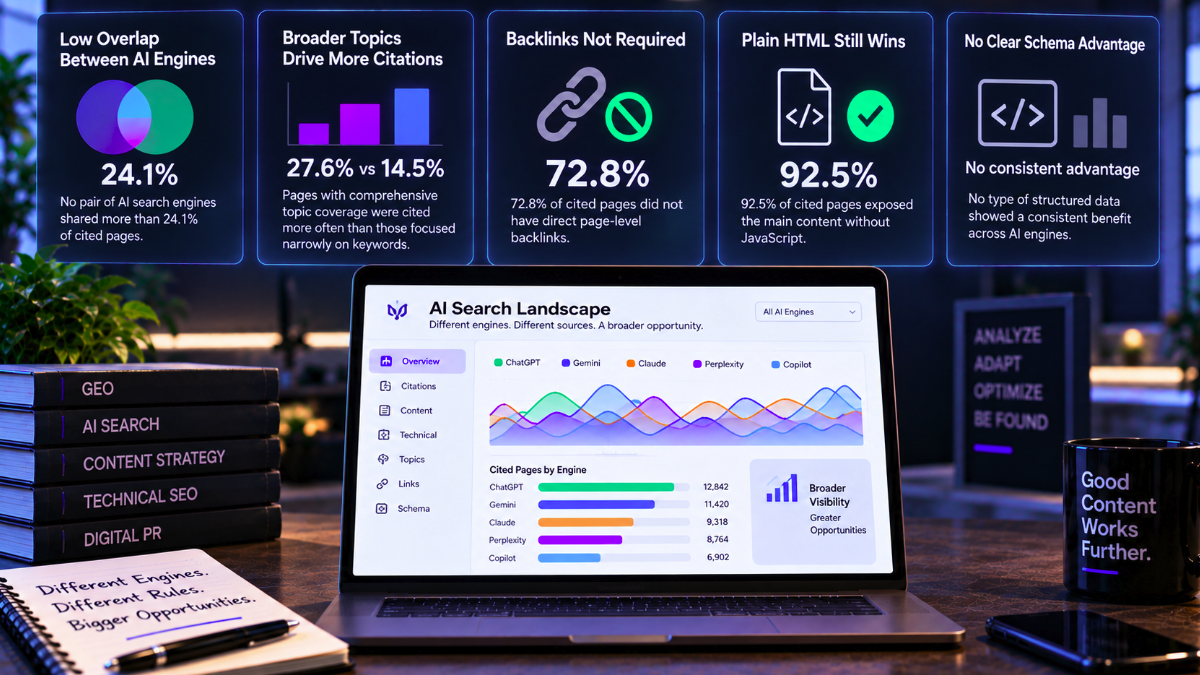
The idea of a single “AI search ranking” is becoming harder to defend. In a new Rankability analysis, no pair of AI platforms shared more than 24.1% of the pages they cited. Even the two systems with the greatest overlap—Brave AI and Claude—agreed on fewer than one in four cited pages.
The finding comes from Rankability’s 2026 AI citation study, an August observational snapshot covering 1,645 distinct AI query-page observations and 916 traditional search observations across 31 topics. The AI sample spans Claude, Gemini, DeepSeek, Meta AI, Perplexity, Microsoft Copilot, Brave AI, Grok, ChatGPT, Google AI Mode and Google AI Overviews.
For marketers, the practical implication is significant. A content strategy that earns citations in one answer engine cannot be assumed to reproduce the same result elsewhere. GEO is increasingly a multi-engine visibility problem, not a new version of optimizing for one universal results page.
The highest overlap was only 24.1%
Brave AI and Claude produced the highest page-level overlap in Rankability’s comparison, at 24.1%. Every other platform pair shared an even smaller portion of cited pages. The number and concentration of sources also varied substantially by platform.
That fragmentation helps explain why manual spot checks can be misleading. A brand may appear repeatedly in one assistant and remain almost absent from another, even when both are answering similar questions. Measuring only one engine can therefore produce a distorted picture of overall AI visibility.
Rankability also found evidence that the platforms differed in how closely their citations resembled conventional search. In an earlier dataset, sources without a measured organic ranking represented only 12.2% of Perplexity citations but 77% of ChatGPT citations. Perplexity most closely resembled Google in that snapshot, Brave AI aligned most closely with Brave Search and Copilot with DuckDuckGo, while ChatGPT did not closely match any measured search index.
Those figures should not be treated as permanent descriptions of the products. Rankability explicitly notes that AI platforms can change models, retrieval systems and source behavior, and that the study captures a particular period rather than immutable architecture.
Different engines create different source opportunities
Search marketers are accustomed to a dominant optimization target. Google’s scale made it rational for many organizations to build an SEO program around one primary ranking system, even while monitoring alternatives.
AI search is developing differently. ChatGPT, Gemini, Claude, Perplexity, Copilot and Google’s own AI surfaces do not necessarily retrieve, rank or present evidence in the same way. Some may lean more heavily on search indexes, some may use proprietary retrieval layers, and some may combine several mechanisms.
The external observer does not need to know the complete internal architecture to see the consequence: the cited source sets diverge.
That creates both complexity and opportunity. A publisher that struggles to become a preferred source in one engine may still perform well in another. A brand that dominates one platform cannot assume it has secured the category everywhere.
One blended visibility score can hide the real problem
The 24.1% ceiling is also an argument against relying exclusively on a single blended “AI visibility” number. Aggregation is useful for executive reporting, but it can conceal which engines are driving the score.
Imagine a brand with excellent visibility in Google AI Overviews and almost none in ChatGPT. A combined percentage could make performance look acceptable while hiding a strategically important gap. The reverse could be true for a company whose audience relies heavily on ChatGPT but whose reporting is inflated by citations on less relevant platforms.
Rankability’s own recommendation is to track the AI platforms that matter to the audience rather than relying on one blended total. That makes the measurement framework resemble channel analytics more than a universal SERP position.
Multi-engine GEO does not mean creating eleven versions of every article
The wrong response to fragmentation would be to manufacture a separate page for every AI engine. There is no evidence in the study that ChatGPT requires one writing style, Claude another and Gemini a third.
In fact, Rankability’s broader findings point toward durable foundations rather than platform-specific gimmicks: accessible HTML, clear titles and headings, strong intent alignment, early topic introduction, thorough semantic coverage and useful evidence.
Those qualities give multiple retrieval systems something coherent to work with. The platform-specific part should happen primarily in measurement and diagnosis. If one engine consistently ignores a brand while others cite it, teams can investigate source preferences, technical access, entity representation and third-party corroboration before rewriting everything.
Source diversity makes third-party visibility more important
Fragmented citation ecosystems also make it risky to think only about a company’s own domain. AI answers may cite publishers, directories, community discussions, documentation, comparison sites and other independent sources.
If different engines prefer different source environments, a brand’s visibility can depend on whether it is accurately represented across that wider information ecosystem. Digital PR, authoritative directory profiles, community participation and expert coverage can therefore complement owned content.
The objective is not to manipulate every possible source. It is to ensure that useful, consistent and verifiable information exists in places answer engines already trust for the topic.
The study is a snapshot, not a map of permanent engine behavior
Rankability’s methodology is careful about the limits of the data. The citation analysis covers 31 topics, and 24 of those queries contained “best” or “top,” which means the sample leans heavily toward recommendation-style intent. Results can also change by model, location, account state and time.
Smaller samples for some platforms make pairwise comparisons less stable. A 24.1% maximum overlap in this study therefore does not prove that no two AI engines could ever share a larger source set under different conditions.
What the result does demonstrate is substantial fragmentation in the observed environment. That is enough to challenge the assumption that winning one engine is equivalent to winning AI search.
GEO is becoming portfolio management
The emerging strategy looks less like optimizing for one algorithm and more like managing a portfolio of discovery channels. Teams need to identify which AI products their customers actually use, establish prompt sets that represent meaningful buying or research journeys, and monitor citations separately by platform.
Common content and technical foundations can remain centralized. The performance layer needs to become more granular.
That is the larger lesson behind the 24.1% figure. AI engines are not producing one shared source hierarchy. They are assembling different evidence sets, and those differences are large enough to matter commercially.
There may eventually be greater convergence as the market matures. For now, a GEO strategy built around a single engine is not really an AI-search strategy. It is a channel strategy with a broader name.