

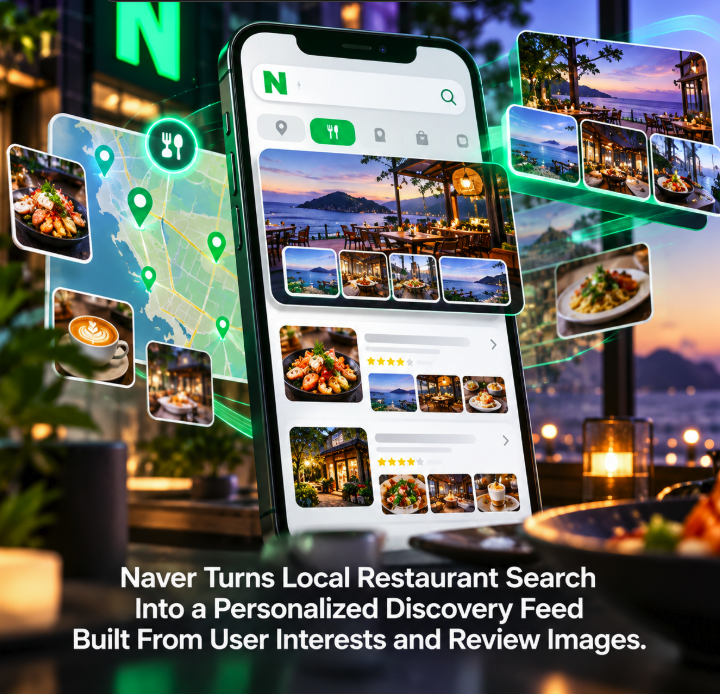

Naver is about to make a meaningful change to local restaurant discovery in South Korea: for selected mobile searches, two people entering a similar restaurant query may increasingly see different thematic results based on their interests. Starting October 1, the company will formally deploy a redesigned restaurant-search experience that can personalize themes, surface multiple discovery modules in a single search and animate image carousels using assets that may include visitor review photos.
The change was announced by Naver Search Ads on September 23 and follows testing conducted in August. The rollout is deliberately limited. Naver says the new UI and UX will apply to its mobile integrated search results for the restaurant category and only to selected location-plus-restaurant queries, including patterns around places such as Gangneung, Gyeongju, Gwanggyo, Gwanghwamun, Daejeon, Bundang, Yeosu, Jamsil, Haeundae and Seongsu. The eligible query set can change, and Naver explicitly says the redesign is not being applied to all restaurant searches.
The same local query can lead to a different discovery experience
The most consequential part of the announcement is personalization. Naver gives a concrete example: a user who regularly looks for cafés with attractive views may be shown an “ocean-view café” theme. Multiple themes can appear within one set of search results, turning what might once have behaved like a relatively uniform local results page into something closer to a personalized discovery feed.
Users who are not logged in will continue to receive non-personalized results, according to Naver. That distinction matters for anyone trying to monitor rankings. A logged-in search shaped by behavioral interests and a logged-out search can represent materially different environments even when the query and location are otherwise similar.
This makes local visibility harder to describe with a single position. A restaurant may be highly relevant to a personalized theme for one user while appearing differently for someone whose prior behavior suggests another preference. The strategic unit therefore starts shifting from “Where do we rank for this restaurant keyword?” toward “For which needs, themes and audiences does the platform understand this business to be relevant?”
Review photos are becoming part of the search-result interface
Naver is also changing how imagery can appear in some themes. The company says thumbnail images may rotate automatically with an animation effect, drawing from advertiser-registered images, expanded creative assets and visitor review images. Rather than presenting a single static thumbnail, the result can therefore communicate several aspects of a restaurant before the user opens its listing.
That gives customer-generated photography a more direct role in discovery. Review images are no longer valuable only after someone has clicked into a place profile to assess credibility. They can become part of the visual material encountered during the search itself, potentially shaping which restaurant attracts attention before a deeper evaluation begins.
The development fits a broader pattern in local discovery in which reviews, photos, attributes and third-party evidence increasingly help platforms construct the answer rather than merely decorate a listing. As NetContentSEO recently examined in our analysis of local business visibility in AI assistants, review ecosystems can influence discovery in ways that go beyond a simple average star rating. Naver’s redesign offers another version of that shift: review imagery itself can become presentation material inside a personalized search experience.
Local SEO becomes an audience-matching problem
Traditional local SEO often encourages businesses to think in relatively stable combinations of category, geography and query intent. Personalization complicates that model because a platform can infer an additional layer of intent from the user rather than requiring the user to type it. Someone may search broadly for restaurants in a district while the system decides that ocean views, atmosphere or another theme deserves greater prominence for that individual.
For restaurants, this increases the value of having accurate and rich signals that describe what the experience actually is. Photos that clearly communicate a waterfront view, terrace, signature dishes, interior style or other distinctive attributes can help users understand the business quickly. Reviews can reinforce those associations by repeatedly describing and visually documenting the same characteristics.
This does not mean that businesses can optimize directly for every personalized theme, nor has Naver published a formula explaining how individual interests translate into ranking. The confirmed change is at the search experience level: Naver can personalize themes according to user interests. Any claim that a specific optimization tactic guarantees entry into a personalized theme would go beyond the company’s announcement.
Rank tracking gets more complicated when the SERP is personal
The measurement problem may be as important as the interface change. Rank trackers traditionally try to reproduce a search under controlled conditions so that positions can be compared over time. Personalized thematic modules weaken the assumption that there is one canonical results page waiting to be measured.
A neutral, logged-out measurement can still be useful—especially because Naver says logged-out users receive non-personalized results—but it may no longer capture the complete discovery environment experienced by logged-in customers. Businesses and agencies may need to supplement positional tracking with outcome metrics such as Place views, calls, reservations, direction requests, branded demand and other indicators of actual customer discovery.
The shift resembles a broader challenge already emerging across search and AI interfaces. As we explored in our analysis of conversational search, the explicit query increasingly reveals only part of the user’s intent. Context supplied by previous interactions can influence what happens next without ever appearing inside the keyword itself.
Naver is not changing the number or position of Place ads
There is an important advertising caveat. Naver says the redesign does not change the number or position of Place ads; those remain as before. However, the company notes that ad exposure is not guaranteed in every theme shown within a personalized result. The structural advertising inventory may therefore remain stable while the surrounding discovery experience becomes more dynamic.
That distinction is useful because the announcement comes from Naver’s advertising center and is specifically framed around restaurant-category Place advertising. The larger editorial significance, however, lies in the organic discovery interface around those ads: personalized themes and richer visual modules change the context in which both paid and unpaid restaurant options compete for attention.
Search is becoming less like a list and more like a recommendation product
Naver’s October rollout is limited in geography, query coverage, device context and vertical, so it should not be generalized to all Naver Search. But the direction is significant. Local search can increasingly infer what kind of restaurant experience a user might want, package candidates into themes and use community-generated imagery to make those candidates visually explorable.
For local businesses, that means discoverability is becoming less reducible to a fixed keyword ranking. The search engine is moving closer to a recommendation system that matches places with inferred tastes. This is especially important in categories such as restaurants, where the decision is often driven by qualities—view, atmosphere, occasion, presentation and experience—that are difficult to capture in a conventional ten-blue-links model.
When the new interface launches on October 1, the most useful question for marketers will not simply be whether rankings changed. It will be whether different users are being routed into different local discovery journeys—and which business signals, images and reviews are visible along those paths. Naver’s limited rollout provides an unusually clear example of where local search is heading: away from a single shared SERP and toward a personalized feed assembled around the user.