

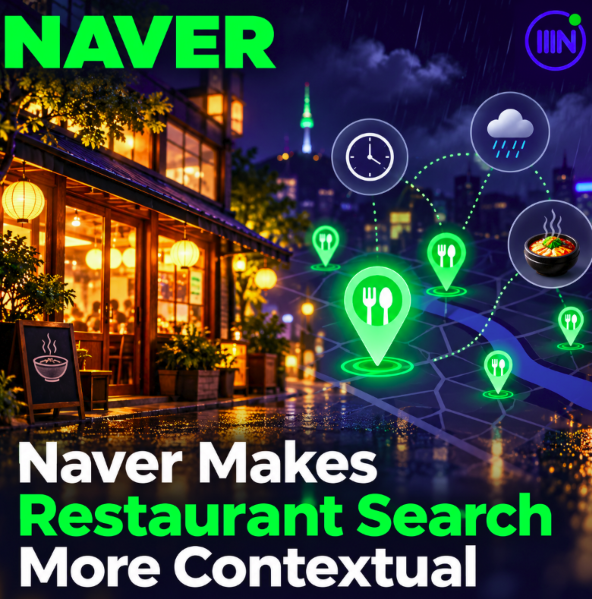
Naver has officially introduced a revised Place restaurant search experience following A/B testing. The SmartPlace notice published October 2, 2026 says the rollout began October 1. In selected areas, searches combining a locality with restaurants now show themed recommendations and venues attracting rapidly growing interest alongside the existing list.
Themed recommendations consider preferences and context, including location, menu, time, weather and visit purpose. The rising-interest section uses signals such as directions, reservations, reviews and saves. Listed areas include Gangneung, Gyeongju, Gwanggyo, Gwanghwamun, Daejeon, Bundang, Seongsu, Yeosu, Jamsil and Haeundae.
The announcement does not disclose signal weights, a ranking formula or the underlying technology. It also does not identify the feature as a generative AI answer system. Its confirmed significance is a change to restaurant discovery within Naver Place, with additional ways to surface a business.
The situation behind a restaurant query matters
Our interpretation is that local search monitoring needs to account for the reason someone wants to visit. A query may express a location while leaving other preferences unstated. A restaurant suitable for a quick lunch, a rainy evening or a particular occasion can serve different needs even within the same neighbourhood.
For a business, that creates a practical reason to make its real offering easy to understand. Menu information, opening hours and useful visit details should accurately describe what customers will find. This is an editorial recommendation for clearer information, not a claim that changing a particular field will secure a themed placement.
The same principle applies to expectations. A venue should not describe itself as suitable for every occasion merely to expand coverage. Clear, specific information helps a potential visitor judge the fit and reduces the gap between a recommendation and the actual experience.
Recent interest is a different view of visibility
A section highlighting growing interest introduces a different observation question from the traditional result list: which venues are gaining attention now? Businesses should inspect whether they appear in the new sections and how that appearance changes over time, instead of reducing the complete experience to one ranking number.
The behavioural signals Naver names should not be treated as an instruction to manufacture activity. A useful local marketing plan encourages genuine customer discovery, accurate booking information and authentic feedback. It should avoid assuming that an isolated increase in saves or reviews establishes a causal change in visibility.
When a restaurant runs a campaign or introduces a menu, record the timing and compare relevant outcomes. Directions, reservations and enquiries can help explain interest, but their movement may reflect seasonality, offline activity or other factors. A report should keep those explanations open until the evidence supports a narrower conclusion.
Audit the new experience with consistent observations
A practical monitoring exercise would define the covered locality, query and observation conditions, then record the traditional list and each recommendation section separately. Keep screenshots and dates so reviewers can distinguish a sustained pattern from a single result. Changes in location or user context should be documented when comparing observations.
For SEO and AI Search practitioners, the broader lesson is about contextual discovery. Interfaces can choose businesses through additional recommendation surfaces even when the user enters a familiar local query. That does not prove every platform uses the same signals or architecture, but it makes a narrow focus on one list position less informative.
Restaurants operating in the initial areas can begin by checking their actual Place information and observing the updated results. Teams elsewhere should follow confirmed expansion notices rather than assume nationwide availability. The most useful response is to improve the accuracy of business information and measure where recommendations create genuine customer interest.