

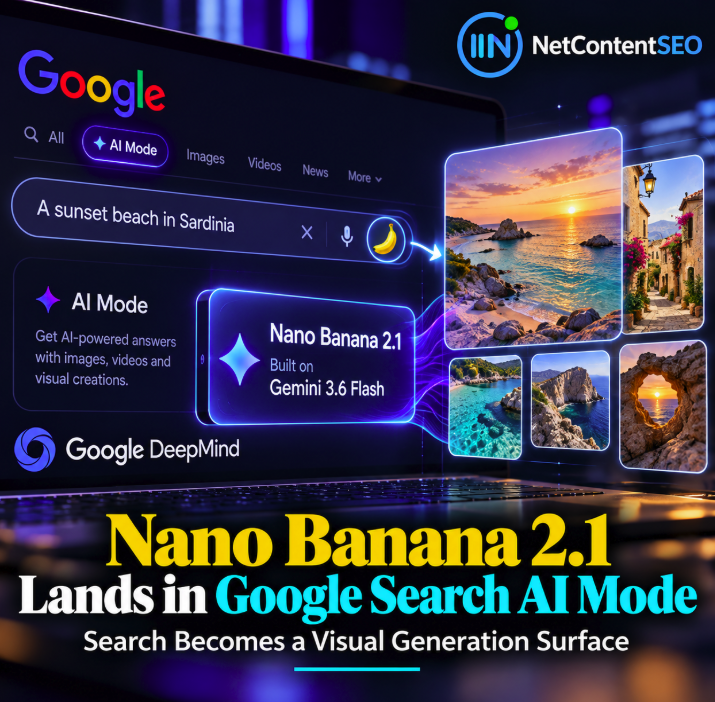

Google Search is becoming more than an answer interface. Google DeepMind's newly documented Nano Banana 2.1 is officially distributed through Google Search AI Mode, putting Google's latest image-generation model directly inside a search environment.
The October 6, 2026 model card confirms that Nano Banana 2.1 is based on Gemini 3.6 Flash and lists Search AI Mode alongside the Gemini app, AI Studio, Gemini API, Google Ads, Flow and Stitch as distribution channels.
For search marketers, the strategic implication is larger than another image model release: Search is increasingly becoming a place where users can create the visual answer itself instead of only discovering existing images and webpages.
What Google officially confirmed
Google DeepMind published the Nano Banana 2.1 model card on October 6.
It describes the model as part of the Gemini 3 family and says it can understand both text and image inputs while generating image and text outputs.
The model is built on Gemini 3.6 Flash, giving it the underlying multimodal reasoning capabilities of Google's Flash architecture while focusing specifically on visual generation and editing.
Google Search AI Mode is an official distribution channel
The clearest SEO-relevant detail appears in the model card's distribution section.
Google explicitly lists Google Search AI Mode as one of the environments where Nano Banana 2.1 is distributed.
This removes the need to infer the connection from screenshots or user reports. The Search integration is part of Google's official model documentation.
Search already had visual creation
Nano Banana did not suddenly introduce image creation to Google Search this week.
Google previously rolled Nano Banana image editing and generation into Lens and AI Mode, including the ability to create new images from scratch and continue editing them conversationally.
Google's interface guidance has used the yellow banana icon as an entry point into creation experiences in the Google app.
The important October change is therefore the model powering the capability, not the invention of visual generation inside Search itself.
Why Nano Banana 2.1 matters
DeepMind says Nano Banana 2.1 improves on earlier Nano Banana models in areas including visual design, mask-based editing, subject consistency and natural-looking images.
The model can use text and images as input, with a context window of up to one million tokens according to its model card.
Its image capabilities sit on top of Gemini 3.6 Flash, allowing visual generation to operate within a broader multimodal reasoning system rather than as an isolated image renderer.
Search is moving from retrieval to synthesis
Classic Google Images is fundamentally a retrieval product: the user asks for an image and Google surfaces images that already exist on the web.
Generative AI changes that model.
If a user asks AI Mode to visualise a room, create an infographic, redesign an object or generate a destination concept, the immediate result may be a newly synthesized image rather than a ranked collection of third-party visual assets.
That is a structural change in what a search result can be.
The discovery question becomes more complicated
For publishers and brands, generative visual search creates at least two distinct discovery layers.
One is familiar: does Google retrieve or cite your webpage or image as a source?
The second is less mature: what external information, entities, products or visual references influence the generated output, and how visible are those inputs to the user?
Google's public documentation does not currently provide a conventional ranking report for “influenced this generated image,” so marketers should avoid pretending that visual-generation attribution is already measurable like Search Console clicks.
Real-world knowledge can enter image generation
Google's Nano Banana documentation highlights the model's use of Gemini's real-world knowledge and, for Nano Banana 2, real-time information and images from web search to produce more accurate depictions of specific subjects.
That connection is particularly important inside Search.
A generated visual does not necessarily exist in isolation from Google's retrieval systems. The boundary between searching for visual information and generating a visual answer is becoming increasingly thin.
What this could mean for travel, ecommerce and local search
Imagine a traveller asking Google to visualise a Sardinian beach at sunset, compare two hotel-room styles or show how a local dish should look.
An ecommerce user could ask to visualise a product in a room or generate variations around a specific aesthetic.
A local-search user could move from “show me examples” to “create what I have in mind” without leaving AI Mode.
Those workflows can still lead to external discovery and commerce, but the generated asset itself increasingly becomes part of the search experience.
Do generated images reduce clicks?
It is too early to make a universal claim.
In some informational queries, a generated visual could satisfy the user without an external visit. In other workflows, generation may create new commercial intent: after visualising an object, destination or style, the user may want to find the real product, location or service.
The correct SEO question is therefore not simply “will this steal traffic?” but where does Google place external sources and actions around the generated result?
Multimodal visibility needs broader monitoring
Traditional rank tracking cannot fully describe this experience.
AI Mode can combine text answers, links, visual layouts and now increasingly capable generated imagery inside one session.
Visibility monitoring will need to distinguish between being ranked, being cited, being visually retrieved, being used as contextual grounding and being surfaced as the next action after generation.
Those are not necessarily the same thing.
Do not call Nano Banana 2.1 a new ranking system
Nothing in Google's model card says Nano Banana 2.1 changes organic ranking or introduces a new Search ranking signal.
The update concerns a multimodal generation model and its distribution.
Any claim that websites need to “optimize for Nano Banana rankings” would currently go beyond Google's documentation.
The useful takeaway is architectural: another major Search surface now includes native content generation.
NetContentSEO take
Nano Banana 2.1 makes the distinction between searching and creating even less useful.
Google Search AI Mode can already answer questions, synthesize web information and support follow-up exploration. With Nano Banana 2.1 officially distributed there, visual generation becomes another native output mode of the search journey.
For SEO and AI visibility teams, the next challenge is not only understanding which sources appear in AI answers.
It is understanding how brands, entities, products and publisher content remain discoverable when the interface can generate the thing the user asked to see.