

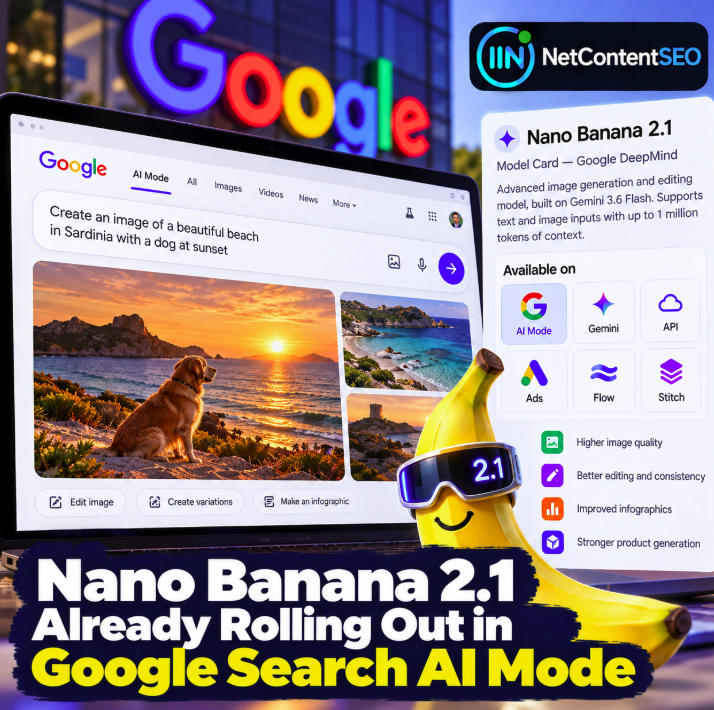

October 8, 2026. Google's official DeepMind model card for Nano Banana 2.1 lists Google Search AI Mode among the model's deployment surfaces, alongside Gemini, APIs, Ads, Flow and Stitch. The documentation describes an image generation and editing model derived from Gemini 3.6 Flash, with support for text and image inputs and a context window of up to one million tokens.
AI Mode is becoming a visual creation environment
The significance for Google Search is broader than answering questions with links and text. AI Mode is among the channels through which Google deploys its image-generation technology, potentially making visual creation and editing part of a search-led workflow. The model card establishes deployment, but does not by itself prove identical feature access for every user, territory or account.
What's new in Nano Banana 2.1?
Google describes improvements across image generation, editing, infographic creation and product consistency. For creators, these capabilities could support more coherent visual assets and iterative changes based on text instructions or reference images. The underlying Gemini 3.6 Flash lineage and long-context support are notable technical characteristics, though a large context window should not be interpreted as a guarantee that every interface exposes the same input limits.
From searching for images to creating them
Traditional image search helps users discover existing pictures on the web. A generative visual workflow can instead produce new illustrations, adapt compositions or edit provided images. This distinction matters to publishers because a generated visual is not the same as a retrieved image with an identifiable original source and license.
What this means for SEO and image visibility
For SEO teams, the emergence of visual generation within AI search creates new questions about image attribution, brand representation and referral traffic. It does not establish that generated images replace Google Images results or that Nano Banana 2.1 directly changes image ranking. Publishers should continue optimizing original assets with descriptive alt text, relevant surrounding content, crawlable image URLs and appropriate licensing metadata.
Product images and ecommerce
Improved product consistency may make AI-assisted merchandising visuals more useful, but merchants should distinguish illustrative AI assets from accurate depictions of items for sale. Product color, size, accessories and other material details must remain truthful. Generated marketing visuals should not create misleading expectations for shoppers.
Editorial workflow: practical considerations
- Track whether AI Mode offers image generation and editing in the target region and account.
- Document whether visual assets are original photographs, licensed media or AI-generated illustrations.
- Review brand and product consistency before publication.
- Retain source assets and provenance information where possible.
- Monitor changes in image search visibility separately from usage of generative features.
The NetContentSEO takeaway
Nano Banana 2.1's inclusion in Google Search AI Mode illustrates the expansion of search from retrieval and answers toward visual creation. That shift could reshape how users interact with imagery, but its measurable effects on indexing, rankings and publisher traffic require separate evidence. For now, the model card is a strong signal of product direction, not proof of a specific SEO impact.
Official source: Google DeepMind: Nano Banana 2.1 model card.