

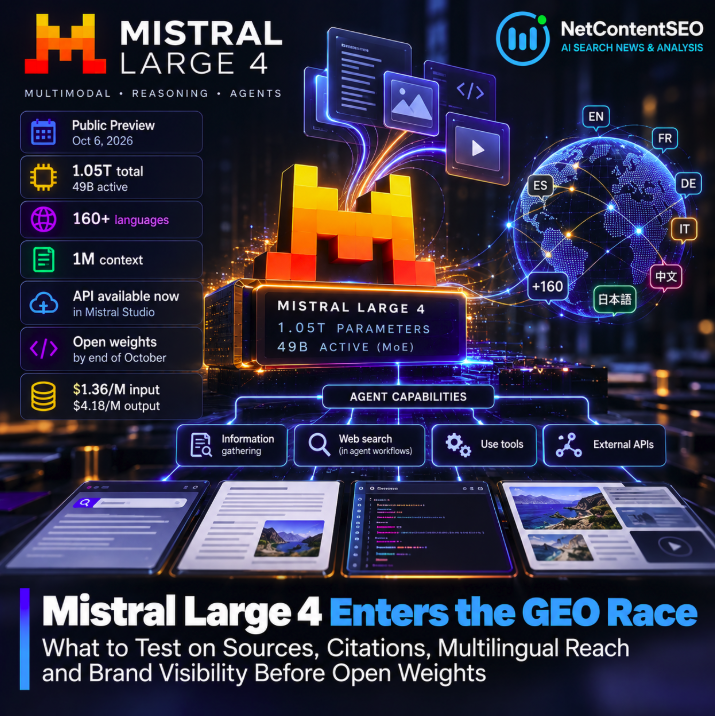

Mistral has launched Mistral Large 4 in public preview, creating a new model that GEO and AI visibility teams should begin testing before its open weights arrive later this month.
The model is available now through the preview API in Mistral Studio. Mistral describes ML4 as its largest and most capable model to date: a natively multimodal Mixture-of-Experts system with approximately 1.05 trillion total parameters and 49 billion active parameters.
For search marketers, however, the important question is not simply how large the model is. It is how Mistral Large 4 discovers information, chooses sources, handles brands across languages and behaves when agents are given access to retrieval tools.
Mistral Large 4 is available now in public preview
Mistral announced ML4 on October 6, 2026. The company's changelog confirms that mistral-large-4 is available in Public Preview with a 1 million-token context window. Open weights are scheduled for later in October.
Mistral's English launch announcement says the weights will drop by the end of the month, while its localized announcement specifies October 26.
49 billion active parameters inside a trillion-parameter model
ML4 uses a granular Mixture-of-Experts architecture. Mistral's current model documentation lists 1.05T total parameters, 49B active parameters and a 1.6B vision encoder.
This distinction matters because the full parameter count does not represent the amount of model capacity activated for every token. The MoE architecture routes work through a smaller active subset while retaining a much larger total model.
160+ languages create an immediate GEO testing surface
Mistral says a significant share of ML4's training data was multilingual and spans more than 160 languages, including every official language of the European Union.
That makes multilingual source selection one of the most interesting early GEO experiments.
Brands should test whether the same factual query in English, French, German, Italian and other languages produces the same preferred sources, whether local-language sources displace English authorities, and whether entity recognition remains consistent across markets.
Agentic workflows are directly relevant to source visibility
Mistral says ML4 can run general-purpose agents that gather information, use tools and produce finished deliverables across complex workflows. It reports a 59.9% score on AutomationBench, a benchmark covering 657 business workflows.
The model's training environments also use resources including code sandboxes, web search and external APIs.
That does not mean Mistral has announced a new consumer search engine or a fixed citation system for ML4. It does mean that retrieval and tool use are part of the environment in which the model's agentic behavior is being developed.
Do not assume “web search” means a new Mistral search product
This distinction is critical for GEO analysis.
Mistral's launch material discusses web search as a resource available inside agent environments. It does not announce a new integrated web-search product for Mistral Large 4, nor does the launch define a new universal citation format or ranking system for web sources.
Any claim about ML4's preferred domains, citation frequency or brand-selection behavior therefore needs empirical testing rather than inference from the launch announcement.
What GEO teams should test now
The public preview provides an opportunity to establish a baseline before the weights are released.
First, test source selection. Run factual prompts that require external evidence and record which domains are retrieved when web-enabled agent workflows are available.
Second, test citation behavior. Measure whether retrieved sources are explicitly cited, merely paraphrased or omitted from the visible answer.
Third, test brand visibility. Use neutral category prompts rather than prompts containing the brand name and measure which companies are recommended or mentioned spontaneously.
Fourth, repeat the same tests across languages. A model trained heavily on multilingual data may expose very different source ecosystems depending on query language.
Open weights could make visibility less centralized
The planned open-weight release introduces another variable.
Once organizations can deploy and customize ML4 themselves, there may no longer be one canonical Mistral Large 4 retrieval environment. Different deployments can connect the same underlying model to different search providers, enterprise indexes, APIs, vector stores and citation layers.
For GEO measurement, that means researchers should distinguish model behavior from retrieval-stack behavior.
A brand that appears frequently in one ML4-powered application may be absent from another if the two products use different retrieval sources.
Pricing makes large-scale testing practical
Mistral lists standard pricing of $1.36 per million input tokens and $4.18 per million output tokens for Mistral Large 4. Its changelog also notes launch pricing at 50% off for two weeks.
That price point makes systematic prompt testing feasible for teams measuring AI visibility across hundreds or thousands of queries.
The NetContentSEO takeaway
Mistral Large 4 should enter the GEO test matrix now, but not because Mistral has announced a new search engine.
The opportunity comes from the combination of multilingual training, agentic information gathering, tool use, web-search-enabled environments and forthcoming open weights.
Those characteristics create exactly the conditions in which source selection and brand visibility can become important — while also making those behaviors dependent on the retrieval layer surrounding the model.
Before open weights arrive, GEO teams have a useful window to establish a public-preview baseline: which sources ML4 finds, which ones it cites, which brands it recognizes without prompting, and how those patterns change across languages.
Then the same tests can be repeated after the open-weight release to determine what belongs to Mistral Large 4 itself and what belongs to the retrieval infrastructure built around it.