

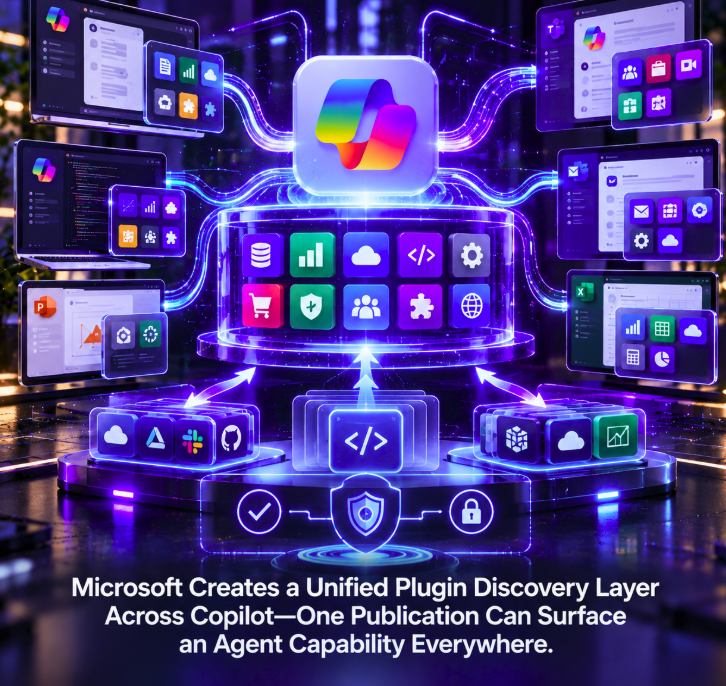

Microsoft is consolidating plugin discovery across Copilot into a single registry, giving developers a publish-once route into multiple supported experiences while giving enterprise IT a central place to approve and manage what users can access. The change turns plugins from isolated integrations into reusable capabilities that can travel across the broader Copilot environment.
The new registry was announced by Microsoft on September 25 as part of its wider Copilot redesign. Microsoft says the registry is rolling out now and will become generally available across surfaces in the coming weeks. It will bring Microsoft-built, partner and custom plugins together in one unified catalog, while developers and partners can publish once to extend Copilot across supported experiences.
One catalog becomes the discovery layer for Copilot capabilities
The most consequential part of the announcement is not simply that Microsoft has another marketplace. Plugins are becoming a shared capability layer inside Copilot. Microsoft describes them as the mechanism that brings together skills, connectors and other capabilities so users can complete more workflows without leaving the applications where they already work.
A unified registry changes how those capabilities can be discovered and distributed. Instead of treating every Copilot surface as an independent publishing destination, Microsoft can maintain a common catalog that sits behind multiple experiences. The developer publishes the capability once; the platform can then make that plugin available where it is supported and permitted.
That architecture reduces one of the practical problems in agent ecosystems: fragmentation. A useful capability is less valuable if users must know which specific product, store or integration page contains it. A shared registry gives Microsoft a foundation for matching users and agents with trusted capabilities across a broader environment.
Plugin discovery is moving from app stores toward capability matching
Traditional software marketplaces ask users to choose an application. Agent systems increasingly need to choose capabilities. A user may not care which connector, skill or plugin implements a workflow; the immediate need might simply be to retrieve CRM data, update a record, analyze a spreadsheet or interact with another business system.
This changes the optimization problem for developers. The plugin is not only a product someone may browse in a catalog. It is a machine-readable description of something Copilot can potentially use when a task requires it. Names, descriptions, permissions, supported actions and trust signals therefore become part of a capability-discovery layer rather than merely store merchandising.
NetContentSEO has been tracking the same transition elsewhere. In our analysis of OpenAI’s move from custom GPTs toward plugins, the strategic shift was similar: discovery becomes less about persuading a user to select a standalone bot and more about making a reusable capability available inside the assistant’s broader workflow.
Publish once is a distribution advantage
Microsoft’s explicit promise that developers and partners can publish once and extend Copilot across supported experiences is important because it separates capability creation from surface-by-surface distribution. The plugin becomes a reusable asset in the platform rather than an integration that must be independently rebuilt for every endpoint.
Microsoft does not say that every plugin will automatically appear everywhere. The wording is narrower: publishing once can extend Copilot across supported experiences, while IT retains approval and management controls. Compatibility, organizational policy and product availability still determine where a capability can actually be used.
Even with those qualifications, the model creates a potentially powerful distribution effect. A developer can focus on making one capability understandable and trustworthy to the registry rather than maintaining separate discovery identities across multiple Copilot surfaces. As Microsoft expands where plugins are consumed, the value of being present in that common layer can grow without requiring a new publication event for every experience.
IT governance sits directly inside discovery
Enterprise plugin discovery cannot operate like an unrestricted consumer app store. A plugin may access organizational data, trigger actions or connect Copilot to external systems. Microsoft therefore pairs the unified catalog with centralized IT approval and management.
This creates an important distinction between discoverability and availability. A plugin can exist in the wider Microsoft ecosystem while an organization decides whether its users are permitted to access it. Discovery is therefore filtered through governance: the capability needs to be publishable, supported and allowed within the tenant before it can become useful to an employee or agent.
For developers, security and administrative clarity become part of distribution. A plugin that is technically powerful but difficult for IT to evaluate may face a different adoption problem from one that clearly communicates its permissions and role. In enterprise agent ecosystems, trust is not a layer added after discovery; it can determine whether discovery leads to access at all.
The registry complements Microsoft’s move toward persistent agents
The plugin announcement arrives alongside Autopilot, Microsoft’s new persistent Copilot agent with its own identity, memory, computer and workspace. Autopilot can monitor channels, run recurring work and resume projects days later without waiting for another prompt. A unified capability registry becomes especially relevant when agents themselves can continue operating over time.
A persistent agent may encounter different needs as a project evolves. If the platform can draw on a governed catalog of plugins, the agent ecosystem has a structured way to expose the tools and connectors that can satisfy those needs. Microsoft has not said that Autopilot autonomously installs arbitrary plugins from the registry, so that behavior should not be inferred. The broader architectural relationship is nevertheless clear: long-running agents become more useful when the surrounding platform has a common, governed capability layer.
This is also why agent discovery is becoming a technical SEO concern rather than only a developer-marketplace issue. In our coverage of Google Lighthouse’s Agentic Resource Discovery audit, the emerging question was whether agents can discover callable resources published by an organization. Microsoft is solving a related problem inside its own ecosystem through a centralized registry rather than relying solely on decentralized web discovery.
Microsoft is connecting plugin distribution to Copilot’s new build layer
The September 25 launch also introduces Code, a Copilot environment for creating apps, trackers, dashboards, automations and workflows through natural language. Microsoft says Code is powered by the same underlying technology as GitHub Copilot, runs in a sandboxed environment and can be hosted inside the customer’s tenant. Significantly, the company says plugins sync automatically.
That detail shows why a unified registry matters beyond a conventional catalog page. Plugins are intended to participate in the broader construction and execution environment around Copilot. A capability published into the ecosystem can become part of what users and builders draw on as they create workflows and software inside the platform.
Microsoft is reinforcing that architecture with Copilot Managed Runtime, hosting infrastructure for code running within Microsoft 365. The runtime supports applications built through Cowork, Code and Copilot Studio and is being opened to third-party and professional developers. The registry supplies capabilities; the runtime supplies execution infrastructure; Microsoft IQ supplies organizational context and governance.
Agent ecosystems are building their own search and distribution layers
The larger trend is that AI assistants are beginning to require the equivalent of search infrastructure for capabilities. Once an ecosystem contains enough tools, connectors, skills and agents, users cannot be expected to know which one should handle every task. The platform needs a catalog, metadata, trust controls and some mechanism for surfacing the appropriate capability.
OpenAI is moving in the same broad direction as it shifts creator workflows from standalone custom GPTs toward composable plugins. NetContentSEO recently examined how that transition changes discovery from choosing a bot toward matching a capability. Microsoft’s unified registry provides another strong signal that the agent economy is standardizing around reusable components rather than thousands of isolated assistant identities.
The discovery challenge also changes accordingly. Developers will increasingly need to ask whether an agent ecosystem can understand what their capability does, under which conditions it should be surfaced, what permissions it requires and whether the organization trusts it. Those questions resemble search optimization, software distribution and security review at the same time.
One publication can have many discovery surfaces
Microsoft’s rollout remains bounded by supported Copilot experiences and enterprise governance, and the company has not published a ranking algorithm explaining how plugins will be ordered or selected inside the unified catalog. It would therefore be premature to talk about a specific “Copilot plugin SEO” formula.
What is confirmed is the infrastructure that makes such discovery strategically important. Microsoft is creating one registry for its own plugins, partner plugins and custom-built capabilities; developers can publish once; IT can centrally approve and manage access; and the registry is intended to become generally available across surfaces in the coming weeks.
That turns plugin publication into a potentially cross-surface distribution event. The unit being discovered is no longer necessarily an app or chatbot. It is a capability that can travel through the Copilot ecosystem and become available wherever the platform, organization and workflow allow it. For developers, that makes the quality of the capability’s metadata, trust model and functional description increasingly central to whether the agent economy can find and use what they have built.