

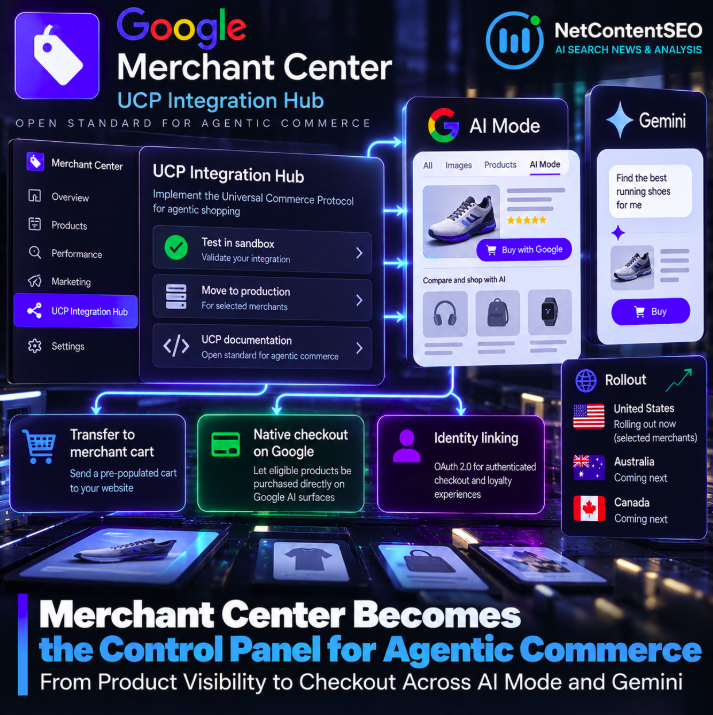

Google Merchant Center is becoming an operational control panel for agentic commerce, with a new Universal Commerce Protocol integration hub that lets participating merchants test and validate shopping flows designed for AI Mode in Google Search and Gemini.
Google's current Merchant Center documentation confirms that the UCP Integration Hub is gradually rolling out in the United States. Australia and Canada are scheduled to follow next year. Access is not universal: merchants must complete the technical implementation, express interest and be selected before they can complete onboarding and production validation.
Merchant Center now manages the path from discovery to transaction
The Universal Commerce Protocol is Google's open standard for enabling agents and commerce systems to work together across the shopping journey.
For merchants, the new Integration Hub turns Merchant Center into the place where UCP implementations can be configured, tested in a sandbox and validated before going live on Google's AI surfaces.
The hub supports multiple integration paths: transfer to merchant cart, native checkout on Google and, when native checkout is selected, optional identity linking.
Cart transfer keeps checkout on the merchant's site
The cart-transfer path allows a shopper to build a cart on a Google surface and then move that pre-populated cart to the merchant's own website to finish the purchase.
Google's UCP Cart API documentation says the initial implementation centers on the CreateCart operation. When the user chooses to transfer the cart, Google sends the line items to the merchant's endpoint and receives a continuation URL pointing to the pre-populated cart.
This gives merchants a lower-friction route into agentic shopping without requiring them to move the entire transaction onto Google's interface.
Native checkout moves the purchase into Google's AI surfaces
The deeper integration is native checkout.
Google's developer documentation says participating merchants can implement checkout logic that allows users to complete purchases directly on Google AI surfaces. The current REST flow includes creating, updating and completing a checkout session, together with payment and order-lifecycle requirements.
Google says eligible product listings can expose this checkout experience in AI Mode in Google Search and Gemini.
Identity linking connects accounts and loyalty experiences
Merchants implementing native checkout can also select identity linking.
The capability uses OAuth 2.0 to support authenticated checkout and loyalty benefits, allowing an agentic shopping flow to recognize a customer's relationship with the merchant rather than treating every transaction as an anonymous guest checkout.
This is significant because agentic commerce is not limited to moving products into a cart. The infrastructure is beginning to connect product discovery, merchant identity, customer identity, payment and post-purchase workflows.
Product feeds now determine agentic checkout eligibility
Merchant Center product data is also becoming part of the transaction layer.
Google documents a native_commerce attribute containing the checkout_eligibility sub-attribute. If checkout eligibility is false or absent, the product is not eligible for the native checkout experience.
That means feed optimization can increasingly affect more than whether a product is understood and displayed. Structured merchant data can determine whether a product is technically eligible to participate in an AI-mediated purchase flow.
The Integration Hub includes sandbox and production validation
Google divides onboarding into implementation, sandbox testing and production validation.
The sandbox lets merchants simulate their selected capabilities and inspect responses before going live. Native checkout implementations can test checkout creation, updates and completion. Cart implementations can validate cart-transfer behavior.
Once the integration is ready, merchants publish their UCP profile, select supported capabilities and complete the relevant production checklist before Google's support team reviews the implementation.
Merchant Center also gains UCP analytics
Google's developer guide says the Integration Hub contains both Overview and Analytics areas. The Analytics section is designed to provide visibility into the UCP checkout funnel across agentic purchase flows and associated performance metrics.
This is an important evolution for commerce measurement. Merchant Center is no longer only supplying product information upstream to Search and Shopping experiences; it can also become a measurement interface for transactions initiated through AI agents.
Rollout is limited and gradual
The availability details need careful interpretation.
The Integration Hub is gradually rolling out in the United States and currently applies to participating merchants rather than every Merchant Center account. Google says Australia and Canada will follow next year.
Google's separate UCP documentation also makes clear that integrations must be approved before they can go live across AI Mode and Gemini.
So this is an official product rollout, but not an immediate global switch for all merchants.
Why this matters for SEO, GEO and product visibility
Search visibility has traditionally ended when Google sent the shopper to a merchant website.
Agentic commerce changes that boundary.
A product can now be discovered inside an AI experience, evaluated in context, added to a cart and potentially purchased without the conventional sequence of search result, website landing page and checkout funnel.
For GEO teams, product visibility therefore needs to be considered alongside transaction eligibility. Being selected by an AI answer is valuable, but being technically capable of participating in the agent's next action may become a separate competitive advantage.
The NetContentSEO takeaway
Merchant Center is evolving from a product-data hub into an agentic commerce control layer.
UCP connects product data to actions. Cart transfer can move an AI-built basket to the merchant. Native checkout can keep the transaction inside Google's AI surfaces. Identity linking can connect customer accounts and loyalty. Merchant Center provides the environment to configure, test, validate and eventually measure those flows.
The shift is strategically important: AI Search is moving beyond recommending what users should buy toward infrastructure capable of helping them complete the purchase.
For merchants, the next visibility question may no longer be simply “Does my product appear in AI Mode or Gemini?” It may also be: Can the agent actually transact with it?