
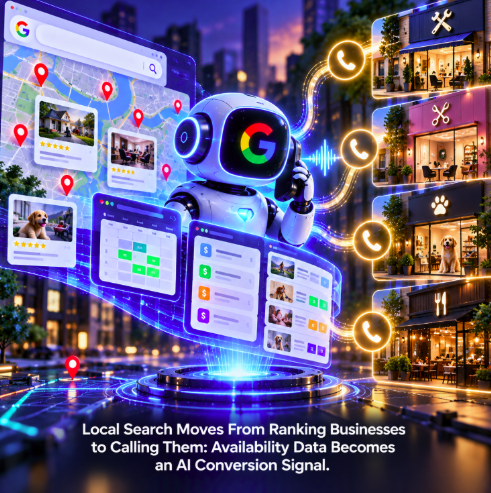
Google is pushing Local Search beyond ranking nearby businesses and toward completing the work that traditionally happened after the click. Search is expanding its agentic booking capabilities across local experiences and services, gathering current pricing and availability for detailed requests and, in selected U.S. categories, calling businesses on the user’s behalf.
Google announced the expansion at I/O 2026 as part of its broader move into Search agents. The company says users can describe specific criteria—for example, a private karaoke room for six people on a Friday night that serves food late—and Search will bring together the latest prices and availability, then provide direct links to finish booking with the provider the user chooses. For selected categories including home repair, beauty and pet care, users can also ask Google to call businesses for them.
Google said these expanded capabilities would roll out to everyone in the United States during summer 2026. The change does not mean Google universally books every local service autonomously, nor does it make availability a newly disclosed ranking factor. What it does establish is that pricing and availability can now become information the AI needs between discovery and conversion.
The local result is becoming an executable option
Traditional local search presents a set of businesses and leaves the user to perform the next steps: visit websites, check prices, call providers, compare appointments and decide whom to contact. Agentic Search can absorb several of those steps.
The user can specify operational constraints rather than simply a category and location. Search can then assemble current information that helps determine whether a business can actually satisfy the request. A karaoke venue that ranks prominently but cannot accommodate six people at the required time is less useful to that particular task than a provider whose live conditions match the prompt.
This is why agentic local discovery should not be reduced to another ranking interface. Google is increasingly trying to resolve the gap between “this business appears relevant” and “this business can serve the user now.”
Google was already calling local businesses before the I/O expansion
The underlying calling capability predates the 2026 announcement. In July 2025, Google began rolling out AI-powered calls to U.S. local businesses for pricing and availability. A search such as “pet groomers near me” could surface an option to have AI check pricing, after which Search would contact businesses and consolidate information about services and appointments.
Google described the feature as available to U.S. Search users, with higher usage limits for Google AI Pro and Ultra subscribers. Businesses retained control through their Business Profile settings.
The I/O 2026 announcement broadens the agentic framing. Rather than treating calling as a narrow price-checking experiment, Google now places it alongside expanded booking for local experiences and services as part of the Search-agent roadmap.
AI calling has already expanded into local retail inventory
Google has also extended agentic calling beyond service businesses. Its official agentic calling guide, updated in July 2026, describes how U.S. users can ask Google to call local retailers to confirm whether products such as toys, health and beauty items or electronics are in stock nearby.
Users answer a short set of questions about what they need and can request the resulting summary by text, email or both. Google then calls relevant businesses and reports back.
The common pattern across these implementations is operational verification. Search already knows that a business may sell a product or provide a service; the call retrieves information that can change too quickly or remain too poorly structured to rely on static web content alone.
Availability becomes part of the conversion decision
This makes availability strategically important for local businesses, but precision matters. Google has not announced “availability” as a new local ranking signal in the conventional algorithmic sense. There is no documented rule saying businesses with more open appointments receive higher Local Pack rankings.
Availability can nevertheless become an AI conversion signal in a functional sense. When an agent is trying to satisfy a user’s explicit request, whether a provider can perform the service at the requested time can determine whether that provider remains a viable option.
The same applies to price. A business can be geographically relevant, reputable and semantically matched to the query while failing the user’s budget constraint. Agentic Search is designed to gather enough current information to distinguish relevance in theory from feasibility in practice.
The phone call becomes a retrieval mechanism
For decades, search engines primarily retrieved information from digital documents and structured databases. Google’s local AI calling turns a telephone conversation into another retrieval channel.
If a price, appointment slot or inventory status is not reliably available online, Search can ask the business directly. The resulting information can then be summarized for the user alongside other options.
This is an important change for local SEO because the machine-readable web is no longer the only place Google can obtain decision-stage facts. A business employee answering the phone can effectively become a real-time data source for an AI-mediated search session.
Local businesses now need consistency between their web data and operational reality
Agentic verification increases the cost of stale information. If a website advertises a service that the business no longer provides, or lists opening hours that conflict with reality, an AI call can expose that discrepancy before the user converts.
The strongest local data strategy is therefore not merely to publish more information. It is to keep Business Profile data, website content, booking systems, inventory and staff responses aligned around the current state of the business.
This does not guarantee selection by Google’s agent. It reduces friction when Search tries to determine whether the business can meet a specific request.
Business Profile controls remain part of the system
Google has emphasized that businesses retain control over AI calls through Business Profile settings. That matters because automated calls create operational considerations: staffing, consent, call handling and the accuracy of information supplied during the interaction.
A business may choose not to participate in some automated calling experiences. That choice can reduce the agent’s ability to obtain information by phone, but Google has not stated that opting out itself causes a local-ranking penalty.
Publishers and local SEO practitioners should keep that distinction clear. Participation in an agentic workflow and ranking in conventional Search are related to the same discovery ecosystem but are not documented as the same mechanism.
The best-ranked business may not be the best executable result
Agentic Search introduces a second layer after relevance. The first layer identifies plausible providers. The second tests which of those providers satisfy the user’s operational constraints.
That distinction is easiest to see with time-sensitive services. A highly visible pet groomer with no appointments this week may be a poor answer to a user who needs an appointment tomorrow. A less prominent provider with a suitable opening can become more useful to the agent’s task.
Google has not published enough implementation detail to say exactly how initial candidate businesses are selected or how the agent orders the final options. The defensible conclusion is narrower: current availability and pricing can affect whether a business satisfies the user’s request after it enters the agentic workflow.
Structured booking integrations still matter
AI calling should not be interpreted as evidence that businesses no longer need online booking or structured availability. Google’s I/O example for experiences and services emphasizes bringing together the latest pricing and availability and then linking users directly to the chosen provider to finish booking.
Machine-accessible booking data can therefore reduce the need for the system to discover basic operational facts indirectly. Phone calls provide another path when information is missing, fragmented or needs confirmation.
For businesses, the practical goal is to make conversion-critical data easy to obtain through whichever supported channel Google uses: website, booking provider, Business Profile, structured integration or direct contact.
Agentic Search compresses the local funnel
The traditional local funnel contains several measurable stages: impression, result click, website visit, phone call, booking and purchase. An AI agent can collapse some of those stages into a single Search interaction.
The user may never visit three competing websites to compare prices. Google can perform the comparison and return a smaller set of viable options. The eventual click may occur much closer to booking than a conventional discovery click.
That can change the meaning of referral traffic. A business might receive fewer exploratory visits but more highly qualified handoffs if the agent has already checked constraints upstream. Google has not published data demonstrating that outcome broadly, so it remains an analytical possibility rather than a proven traffic effect.
Local SEO measurement needs to separate discovery from agent qualification
Existing analytics tools are not designed to expose every step of this workflow. A business can appear in Search, be considered by an agent, receive an automated phone call and then either remain in or disappear from the final set of options.
Search Console and Business Profile performance data do not necessarily reconstruct that entire chain as a single traceable journey. Call records, booking-system events and first-party lead data may therefore become increasingly important for understanding agentic conversions.
Businesses should avoid assuming that a missing website click means Search contributed nothing to the lead. The AI may have performed part of the research before handing the user to the provider.
Local information freshness becomes operational SEO
The most actionable consequence is mundane but important: keep operational data current. Services offered, business hours, booking links, service areas, pricing where appropriate and availability mechanisms should reflect what customers can actually obtain.
Staff who answer calls also need accurate information. When Google is the caller, inconsistent answers can affect the summary presented to the user just as surely as inconsistent website information can confuse a human shopper.
This is not a reason to script employees for search engines. It is a reason to treat operational truth as part of discoverability.
Google is moving from recommending businesses to negotiating the next step
The broader pattern is clear across Search. Information agents can monitor changing conditions, AI Mode can maintain conversational context, and agentic booking can assemble prices and availability before sending the user to a provider.
NetContentSEO recently covered how Google’s information agents turn Search into a persistent monitoring system. Local calling applies the same agentic principle at the conversion end of the journey: Search can gather missing information instead of merely telling the user where to look for it.
The result is a different competitive environment for local businesses. Ranking and visibility still matter because the agent needs candidates to consider. But once a business enters the candidate set, operational facts can determine whether it can actually satisfy the request.
Local visibility increasingly ends in a real-world test
Google is not replacing Local Search with automated phone calls. It is adding an execution layer on top of discovery. For experiences and services, Search can compare current prices and availability and provide booking links. For selected categories such as home repair, beauty and pet care, it can call businesses for the user.
That makes the local optimization problem more concrete. A business must still be discoverable, understandable and trusted enough to enter consideration. But it also needs to be available, accurately represented and capable of fulfilling the constraints the user gave the agent.
Local Search used to stop at the recommendation. Increasingly, Google can test whether the recommendation can convert.