


A small LinkedIn SEO experiment is raising a surprisingly specific question about Google AI Overview visibility: can the first words of a social post influence whether Google retrieves and cites it?
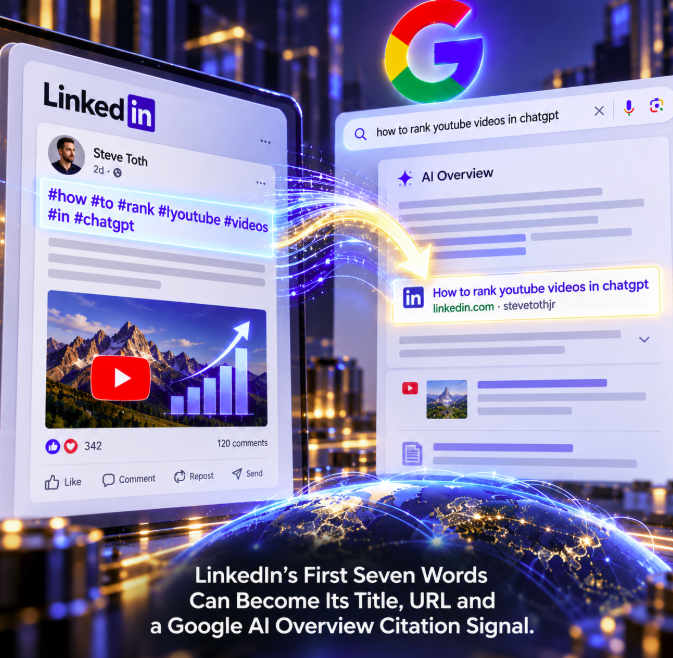
SEO consultant Steve Toth says he studied 60 LinkedIn posts ranking in the top three positions before testing a formatting pattern of his own. He then published a LinkedIn post whose opening hashtags collectively formed the target query how to rank youtube videos in chatgpt. According to Toth’s documented test, LinkedIn used those opening words in the page-level title and permanent URL structure, and within days the post reportedly became the first citation in Google’s AI Overview for that query.
A follow-up test was even faster. Toth says he opened another post directly with the target query, without relying on hashtags, and observed it appearing in Google results roughly 10 minutes after publication. The experiments are intriguing because they suggest the beginning of a LinkedIn post may do more than attract human attention: it can also become machine-readable page metadata that Google can associate with a query.
But the evidence needs tight boundaries. Google has not confirmed the opening words of a LinkedIn post as a ranking or AI Overview citation factor, the tests come from one practitioner rather than a controlled multi-site study, and Toth himself warns that the observed visibility may last only weeks. This is a tactical experiment, not a durable ranking rule.
The experiment started with 60 LinkedIn posts already ranking near the top
Toth did not begin by randomly changing post copy. His methodology started by examining 60 LinkedIn posts that were already ranking in the top three for their respective searches and looking for patterns in how LinkedIn represented those pages to search engines.
The observation behind the test was that the opening portion of a LinkedIn post can influence the page title Google sees and the permanent URL LinkedIn generates. That creates an unusual SEO surface because the same words can potentially operate simultaneously as visible copy, title-like metadata and URL text.
Toth then designed a post around a query he wanted to target rather than merely observing existing rankings. The opening hashtags spelled out the query word by word, effectively placing the target phrase at the earliest and most structurally prominent point of the post.
According to his account, the resulting LinkedIn page was indexed and later surfaced as the first citation in the AI Overview for the target search.
The important mechanism may be LinkedIn’s page construction, not hashtags themselves
It would be easy to interpret the test as evidence that Google rewards hashtags. The experiment does not establish that.
The more interesting hypothesis is that LinkedIn transforms the opening text into signals Google can retrieve easily. If the first words influence the document title and permanent URL, then putting the target query there creates unusually strong lexical alignment across several parts of the page.
In other words, the hashtags may have been a formatting device rather than the causal ranking factor. Toth’s second test, which reportedly began with the query directly rather than as a chain of hashtags, supports that possibility.
What the experiment suggests is therefore narrower: when LinkedIn turns opening words into page-level metadata, query-aligned openings may make the document easier for Google to associate with the same search. It does not prove that hashtags receive special treatment.
A 10-minute appearance shows speed, not necessarily durable authority
The reported second test is notable because Toth says the LinkedIn post appeared in search roughly 10 minutes after publication. That would make LinkedIn useful for fast-moving query opportunities where publishing and discovery speed matter.
But fast indexing or ranking should not be confused with durable performance. Toth warns that the average lifespan he has observed may be measured in weeks rather than months or years.
That distinction changes how the tactic should be evaluated. A conventional evergreen SEO page may be designed to accumulate links, engagement and authority over a long period. A LinkedIn post can behave more like a temporary search asset: fast to publish, potentially fast to surface and potentially fast to decay.
For time-sensitive topics, that may still be valuable. For durable informational queries, it is not a substitute for publishing a strong page on a domain the organization controls.
The tactic only makes sense where Google already wants LinkedIn
The biggest constraint is query eligibility. Toth’s approach is not a reason to publish every target keyword as a LinkedIn post.
The useful opportunity exists when Google is already demonstrating that LinkedIn is an acceptable source type for the query. If the search results contain LinkedIn posts—or Google’s AI features are already citing LinkedIn—then a well-structured post has evidence that it is competing in a source class Google currently retrieves.
If the results are dominated by product pages, government documents, medical institutions or long-form specialist publications, copying the query into the first seven words of a LinkedIn post does not magically change Google’s preferred source type.
The first step is therefore SERP observation, not post formatting.
AI Overview citation and traditional ranking are related but not identical
The experiment becomes more interesting because the final outcome was reportedly an AI Overview citation rather than merely a conventional blue-link ranking.
Research increasingly shows that those two visibility systems overlap imperfectly. A recent large-scale study covered by NetContentSEO found that 29.8% of domains cited by Google AI Overviews were absent from the co-displayed first page of organic results for the same queries.
That means traditional ranking can be useful evidence of retrievability without fully predicting AI Overview source selection. Google’s generative layer can reach beyond the visible page-one set, and being selected as evidence introduces another decision after conventional indexing and retrieval.
Toth’s experiment therefore cannot establish that the opening words directly caused the AI citation. They may have helped Google retrieve or rank the LinkedIn document, after which a separate source-selection process chose it for the AI Overview.
The test does not isolate the causal signal
This is the central methodological limitation. Several things changed together.
The target phrase appeared at the beginning of the post. LinkedIn could then expose that phrase through the page title and URL. The content itself addressed the query. The LinkedIn domain carries its own crawl and authority characteristics. Google may already have been willing to surface LinkedIn for that topic. Freshness may also have mattered.
Because those variables were not independently controlled, the experiment cannot tell us whether the decisive factor was the first seven words, the title, the URL, exact query matching, freshness, LinkedIn’s domain, the post’s content or a combination of them.
That is why “citation signal” is a more defensible description than “ranking factor.” The experiment reveals a reproducible-looking pattern worth testing, not a confirmed component of Google’s algorithm.
LinkedIn is becoming more relevant to AI source discovery
The experiment also lands in a broader shift toward social content as AI evidence. NetContentSEO recently reported Goodie data showing that LinkedIn’s share of pooled social citations rose sharply across several AI engines during 2026.
Goodie’s dataset is proprietary and should not be treated as an official measurement from Google or other AI providers, but the direction is relevant. Social platforms are no longer merely distribution channels downstream of search. Their pages can become sources inside generative answers themselves.
LinkedIn is particularly interesting because individual posts can contain substantive professional explanations attached to identifiable authors. That format gives retrieval systems compact passages that may answer specialized business, marketing and technical questions directly.
If Google can index those posts quickly and associate them strongly with a query, LinkedIn becomes a lightweight publishing surface for testing topical visibility.
The opening line now has two audiences
Social copywriting traditionally treats the first line as a human hook. Its job is to stop scrolling and persuade the reader to expand the post.
Toth’s experiment suggests that the same line may deserve a second interpretation. If LinkedIn reuses opening words in search-facing metadata, the beginning of the post can also function as document labeling for search engines and AI retrieval systems.
That creates a tension. A highly optimized query phrase may be machine-readable but dull for a human feed audience. A clever curiosity hook may perform socially while failing to describe the document precisely enough for query matching.
The practical challenge is to write an opening that does both: clearly state the problem or query while still sounding natural enough to earn attention inside LinkedIn.
Exact-match openings should not become spam templates
Once a tactic like this becomes visible, the obvious risk is industrialization. Marketers can begin producing posts whose first words are mechanically copied from keyword lists, regardless of whether the content genuinely answers the query.
That would misunderstand the experiment. Even if lexical alignment helps retrieval, Google still has to decide whether the page is useful enough to rank or cite. AI Overview source selection also depends on whether the document can support the generated answer.
Keyword-shaped openings without substantive content may produce short-lived indexing artifacts at best and low-quality social publishing at worst.
The stronger application is selective: identify queries for which LinkedIn is already a viable source, publish genuinely useful expert content and make the opening accurately describe the question the post answers.
The permanent URL makes the first draft unusually consequential
The URL component introduces another operational lesson. Social posts are often treated as editable objects, but a permanent slug can preserve the language chosen at publication even after the visible text changes.
If LinkedIn builds that slug from the opening words, then the initial version of the post has lasting search implications. Editing the first paragraph later may not recreate the same URL structure.
That makes pre-publication planning more important than it appears. The query or topic phrase should be decided before the post goes live rather than retrofitted after indexing.
Again, that does not mean the URL text itself caused the observed ranking. It means the first words can propagate into persistent document features, which makes them strategically different from ordinary disposable social copy.
This is better understood as rapid query testing than permanent SEO
The most compelling use case may be experimentation. LinkedIn allows an expert to publish quickly, observe whether Google indexes and retrieves the content and test whether a topic has citation potential before investing in a larger asset.
A successful social post could reveal that Google is receptive to a particular angle, terminology or source format. The publisher can then develop the subject more deeply on an owned website, where the content can be updated, internally linked, measured and retained indefinitely.
A failed post is also informative. If Google is not surfacing LinkedIn for the query class, repeated exact-match openings are unlikely to solve the source-type mismatch.
Used this way, LinkedIn becomes a fast diagnostic surface rather than a replacement for a durable content strategy.
The bigger lesson is that AI citation optimization begins before the citation layer
Marketers often focus on the final visible event: an AI Overview cites a page. Toth’s experiment points further upstream.
Before Google can cite a LinkedIn post, it has to discover the document, interpret what it is about, retrieve it for a relevant query and decide that it can support the generated answer. The first words may matter because LinkedIn propagates them into structures that help with those earlier stages.
That makes the experiment less about a secret AI Overview trick and more about document clarity. A page whose title, URL, opening language and substantive content all describe the same question gives retrieval systems a coherent representation of its purpose.
Whether seven words are enough to create that advantage consistently remains unproven.
A useful experiment, not a Google rule
The evidence so far supports a narrow conclusion. Steve Toth documented cases in which query-aligned openings on LinkedIn were followed by extremely fast Google visibility and, in one test, a prominent AI Overview citation. His prior review of 60 top-ranking LinkedIn posts gives the experiment more context than a random anecdote.
It still does not establish that Google uses “the first seven words” as a specific ranking signal, nor that copying a query into a LinkedIn opening will reliably produce an AI citation. Google has not confirmed the mechanism, the sample is limited and the visibility itself may be temporary.
For SEO and GEO teams, the test is worth reproducing carefully where LinkedIn already appears in the search ecosystem. Check the source mix first, write the opening before publication, document the resulting title and URL, track conventional ranking and AI citations separately, and measure how long visibility survives.
The most valuable discovery may ultimately be less sensational than a new ranking factor: on LinkedIn, the first words of a post can become part of the document Google sees. In an AI search environment increasingly willing to cite social sources, that makes the opening line a piece of search architecture as well as copywriting.