
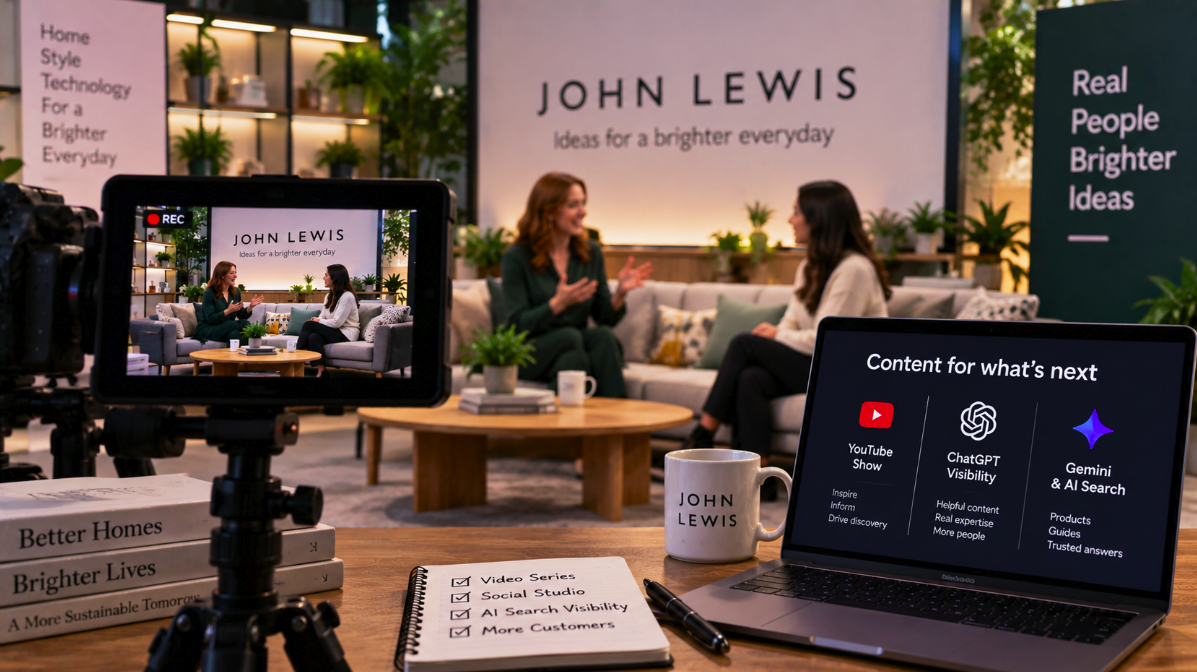
John Lewis is making an unusually explicit bet on generative search: the British department-store chain is launching a YouTube talk show and building an in-house social media studio partly because it wants more of its products and expertise to surface when consumers ask ChatGPT, Gemini and other AI systems what to buy.
The strategy was detailed by The Guardian on September 3. John Lewis’s new YouTube “vodcast,” called Gift List, will be hosted by television presenter Angela Scanlon and feature celebrity guests discussing memorable gifts and the stories behind them. Six episodes are planned in the run-up to Christmas, with Louis Theroux among the guests.
On its own, that could look like another retailer moving marketing budgets toward creator-style video. What makes the project more significant is the reason John Lewis gives for doing it. The company says richer video and social content should help increase its visibility inside large language models and AI-powered search, at a time when a rapidly growing share of its customers are using those systems to research products.
Outgoing John Lewis managing director Peter Ruis told The Guardian that the proportion of customers using LLMs for product search has risen from 0.3% to 2.5% in a year. That is still a small minority of shoppers, but it represents more than an eightfold increase in twelve months.
John Lewis is treating AI discovery as a content-distribution problem
Retailers have spent decades optimizing product pages for Google, buying paid search ads and building social campaigns around platforms where consumers discover products. John Lewis’s new strategy suggests another distribution layer is becoming important enough to influence the content it produces in the first place.
The retailer is not merely asking how to make its existing ecommerce pages easier for AI systems to crawl. It is creating new media formats designed to generate more discussion, recommendations and contextual material around its brand and product categories.
According to The Guardian, Ruis said AI models are looking for real-time content and advice from other people, which is one reason John Lewis believes the YouTube show and social studio can improve its presence in AI-generated results.
That should be understood as John Lewis’s marketing thesis rather than a documented ranking formula for ChatGPT or Gemini. Neither OpenAI nor Google has published a rule saying that producing a YouTube chat show will cause a retailer to rank more prominently in AI answers. Different AI products also retrieve and cite information in different ways.
But the underlying strategy is notable: John Lewis believes a broader footprint of useful, current, third-party-style media can make the brand more discoverable in an environment where consumers increasingly ask AI systems for recommendations instead of starting with a conventional search query.
The Gift List is designed to behave like media, not an advertisement
The choice of format is important. Gift List is not described as a sequence of traditional product commercials. It is a conversational program built around recognizable personalities and personal stories about gift giving.
That gives John Lewis opportunities to create content around the kinds of natural-language concepts that consumers might use in AI-assisted shopping: meaningful presents, gifts for particular personalities, ideas for different relationships, seasonal occasions and the reasons people choose one product over another.
A conventional category page may contain product names, prices and specifications. A long-form conversation can contain motivations, comparisons, preferences and cultural context. Those are different information assets.
The retailer has a precedent inside its own group. The Guardian reports that the strategy follows the success of Waitrose’s Dish podcast, which features celebrity conversations around food and has helped the supermarket build an audience beyond ordinary retail advertising.
The social studio turns content production into infrastructure
John Lewis is also creating a dedicated social media studio. That detail may ultimately matter more than the first six episodes of one YouTube series.
A permanent studio suggests the retailer wants a repeatable system for producing timely video and social content rather than treating AI visibility as a one-off campaign. If product discovery continues shifting toward conversational systems, brands may need a constant stream of material that explains products, demonstrates expertise and gives external platforms more context about what the brand is associated with.
This resembles the evolution that occurred with search marketing. Early SEO could be treated as a technical project. Over time, organizations discovered that sustained search visibility required editorial processes, content teams, analytics and ongoing optimization.
AI discovery may be moving toward the same organizational stage. The question becomes not “What page should we optimize for ChatGPT?” but “What information ecosystem are we creating around the brand?”
The 0.3% to 2.5% shift explains why a small channel can command attention
At 2.5%, LLM-assisted product search is nowhere near a majority behavior among John Lewis customers. The more strategically important number is the rate of change.
Moving from 0.3% to 2.5% in one year is an increase of roughly 733%. A channel can remain small in absolute terms while growing quickly enough that a retailer does not want to wait until it becomes mainstream before learning how to operate there.
That is especially true in retail, where early discovery can shape the entire purchase journey. If a consumer asks an AI assistant for the best cookware set, Christmas gift, television, sofa or skincare product, the brands introduced in that first answer can define the shortlist before the shopper reaches a retailer’s website.
For John Lewis, visibility inside that recommendation layer may therefore matter even when the AI assistant does not generate an immediate referral click.
This is a different goal from traditional SEO traffic
Search optimization has traditionally been measured through rankings, impressions, clicks and conversions. AI visibility introduces outcomes that are harder to quantify.
A consumer might ask ChatGPT for gift ideas, see John Lewis mentioned, and later navigate directly to the retailer’s app or website. Another user might see a recommendation in Gemini and complete the purchase in a physical store. The AI interaction influences demand without necessarily appearing as a clean referral in web analytics.
That means retailers pursuing AI visibility need to measure more than traffic from chatbot links. Brand mentions, citation frequency, product inclusion, recommendation position, sentiment and eventual branded search behavior can all become relevant indicators.
John Lewis’s initiative is particularly interesting because it starts from observed customer behavior rather than from a purely SEO-led theory. The company says more of its own shoppers are using LLMs for product research, so it is changing its content strategy in response.
YouTube gives brands a second layer of searchable expertise
Video can do something ecommerce pages often struggle to achieve: demonstrate how products fit into real lives. A conversation about why someone chose a particular gift can expose attributes that are difficult to express through a standard product description.
For AI systems capable of retrieving web and multimedia information, that can create additional signals around a brand’s expertise and relevance. Video titles, descriptions, transcripts, captions, surrounding articles and social discussion all expand the textual footprint associated with the content.
That does not mean YouTube is a guaranteed shortcut into AI answers. It means a well-distributed video series can create multiple discoverable representations of ideas that previously existed only inside a retailer’s commercial pages.
The strategy also makes sense independently of AI. YouTube is a major discovery platform in its own right, and successful episodes can generate direct audience reach, social clips and brand familiarity. AI visibility becomes an additional potential return rather than the only justification for the content.
Retailers may need to optimize for recommendations, not just products
Product pages are built around individual items. Consumers often ask AI systems broader questions: what should I buy, which option is better, what is suitable for this person, what fits this budget, or what are the alternatives?
Those queries reward information that connects products to situations and decisions. Retailers that publish only transactional catalog data may therefore leave a gap between what they sell and the questions consumers ask before deciding what to buy.
A show such as Gift List naturally generates recommendation-oriented language. Guests explain preferences, stories and emotional reasons behind purchases. A social studio can then turn those themes into shorter content around trends, products and occasions.
From an AI-search perspective, the opportunity is not simply to mention John Lewis more often. It is to associate the brand with richer answers to consumer questions.
The strategy also increases the importance of third-party credibility
Brands cannot control every source an AI system uses. In fact, recommendation systems may benefit from drawing on sources that are independent of the seller: reviews, publishers, creators, forums and expert commentary.
John Lewis’s celebrity-led program occupies an interesting middle ground. It is brand-produced media, but its conversational format brings outside voices into the content. That can make it more engaging and culturally relevant than a conventional corporate product video, even though the retailer still controls the production.
For marketers, this highlights a broader distinction between creating more brand claims and creating more useful evidence around a brand. AI visibility strategies that simply repeat promotional copy across channels may add little informational value. Content that answers genuine questions, demonstrates products or introduces credible perspectives has a stronger reason to exist for human audiences first.
AI optimization is starting to shape real marketing budgets
The most important part of the John Lewis story may be that AI search is no longer being discussed only by SEO teams and software vendors. A major retailer is connecting it to a television-presenter-led YouTube production and a dedicated social studio.
That means generative discovery is beginning to influence actual content budgets, staffing and media formats.
The shift resembles the early expansion of social media marketing. Brands initially experimented with individual posts and accounts. As audiences grew, they built social teams, studios, creator partnerships and measurement frameworks. AI search may now be creating a similar pressure to institutionalize content production around a new discovery environment.
The difference is that brands do not publish directly “into” most AI answers. They publish across the open web and other platforms, then hope AI systems retrieve, understand and select that material when responding to users.
There is no single AI ranking to optimize
John Lewis names ChatGPT and Gemini, but those products do not operate as one unified search engine. They can use different models, retrieval systems, sources and citation behaviors. The same brand can be prominent in one answer engine and absent from another.
That makes a broad content strategy more defensible than attempting to reverse-engineer one narrow prompt or citation pattern. Useful videos, transcripts, product expertise, social discussion and authoritative web pages can create multiple discovery paths even when the engines themselves change.
Retailers should still be cautious about vendors promising deterministic “LLM rankings.” The John Lewis initiative is better understood as increasing the amount and variety of credible information available about the brand, then measuring whether that broader presence correlates with stronger AI visibility.
The company is betting before AI product search becomes mainstream
John Lewis is making this move while only 2.5% of its customers reportedly use LLMs for product search. That makes the initiative less a reaction to a dominant channel than a bet on where consumer behavior is heading.
The risk is obvious: the retailer could invest heavily in formats that have little measurable effect on AI recommendations. Models, retrieval systems and consumer habits can change quickly, and no company controls how ChatGPT or Gemini will rank sources a year from now.
But waiting carries its own risk. If conversational product discovery continues growing at anything close to the rate John Lewis has observed, brands that start building expertise, content libraries and measurement practices now will have more data and experience when the channel becomes commercially larger.
John Lewis is turning GEO into a media strategy
Generative engine optimization is often discussed as a technical extension of SEO: structure pages better, make entities clear, publish statistics and earn citations. John Lewis is taking a broader approach. Its answer to AI search is to produce a show.
That is a useful signal for marketers. If AI systems increasingly mediate product discovery, optimizing for them may involve public relations, creator content, video, social media, product data and editorial expertise as much as conventional on-page optimization.
The retailer’s experiment does not prove that a YouTube vodcast will cause ChatGPT or Gemini to recommend John Lewis more often. The company will need to measure that outcome over time.
But its reasoning is unusually clear. Customer behavior is moving toward LLM-assisted product research, rising from 0.3% to 2.5% in a year, and John Lewis wants more high-quality material available wherever those systems look for context. Instead of waiting for AI search to become a major retail channel, it is building the content operation now.
That may be the larger shift behind Gift List: brands are beginning to produce media not only for people and social algorithms, but for the AI systems increasingly standing between consumers and their next purchase.