

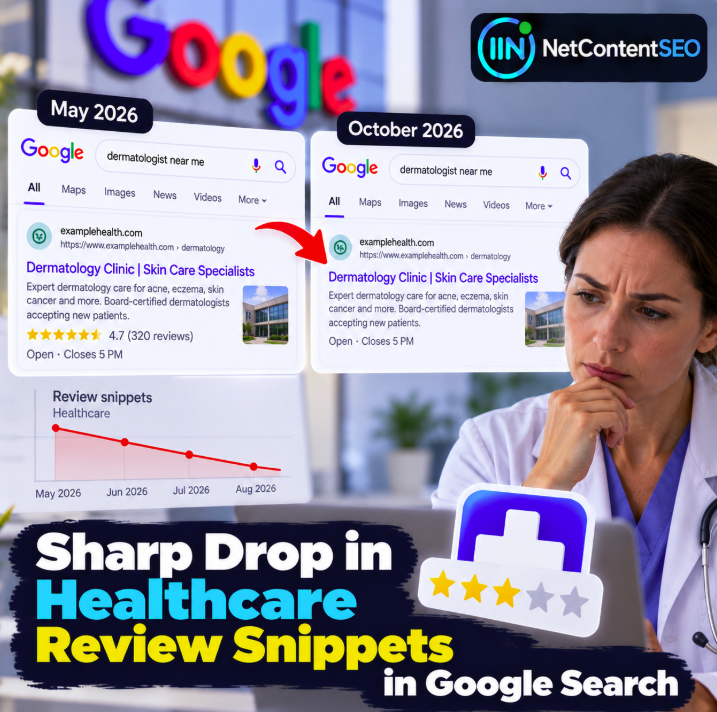
October 8, 2026. A report highlighted by Search Engine Roundtable on October 7 describes a substantial decline in review-star snippets for healthcare websites. Schema App observed reduced visibility among healthcare clients beginning in late May, followed by another contraction in August. Google has not officially announced the removal of review rich results for the healthcare sector.
What Schema App observed
The reported pattern spans multiple healthcare sites, making it worth investigating beyond a single implementation. The observations are still a vendor dataset rather than a published Google policy change or a comprehensive measurement of all healthcare results.
Why schema adjustments did not restore stars
According to the report, tests involving aggregateRating, property paths and multi-typing did not bring back the missing snippets. That weakens the explanation that one simple markup adjustment caused the decline. It does not conclusively establish a new industry-wide restriction, because Google can choose not to show eligible rich results even when structured data is valid.
Eligibility is not a display guarantee
Structured data helps search engines understand eligible content, but the presence of valid review markup never guarantees visible stars. Site owners must also respect Google's review snippet guidelines, including rules for eligible item types and self-serving reviews. Healthcare publishers should avoid adding unrelated types or misleading ratings solely to trigger a rich result.
Technical issue or unannounced vertical restriction?
At least three hypotheses deserve testing: a change in Google's rich-result display systems for particular healthcare queries, a shift in eligibility or enforcement, or changes in SERP composition and user intent. The available observations do not identify which explanation is correct. Google's lack of an announcement should not be treated as confirmation of a hidden policy.
How healthcare SEO teams should investigate
- Record the affected URLs, query groups, countries and devices, comparing periods before late May, after late May and after August.
- Check structured data with Google's Rich Results Test and inspect Search Console enhancement reports where available.
- Confirm that ratings are visible, accurate and associated with eligible entities rather than relying on schema alone.
- Track review-star appearance in actual SERPs separately from organic ranking and click-through rate.
- Compare healthcare results with suitable non-healthcare controls before attributing changes to a vertical restriction.
- Preserve dated evidence and monitor official Google documentation for policy changes.
What it means for CTR and healthcare search visibility
Review stars can affect how a result appears, but the report does not establish a universal CTR loss or a ranking penalty. Teams should measure their own performance rather than equating the disappearance of a visual enhancement with lost rankings.
The NetContentSEO takeaway
The most important question is not which schema trick restores stars. It is whether Google is changing how healthcare review information is displayed and whether that change is consistent across sites and queries. Until Google clarifies the situation, evidence-based monitoring is more useful than speculative markup workarounds.