
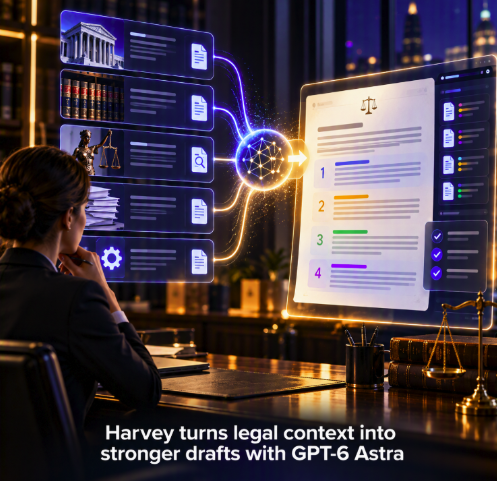
Harvey is using GPT-6 Astra to push legal AI drafting beyond the blank-prompt model. In an OpenAI customer story published September 23, 2026, the legal AI company says Astra can take more of the material surrounding a legal matter into account and produce more structured documents from it. The emphasis is not simply on generating more fluent legal prose. It is on making the draft reflect the records, research and lawyer-specific instructions that determine what the document should actually say.
Harvey serves law firms and in-house legal teams across workflows ranging from litigation to mergers. OpenAI says its customers use the platform to turn large amounts of information into complex legal documents, and Harvey reports substantial improvements in document formatting and context awareness when using GPT-6 Astra compared with other models. The result, according to the companies, is more complete output that better reflects the material supplied to the system.
The legal drafting problem is increasingly a context problem
A legal memorandum is rarely produced from one question and general legal knowledge. The relevant context can include court information, internal law-firm documents, case-law research and other matter-specific sources. OpenAI says Harvey uses GPT-6 Astra to analyze, synthesize and draft from this collection of material.
That changes the role of the model. Instead of being asked to invent a polished document from a short instruction, it is being positioned as a synthesis layer over an existing evidence environment. The quality of the output therefore depends not only on the model's general reasoning ability but on whether it can identify which parts of a large context actually matter to the legal task.
OpenAI describes this as one of Astra's broader professional-work improvements. The company says the model is trained to pull relevant context into outputs without unnecessarily repeating everything available to it, while producing documents that better follow existing templates and writing styles.
Harvey says Astra produces more complete, better-formatted documents
Harvey cofounder and president Gabe Pereyra summarizes the improvement as the ability to provide more context to the model and receive increasingly well-structured output. OpenAI's case study says Harvey has observed substantial gains in formatting and context awareness, allowing customers to obtain documents that more completely reflect the underlying material.
The claim is significant, but its evidentiary limits matter. OpenAI's page does not publish a Harvey benchmark, error rate, productivity percentage or controlled comparison showing exactly how much better Astra performs on these legal drafting tasks. The improvement is reported by Harvey and OpenAI rather than established through an independent legal evaluation. It should therefore be understood as an early customer deployment result, not a universal quantitative performance claim.
The memory panel brings individual lawyer preferences into the draft
One of the more concrete details in the case study is Harvey's memory panel. A lawyer can encode preferences such as using numbered lists, prioritizing EDGAR as a source or color-coding issues according to priority. Those preferences appear alongside the source material and draft memorandum.
This illustrates a broader shift in professional AI systems. Personalization is moving beyond tone instructions such as “make this concise.” The model can be given persistent procedural preferences about source hierarchy, document structure and issue presentation. In legal work, those choices can materially affect whether an output fits the lawyer's established workflow.
The memory layer also reduces the need to restate routine drafting preferences in every prompt. The user can spend more attention on matter-specific judgment while the system preserves recurring conventions around how work should be organized.
Astra is designed to distinguish records from assumptions
Harvey's assessment of GPT-6 Astra extends beyond formatting. In OpenAI's broader Astra launch material, Harvey Head of Applied Research Niko Grupen says the model showed a significant improvement over GPT-5.6 Sol on complex legal tasks. He specifically points to Astra's ability to distinguish documents from established records, identify unsupported assumptions and turn information gaps into concrete drafting positions.
That distinction is especially important in legal drafting because fluent completion can be dangerous when the source material is incomplete. A system that silently fills a missing fact with a plausible assumption may produce a document that reads well but misstates the record. A model that surfaces the gap instead gives the lawyer something actionable to resolve.
This does not mean Astra eliminates hallucinations or makes unsupervised legal drafting reliable in every setting. Neither OpenAI nor Harvey makes that claim in the customer story. The relevant reported improvement is narrower: Harvey's early testing found the model better at reasoning about the relationship between supplied documents, established facts and missing information.
Long context is useful only if the model can discriminate within it
GPT-6 Astra's API specification lists a 1.05-million-token context window and a maximum output of 128,000 tokens. OpenAI positions the model for complex reasoning, research, document creation and other end-to-end professional work.
For legal applications, the size of that context window is only part of the story. Loading more documents into a prompt does not automatically improve the answer. A model also has to separate relevant from irrelevant material, preserve the hierarchy between sources and keep track of constraints while drafting.
The Harvey example is therefore better understood as context engineering rather than simply “more tokens.” The product supplies matter information and lawyer preferences; Astra is expected to synthesize the relevant pieces into a structured artifact.
Enterprise AI is moving from generic intelligence to institutional context
This pattern extends beyond Harvey. The competitive advantage of an enterprise AI application increasingly comes from combining a capable general model with the private information, workflows and standards that make an organization distinctive.
For legal teams, that can mean matter records, firm documents, research and individual drafting conventions. Other legal products are pursuing a related architecture through retrieval. NetContentSEO recently examined ChatGPT's GC AI integration, which retrieves from private contracts, playbooks and legal workspaces while linking conclusions back to source clauses. The implementations differ, but the direction is similar: generic model knowledge becomes more useful when it is grounded in the organization's own authoritative context.
Structured output can move AI closer to the actual deliverable
Early generative AI adoption often treated the model as an assistant that produced raw text for a professional to reshape. OpenAI is positioning Astra differently. Its launch materials emphasize the creation of polished documents, spreadsheets and presentations that follow templates, structure and business standards.
Harvey's use case shows why that matters. Lawyers do not merely need an answer to a legal question; they often need a memorandum, argument or other document that fits a professional format and can be reviewed as part of an existing workflow. Better formatting therefore has practical value when it reduces the amount of mechanical restructuring required before substantive review begins.
The highest-value automation may consequently be less about replacing the lawyer's reasoning and more about moving the machine-generated output closer to the form in which legal reasoning is actually consumed.
The human role shifts toward consequential judgment
OpenAI says the additional context processing lets Harvey customers focus more of their time on strategy.
That claim describes the intended division of labor rather than a measured reduction in lawyer hours. The case study does not provide time-saved data. Still, the workflow makes the allocation visible: AI handles more synthesis, organization and document construction, while the lawyer remains responsible for decisions where the consequence of an assumption, argument or source interpretation matters.
Astra's general design reinforces that model of collaboration. OpenAI says the system uses context to fill routine gaps but asks focused questions when missing information could change the outcome. It is also designed to preserve the broader task when users steer or modify requirements during a workflow.
Legal AI increasingly depends on provenance, not just prose quality
The Harvey case also illustrates a more general requirement for professional AI: the answer has to remain connected to the information that justified it. A beautifully drafted memorandum is not enough if a lawyer cannot determine whether an important statement came from case law, a firm document, a court record or an unsupported inference.
Harvey's reported emphasis on distinguishing documents from established records and surfacing unsupported assumptions is therefore more consequential than a simple improvement in writing style. It moves the system toward explicit evidence handling.
This is closely related to the retrieval architecture seen elsewhere in legal AI, where source clauses and internal standards are kept accessible alongside generated conclusions. The model's value grows when generation remains inspectable rather than becoming a black box between a pile of documents and a polished memo.
Harvey offers a concrete example of Astra's professional-work thesis
OpenAI launched GPT-6 Astra in September as its most capable model for complex end-to-end work, highlighting advances in computer use, browsing, software engineering and professional workflows. The company says Astra is particularly strong at producing structured artifacts and using relevant context without indiscriminately repeating it.
NetContentSEO has already covered the broader Astra launch and its unusually consequential cybersecurity capabilities in its analysis of OpenAI's GPT-6 Astra release. Harvey provides a narrower view of the same model: what the professional-work improvements look like when applied to a domain where source hierarchy, unsupported assumptions and document structure matter every day.
The competitive layer is becoming context orchestration
The Harvey story is ultimately less about an AI model learning to write legal language and more about an application learning to assemble the right conditions for a useful legal draft. The general-purpose model supplies reasoning and generation. Harvey supplies matter context, source material, workflow and lawyer preferences. The professional reviews the result and makes the consequential decisions.
That architecture is likely to matter across enterprise AI. As frontier models become broadly available through APIs, access to the same underlying intelligence becomes less differentiating. The product advantage shifts toward how effectively an application selects private context, preserves provenance, captures user preferences and converts model output into the artifact the professional actually needs.
Harvey's early Astra deployment is one example of that transition. OpenAI and Harvey report stronger structure and context awareness, but they do not publish enough quantitative evidence to turn the customer story into a universal productivity benchmark. What the source does establish is a clear design direction: legal AI is moving from generating plausible drafts toward building documents from the specific records, research and working preferences that make a legal matter unique.