

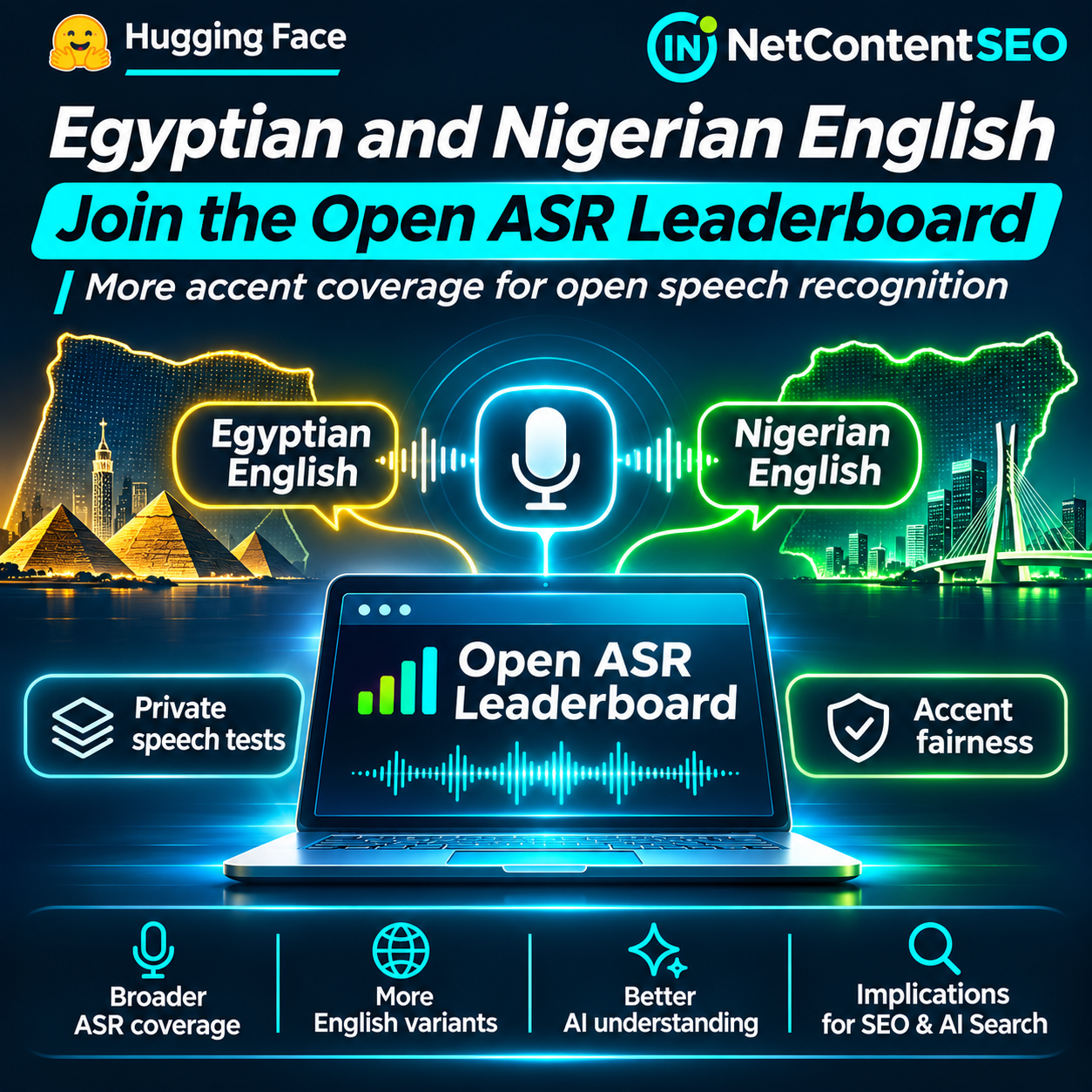
November 9, 2026. Hugging Face has expanded its Open ASR Leaderboard with two private datasets covering conversational English spoken with Egyptian and Nigerian accents. Announced on November 6 in collaboration with Liva AI, the update makes accent-level performance more visible when evaluating automatic speech recognition (ASR) systems.
The change is modest in the amount of audio added but important in what it measures. A speech recognizer that performs well on a familiar US English benchmark may still struggle with spontaneous conversations, unfamiliar names or pronunciation patterns encountered by users in Egypt or Nigeria. Adding held-out test data provides another way to identify such gaps without making the test recordings available for repeated model-specific tuning.
This is an evaluation update, not the release of a new speech model. Hugging Face has not claimed that all participating ASR systems have suddenly become more accurate, or that a new ranking factor has appeared in Google Search or AI search engines. The immediate benefit is better evidence for comparing models.
What Hugging Face and Liva AI added
According to the official announcement, the two new private datasets are:
| Dataset | Accent | Duration | Speech style |
|---|---|---|---|
| Liva AI Conversational EG | Egyptian English | 1.34 hours | Spontaneous conversation |
| Liva AI Conversational NG | Nigerian English | 1.55 hours | Spontaneous conversation |
Both datasets use transcripts that retain capitalization, punctuation and disfluencies such as hesitations or false starts. Together they add 2.89 hours of conversational audio. That is enough to introduce additional accent-specific test slices, but not enough to represent the full diversity of English speakers in either country.
Liva AI describes its approach as collecting multimodal interaction data through consumer products used by real people. This differs from relying exclusively on scripted reading tasks, although the announcement does not provide all demographic, recording or sampling details needed to assess representativeness.
Why private evaluation data matters
Public benchmark datasets are useful because researchers can inspect examples, reproduce tests and identify mistakes. But once a benchmark becomes widely known, model developers may tune systems to perform well on those exact recordings. The result can be a score that looks impressive without reliably predicting performance on new speech.
Private datasets introduce a complementary test. Developers can see comparable evaluation results without receiving the underlying audio, making it harder to optimize directly against the test samples. Hugging Face explicitly describes this as part of its effort to reduce benchmark overfitting, sometimes called “benchmaxxing.”
Private data does not guarantee independence, eliminate every form of contamination or prove real-world generalization. It does provide an additional check against performance claims based solely on familiar public benchmarks.
The Liva collaboration builds on earlier private contributions: 11 splits from Appen and DataOceanAI spanning scripted and conversational speech across five accents, followed by an Indian-accented English split from Voice Arena. The new Egyptian and Nigerian additions broaden that private evaluation pool.
New accent comparisons in the Private tab
Hugging Face has also introduced richer groupings in the leaderboard's Private tab. One compares US-accented English with non-US accents from the UK, Australia, Canada, India, Nigeria and Egypt. Another uses Braj Kachru's Three Circles of English framework to compare the Inner Circle—US, UK, Australia and Canada—with a combined Outer and Expanding Circles group covering India, Nigeria and Egypt.
The distinction is sociolinguistic, not a claim that all speakers in a country sound alike. In Kachru's framework, Nigeria and India fall within the Outer Circle, where English has an institutionalized second-language role, while Egypt is classified in the Expanding Circle. Hugging Face says it plans to separate those two groups when more accents are represented.
The leaderboard's published code describes the grouped values as macro-averages across relevant dataset scores. That means the number of samples and the mix of test splits matter when interpreting a summary. A single group average should not be treated as a universal measure of fairness or performance for every speaker.
What is Word Error Rate—and what can it miss?
The Open ASR Leaderboard uses Word Error Rate (WER) as a principal accuracy metric. WER compares a system's transcription with a reference transcript by counting substitutions, deletions and insertions relative to the number of reference words. Lower values indicate fewer word-level errors under the evaluation's normalization rules.
WER is useful but incomplete. A system could transcribe most of a sentence correctly and still mishear the name of a company, the number in a price or a location needed to complete a task. Those mistakes can have outsized effects in customer support, voice commerce or local discovery.
Transcript formatting also matters. If reference data preserves hesitations while an application automatically removes them, the measured error rate may reflect normalization differences as well as recognition quality. Teams should document how they handle punctuation, capitalization, numbers and disfluencies before comparing providers.
Why Egyptian and Nigerian English matter for AI discovery
Speech interfaces increasingly sit at the beginning of information journeys. Users ask assistants for directions, businesses, services, product comparisons and explanations. The first step in many such systems is converting speech into text. If the transcript is wrong, downstream retrieval or reasoning may be working with the wrong question.
Consider a customer asking a voice assistant for a nearby clinic, a specific bank branch or a local product. Misrecognizing the place name or organization can lead the assistant to retrieve irrelevant results. That is a plausible failure mode in voice-driven discovery, not a performance result demonstrated by the new Hugging Face datasets.
For companies serving African and Middle Eastern markets, the practical implication is to test recognition on the speech patterns of their actual users instead of relying on a global leaderboard score dominated by other accents. Nigerian English and Egyptian English are themselves diverse; region, background, recording conditions and code-switching may all affect recognition.
What changes for SEO and GEO?
The connection to SEO and generative engine optimization is indirect but meaningful. Traditional SEO measures whether a page can be crawled, indexed and ranked for a query. Voice-enabled AI applications add another potential failure point before retrieval begins: did the system understand what the user actually said?
If a spoken request is transcribed incorrectly, a business may never enter the retrieval process even when its website is accurate and technically accessible. Conversely, improving recognition can help a voice application understand the intended query, but it does not guarantee that the business will be recommended, cited or visited.
There is no evidence in this announcement that Hugging Face's benchmark changes Google's ranking systems, ChatGPT's source selection or any public AI search citation algorithm. The leaderboard evaluates speech recognition models. The impact on a particular search or agent experience depends on whether that application uses the evaluated model, how it handles transcripts and which information sources it retrieves.
A practical evaluation plan for voice search and agent teams
- Define the real task: identify whether the application needs verbatim transcription, captions, customer support, local search, booking or voice commands.
- Collect representative, consented audio: include the accents, devices, environments and interaction styles users actually bring to the product. Avoid treating national labels as uniform acoustic categories.
- Compare candidates on the same test set: use consistent normalization rules and retain a separate holdout for final validation.
- Measure critical terms: track names, addresses, product identifiers, numbers, dates and other entities whose misrecognition can change an outcome.
- Test the full workflow: evaluate whether the assistant retrieves the right information and completes authorized tasks, not only whether the transcript has a low WER.
- Review performance by subgroup: examine errors across accent and recording conditions, and report uncertainty where sample sizes are small.
- Check operational constraints: assess latency, streaming behavior, privacy, language coverage, deployment options and cost.
For publishers and brands, the equivalent exercise is to test realistic spoken questions that mention their business, products or services. Compare the recognized transcript with the user's intended wording, then investigate retrieval and recommendation behavior separately. That distinction helps avoid blaming content visibility for an upstream speech recognition error.
What this announcement does not prove
The two datasets do not establish that one ASR provider is best for every Nigerian or Egyptian speaker. They do not show that all voice assistants have improved, and they do not prove that better transcription automatically increases search traffic. They also do not provide a new universal performance ranking that can be applied to all industries and recording conditions.
Any vendor claiming superiority should identify the exact leaderboard version, evaluated model, test splits, metric, normalization method and date. Results from a private conversational English test should not be generalized to medical dictation, noisy call centers or other languages without additional evidence.
Frequently asked questions
What changed in the Open ASR Leaderboard?
On November 6, 2026, Hugging Face announced two new private conversational English evaluation splits, covering Egyptian and Nigerian accents, supplied through a collaboration with Liva AI.
How much audio was added?
The Egyptian English split contains 1.34 hours and the Nigerian English split contains 1.55 hours, for a combined 2.89 hours.
Are these datasets public?
No. They are private evaluation datasets. The purpose is to provide comparable results while limiting direct tuning to the held-out test audio.
Does this mean speech recognition models now support more languages?
Not necessarily. The update adds accent-specific English evaluation data, not a new model or a promise of additional language support across existing products.
What is the difference between accent coverage and language coverage?
Language coverage refers to the languages a model can process. Accent coverage concerns variation in how a language is spoken. The new tests examine English speech with Egyptian and Nigerian accents.
Does a better WER guarantee better voice search?
No. Word Error Rate measures transcription differences, while successful voice search also depends on recognizing important entities, retrieving relevant information and completing the user's task.
Does this update affect Google Search rankings or AI citations?
No direct change has been announced. The implications for SEO and GEO concern how speech recognition errors may influence the queries passed to voice-enabled search and agent systems.
Where can developers view the results?
Visit the Open ASR Leaderboard and examine its Private data tab and methodology.
The bigger picture: measuring AI performance beyond standard English
The most important part of this release is not a new headline model score. It is the recognition that a single aggregate can hide meaningful differences in how speech technology serves users. Private, accent-specific datasets make some of those differences easier to investigate, while also reducing incentives to optimize exclusively for public tests.
For SEO and AI discovery, that points toward a broader principle: the quality of an AI answer depends on the full chain from user input to retrieved evidence to final response. When the input is spoken, understanding the user's words and names is part of making information discoverable. Better benchmarks help teams test that first link—but only real-world evaluation can show whether the entire experience works.