

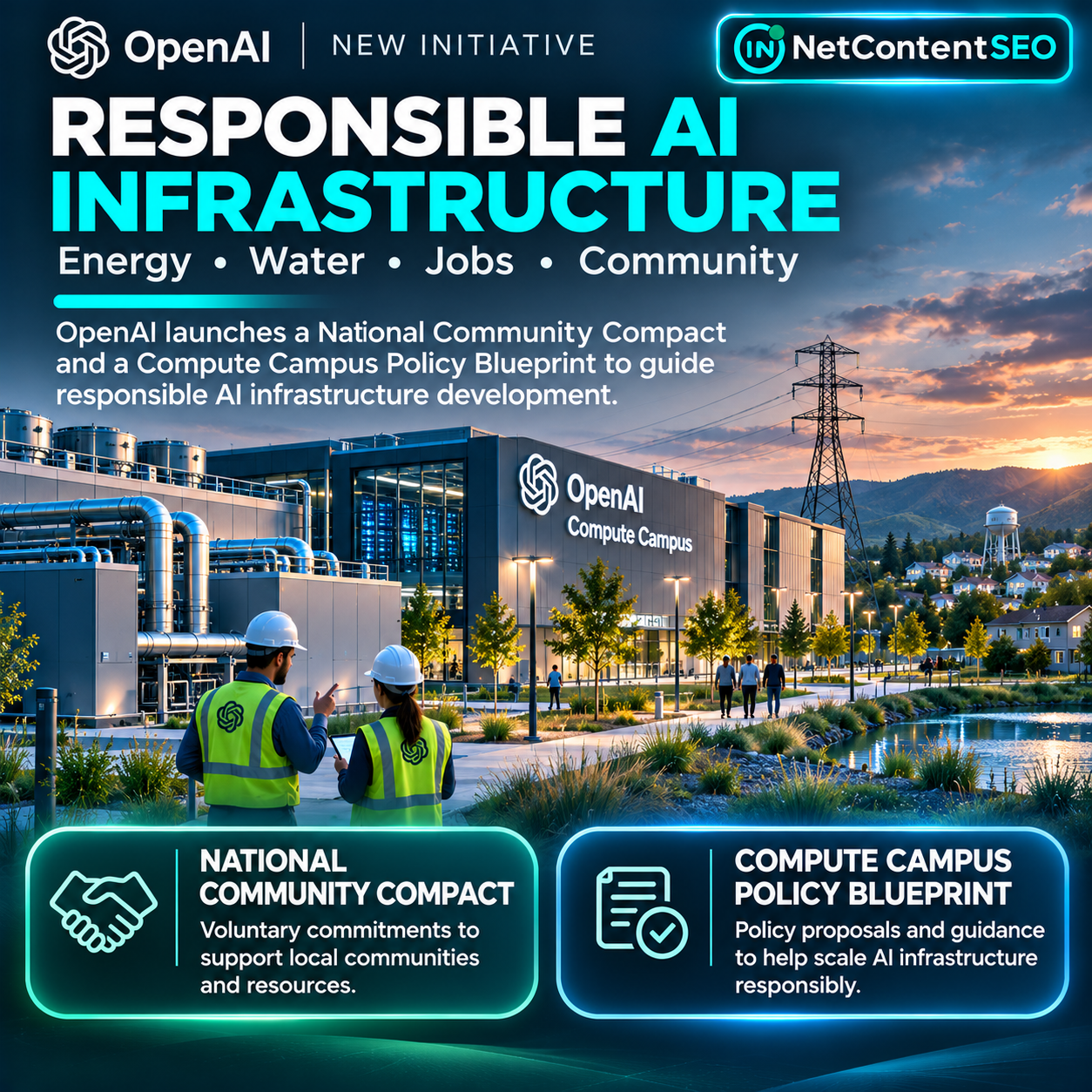

November 5, 2026. OpenAI has published two documents intended to change how large AI computing facilities are developed in the United States: a National Community Compact setting out voluntary commitments for future compute campuses it owns and operates, and a Compute Campus Policy Blueprint urging federal, state and local governments to establish broader rules for infrastructure developers.
The announcement addresses a practical constraint on the AI industry: models cannot scale without electricity, cooling, transmission capacity, construction and community acceptance. But the two documents have different legal status. The compact is a company commitment with a defined scope; the blueprint is a policy proposal, not enacted law. Neither document proves that future campuses will meet all the stated outcomes.
What OpenAI announced
In its November 5 announcement, OpenAI says every future compute campus it both owns and operates will have a locally tailored compact. Residents should be consulted early enough to affect plans, have a point of contact throughout the campus's life, and receive annual public reporting on progress.
The national framework covers paying the full costs of electricity and supporting infrastructure, protecting local resources, reporting water and power consumption, publishing construction plans and independent noise studies, and creating opportunities for local workers and suppliers. The accompanying policy blueprint asks lawmakers and regulators to extend comparable protections across the industry.
Community Compact vs Policy Blueprint: the essential distinction
| Question | National Community Compact | Compute Campus Policy Blueprint |
|---|---|---|
| Who is responsible? | OpenAI at future campuses it owns and operates | Policymakers and regulators would have to adopt proposed rules |
| Legal status on announcement day | Voluntary company commitments | Recommendations, not legislation |
| Community participation | Early engagement and local contact | Broader transparency and accountability expectations |
| Energy costs | OpenAI pledges to cover its own electricity and infrastructure costs | Large-load tariffs and protection against stranded costs |
| Environmental information | Site-level water and electricity disclosure and noise studies | Public reporting standards for developers |
| Local economic benefits | Hiring forecasts, training and community-selected investments | Transparent incentives, local procurement and workforce preparation |
Importantly, a partner-operated data center, leased capacity or third-party infrastructure project should not automatically be assumed to fall under the owned-and-operated commitment. OpenAI's announcement does not establish that all Stargate-related sites have identical obligations.
Will local residents pay for the electricity?
OpenAI says it will pay the full cost of the electricity it consumes and the infrastructure needed to serve its future owned-and-operated campuses. Before major spending begins, it also promises financial assurances intended to protect other customers if a project is delayed, downsized or canceled.
The policy blueprint goes further, asking state utility commissions to require large electricity users to pay the incremental grid costs they create. This matters because new substations, generation and transmission investments can impose costs that persist even when a large customer's project changes. A promise to cover costs is not equivalent to a verified accounting of who ultimately pays; utility tariff approvals and financial guarantees will determine the actual outcome.
For its planned Effingham County campus in Georgia, OpenAI points to an agreement with Georgia Power allowing electricity deliveries to the campus to be reduced by up to 1,000 megawatts during periods of high demand. This is a contractual flexibility figure, not a claim that the site continuously consumes or saves 1,000 MW. OpenAI also discussed the approach in its November 2 Grid Protectors Program announcement.
Water consumption, cooling and noise: what is promised?
Every covered campus is supposed to develop a water plan that reflects local conditions, with priority given to closed-loop or low-water cooling. OpenAI says it will disclose water and electricity use at site level. It also promises construction plans and independent noise studies before operations and annually afterward.
These commitments create potentially useful data, but the November announcement does not provide a complete table of future campus water withdrawals, consumption, cooling technologies, electricity demand or noise measurements. Closed-loop cooling can reduce some forms of water demand, but its environmental effects still depend on the actual design, energy supply, climate and operating conditions.
Residents should distinguish between water withdrawn and water consumed, annual totals and peak demand, and on-site electricity use versus grid-wide emissions. Independent noise studies are a specific assurance; the compact as a whole is not described as subject to a comprehensive independent audit.
Will compute campuses create local jobs?
OpenAI says it will publish expected employment, cooperate with unions and training providers, and report annually on hiring and apprenticeships. The blueprint recommends that developers share purchasing and hiring plans early enough for local contractors, suppliers and community colleges to prepare.
Construction employment and permanent operating jobs must be reported separately. A large construction workforce may be temporary, while maintenance, electrical systems, cooling and other operations can support longer-term roles. Without site-specific verified figures, it would be misleading to turn a broad employment commitment into a universal number of jobs per campus.
OpenAI cites two examples of community-directed investment: a $4.8 million grant in Effingham County, Georgia, intended to provide free school meals for approximately 14,000 students, and a $6 million joint commitment with SB Energy in Pike County, Ohio, responding to local childcare priorities. These are announced commitments and examples, not evidence that every campus will receive comparable funding.
Transparency, public officials and tax incentives
The compact says OpenAI will not use nondisclosure agreements with public officials, except for narrowly defined protections concerning security, trade secrets and proprietary or competitively sensitive information. The policy blueprint recommends that discretionary public tax incentives have disclosed terms, measurable commitments and mechanisms to recover benefits if developers fail to deliver.
That distinction matters for accountability. Publishing a plan makes it easier to scrutinize, but an enforceable requirement needs a contract, regulatory condition or law with clear responsibilities and remedies. The announced documents do not set out a universal penalty schedule for a failed compact commitment.
Why AI infrastructure is becoming an AI Search issue
The connection to AI Search is indirect but consequential. Search products that rely on large-scale inference need dependable compute capacity. Electricity constraints, water access, grid connection delays and local approvals can affect the cost and timing of new capacity. That may influence how quickly providers can expand AI-powered search and agentic services.
It would be incorrect, however, to claim that this compact directly changes Google's rankings, ChatGPT citations, indexing, GEO optimization or any search algorithm. No such change is announced. The SEO-relevant lesson is about the physical economics and governance of AI services, not a new content optimization signal.
For businesses building AI products, the announcement raises operational questions: where will compute capacity come from, how exposed is a supplier to electricity price volatility, and what happens if a proposed campus faces delays? Those are infrastructure procurement and resilience considerations rather than ranking factors.
What communities should ask before a campus is approved
Residents and local officials can use the proposed principles as a practical due-diligence framework. First, identify the legal owner and operator, and ask whether the national compact actually applies. Request the local compact in writing, with a public contact and a schedule for annual reporting.
Second, ask the utility or regulator for the proposed tariff, estimated peak demand, transmission upgrades and financial protections if the project is canceled. Distinguish the developer's projected savings from independent regulatory findings.
Third, request the water plan, baseline water conditions, cooling technology, projected withdrawals and consumption, and the method used to measure actual results. Obtain construction traffic and noise information, including how complaints will be handled.
Fourth, ask for separate forecasts for construction jobs and permanent jobs, local hiring goals, apprenticeship opportunities and supplier procurement. When public incentives are offered, request the full agreement and any clawback provisions.
Finally, document the reporting calendar and who will verify compliance. A commitment without published baselines, dates and accessible follow-up data is difficult for a community to evaluate.
What developers and policymakers should do next
Developers can prepare a public project dossier with electricity requirements, tariff arrangements, water and noise assessments, expected jobs, procurement opportunities and a grievance contact. Local governments can require transparent incentive agreements and periodic performance reports, subject to applicable law.
Utilities and regulators should assess whether large-load customers pay the incremental costs they create, whether stranded-asset risks are covered and whether demand-response commitments are technically feasible. The blueprint's proposals can inform those discussions, but adoption requires the relevant public authority to act.
What remains unverified or undecided?
As of November 5, the documents do not demonstrate completed annual compliance reports for future covered campuses. They do not provide comprehensive, independently verified site-level water or power outcomes, nor do they establish that all partner sites are covered. The policy blueprint has not become nationwide law merely because OpenAI published it.
There is also a wider public debate over data center development. Reuters reported on November 5 that OpenAI's outreach comes amid stronger local resistance to data centers. Environmental and community advocates have questioned whether new terminology and corporate promises are sufficient without measurable changes. Those concerns should be evaluated alongside the company's commitments, not dismissed or treated as proof of failure.
Frequently asked questions
What is OpenAI's National Community Compact?
It is a voluntary framework for future AI compute campuses OpenAI owns and operates, covering community consultation, electricity costs, water and noise reporting, local jobs and public accountability.
What is the Compute Campus Policy Blueprint?
It is a set of proposals asking U.S. policymakers to create broader rules for large computing facilities, including grid cost allocation, transparency, public incentives and local workforce opportunities. It is not itself a law.
Does the compact cover every Stargate data center?
Not automatically. The announced scope is future campuses OpenAI both owns and operates. Other ownership or operating structures require separate confirmation.
Will the policy lower household electricity bills?
OpenAI says its approach is intended to protect other ratepayers and cites a Georgia utility agreement. Actual bill effects depend on approved tariffs, investment costs, demand and regulatory oversight. A guaranteed nationwide reduction has not been established.
How much water will each campus use?
The announcement promises site-specific water plans and public reporting but does not supply a complete, verified dataset of consumption for all future campuses. Communities should request the local plan and measured data.
Does this change SEO or AI Search rankings?
No ranking change is announced. The relevance to AI Search is the infrastructure required to train and serve AI systems at scale, not a new SEO signal.
How can residents hold a developer accountable?
Ask for written local commitments, utility and environmental filings, public reporting dates, independent studies where available and enforceable terms in permits or incentive agreements. The proposed compact alone should not be mistaken for a regulatory enforcement mechanism.
The bigger picture
OpenAI's new documents put a concrete question at the center of AI infrastructure growth: who pays the costs, who receives the benefits and who can verify the promises? The National Community Compact offers a voluntary model for OpenAI-owned and operated future campuses. The Compute Campus Policy Blueprint asks governments to make broader protections standard.
The meaningful test will come after the announcement, when actual water and electricity figures, hiring reports, financial safeguards and community outcomes can be checked. Responsible AI infrastructure is not established by a policy title; it is established through measurable implementation.
Sources
- OpenAI, Setting a new standard for responsible AI infrastructure, November 5, 2026 — primary announcement.
- OpenAI, Introducing the Grid Protectors Program, November 2, 2026 — related energy and demand-response commitments.
- OpenAI, Building the compute infrastructure for the Intelligence Age, April 29, 2026 — Stargate and infrastructure context.
- Reuters, November 5, 2026 — independent reporting on local political and community concerns.