

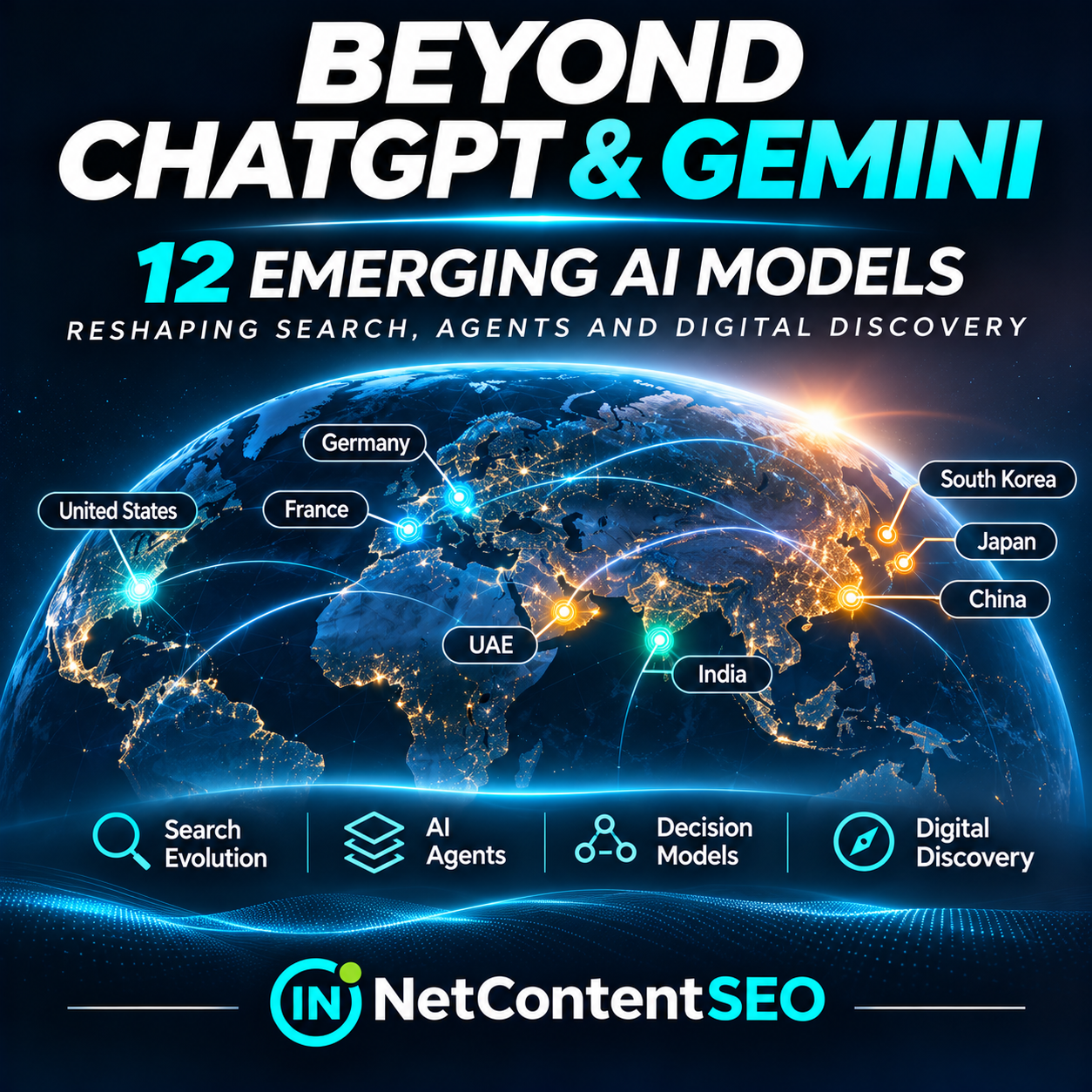

November 6, 2026. AI discovery is no longer a story told only through ChatGPT, Gemini and a handful of US companies. Across South Korea, China, Japan, India, Europe and the Middle East, companies are developing models and products that could influence how people find information, choose businesses and delegate decisions to AI agents.
But a powerful model is not automatically a search engine. A benchmark leader is not necessarily a distribution channel, and a model available on Hugging Face does not necessarily generate traffic for publishers. This guide examines 12 ecosystems through a more useful lens: who controls a real user interface, who supplies decision-making infrastructure, who has access to local language and commerce data, and what publishers can actually measure.
This is an editorial shortlist, not a performance ranking. Reflection AI, based in the United States, is included deliberately as an open-agent-stack comparison. Several organizations are established businesses even if their AI offerings receive less attention in Western consumer coverage.
Three different types of AI ecosystem
Discovery platforms have real users and interfaces through which information, products or businesses can be found. Naver and Kimi are relevant examples, though their search and agent experiences differ considerably. Agent and model platforms provide reasoning, tool use, multimodal classification or APIs that other companies can embed; Kakao's decision model, GLM and MiniMax illustrate this layer. Infrastructure and research ecosystems concentrate on sovereign deployment, model architectures and enterprise governance, as seen with Falcon, Sakana AI and Aleph Alpha. Mistral and Sarvam span multiple layers.
The categories overlap, but confusing them leads to weak GEO claims. A company may publish a high-quality model without offering a consumer search product. Conversely, an established marketplace may become influential through distribution even when it is not at the top of a general-purpose model benchmark.
The 12 ecosystems to watch
1. Kakao Kanana — South Korea
Role: Decision and tool-selection layer. Kakao's Kanana family includes Kanana-2-v-decide, released November 6, 2026, a compact text-and-image decision model producing scores and choices rather than prose. Kakao identifies internal web search and product categorization as early applications. Its reported sub-40ms latency on one H200 is workload-specific and vendor-measured. The opportunity is agent routing and multimodal product classification; there is no announced public search ranking change.
Practical visibility test: Determine whether this ecosystem provides a public discovery interface, an API used by third-party products, or only a research model. For live interfaces, test representative local queries and record cited sources, recommended brands, links and actions. For model infrastructure, evaluate actual deployments rather than inventing referral traffic. Primary ecosystem source.
2. Naver HyperCLOVA X — South Korea
Role: Established discovery ecosystem. Naver already operates search, shopping, maps and local discovery products in South Korea. HyperCLOVA X is a strategic AI layer in that wider ecosystem, where search results, commerce and place discovery can be connected to user tasks. The important distinction is that Naver has an existing consumer distribution surface; specific AI-driven recommendation mechanics and referral effects still require product-level verification.
Practical visibility test: Determine whether this ecosystem provides a public discovery interface, an API used by third-party products, or only a research model. For live interfaces, test representative local queries and record cited sources, recommended brands, links and actions. For model infrastructure, evaluate actual deployments rather than inventing referral traffic. Primary ecosystem source.
3. Sarvam AI — India
Role: Language infrastructure and local agents. Sarvam publishes Indian-language speech recognition, text-to-speech, translation, document understanding, conversational models and voice-agent tools. Its official documentation describes support for 22 Indian languages in some speech and translation products, but coverage differs by model. It matters because voice and mixed-language queries can open new discovery paths for businesses serving multilingual customers; its model catalog is not itself a public web search engine.
Practical visibility test: Determine whether this ecosystem provides a public discovery interface, an API used by third-party products, or only a research model. For live interfaces, test representative local queries and record cited sources, recommended brands, links and actions. For model infrastructure, evaluate actual deployments rather than inventing referral traffic. Primary ecosystem source.
4. Sakana AI — Japan
Role: Alternative research and enterprise pathways. Sakana AI is known for research into evolutionary model merging, efficient adaptation and AI Scientist-style systems. Its value in this comparison is architectural diversity, not an established consumer search interface. The relevant question for publishers is whether its techniques eventually power deployed agents and discovery services; no direct search-traffic channel should be inferred.
Practical visibility test: Determine whether this ecosystem provides a public discovery interface, an API used by third-party products, or only a research model. For live interfaces, test representative local queries and record cited sources, recommended brands, links and actions. For model infrastructure, evaluate actual deployments rather than inventing referral traffic. Primary ecosystem source.
5. MiniMax — China
Role: Multimodal production and agents. MiniMax offers text models, APIs and agent products alongside broader multimodal capabilities. Its October 2026 M3.1 Flash announcement emphasizes coding, computer use and automation, with vendor-reported efficiency gains. This is relevant to digital discovery when agents browse services and complete workflows, but model performance and market distribution should not be confused.
Practical visibility test: Determine whether this ecosystem provides a public discovery interface, an API used by third-party products, or only a research model. For live interfaces, test representative local queries and record cited sources, recommended brands, links and actions. For model infrastructure, evaluate actual deployments rather than inventing referral traffic. Primary ecosystem source.
6. Z.ai / GLM — China
Role: Developer and agent infrastructure. Z.ai's GLM family and ZCode environment target complex coding and long-horizon agent work. Official documentation describes GLM-5.3 handling tools, large codebases and multi-step tasks. Its importance is enabling applications that can retrieve, evaluate and act on information, not proof that GLM independently drives a mainstream search marketplace.
Practical visibility test: Determine whether this ecosystem provides a public discovery interface, an API used by third-party products, or only a research model. For live interfaces, test representative local queries and record cited sources, recommended brands, links and actions. For model infrastructure, evaluate actual deployments rather than inventing referral traffic. Primary ecosystem source.
7. Moonshot AI / Kimi — China
Role: Direct research and agent interface. Kimi is among the strongest examples of an actual user-facing research and agent experience in the shortlist. Its official documentation describes web-connected search, source tracing, autonomous tool use, Deep Research and multi-agent workflows. For publishers, test whether sources are cited or linked and whether answers lead to referrals; do not assume every retrieved page becomes visible.
Practical visibility test: Determine whether this ecosystem provides a public discovery interface, an API used by third-party products, or only a research model. For live interfaces, test representative local queries and record cited sources, recommended brands, links and actions. For model infrastructure, evaluate actual deployments rather than inventing referral traffic. Primary ecosystem source.
8. Xiaomi MiMo — China
Role: Model efficiency and device ecosystem potential. Xiaomi's MiMo research focuses on efficient models and reasoning. Xiaomi also has an extensive consumer-device footprint, creating a potential distribution advantage if AI capabilities become deeply integrated into devices. That potential should not be reported as an already measured MiMo search-referral channel; model releases and consumer deployment need separate evidence.
Practical visibility test: Determine whether this ecosystem provides a public discovery interface, an API used by third-party products, or only a research model. For live interfaces, test representative local queries and record cited sources, recommended brands, links and actions. For model infrastructure, evaluate actual deployments rather than inventing referral traffic. Primary ecosystem source.
9. Falcon / TII — United Arab Emirates
Role: Sovereign model infrastructure. The Technology Innovation Institute's Falcon family represents a sovereign-model approach, emphasizing local research capacity and reusable model infrastructure. Its importance is who can build applications and host models under their own requirements. It is not equivalent to a consumer-facing search engine; the GEO implications depend on downstream services that deploy it.
Practical visibility test: Determine whether this ecosystem provides a public discovery interface, an API used by third-party products, or only a research model. For live interfaces, test representative local queries and record cited sources, recommended brands, links and actions. For model infrastructure, evaluate actual deployments rather than inventing referral traffic. Primary ecosystem source.
10. Mistral AI — France
Role: European enterprise and agent platform. Mistral combines models, APIs and enterprise deployments. Importantly, its former Le Chat product was renamed Vibe in August 2026, with Work, Code and Chat modes. That makes it a live agent and productivity interface, not merely an alternative model vendor. For brands, its connected-tool workflows could matter to discovery, but no universal Mistral citation ranking can be asserted.
Practical visibility test: Determine whether this ecosystem provides a public discovery interface, an API used by third-party products, or only a research model. For live interfaces, test representative local queries and record cited sources, recommended brands, links and actions. For model infrastructure, evaluate actual deployments rather than inventing referral traffic. Primary ecosystem source.
11. Aleph Alpha — Germany
Role: Governed enterprise AI. Aleph Alpha focuses on enterprise and public-sector AI, including sovereign and explainable workflows. Its relevance is regulated knowledge retrieval and organizational decision support rather than mass-market consumer discovery. The SEO impact is likely indirect, through the quality and accessibility of information in enterprise systems.
Practical visibility test: Determine whether this ecosystem provides a public discovery interface, an API used by third-party products, or only a research model. For live interfaces, test representative local queries and record cited sources, recommended brands, links and actions. For model infrastructure, evaluate actual deployments rather than inventing referral traffic. Primary ecosystem source.
12. Reflection AI — United States
Role: Open agent stack: a control case. Reflection AI is the deliberate US exception in this otherwise international selection. In October 2026 it released Beam, an open-weight model under Apache 2.0, and described an ecosystem of more than 40 integrations aimed at an open operating system for agents. It is a useful control case for comparing open agent infrastructure with regional platform ecosystems, not a non-US company.
Practical visibility test: Determine whether this ecosystem provides a public discovery interface, an API used by third-party products, or only a research model. For live interfaces, test representative local queries and record cited sources, recommended brands, links and actions. For model infrastructure, evaluate actual deployments rather than inventing referral traffic. Primary ecosystem source.
Where the real discovery power sits
South Korea: Naver is distinctive because it already combines search, shopping and local information in a major domestic ecosystem. Kakao's Kanana decision model addresses a different technical layer: fast interpretation and routing. Neither announcement alone proves how every consumer recommendation is ranked.
China: Kimi offers a direct research and agent interface, while MiniMax and GLM provide models and tools that may underpin many other applications. Xiaomi adds the possibility of device-level distribution. These are different routes to influence: user-facing discovery, developer infrastructure and potential hardware integration. They should not be collapsed into one Chinese AI search market.
India: Sarvam shows why regional language infrastructure matters. Voice interfaces, transliteration and mixed-language speech can shape whether people can find and use a service at all. That is a discovery opportunity, but a publisher still needs to identify the specific product or agent through which customers arrive.
Japan, Europe and the UAE: Sakana's research, Mistral's agent products, Aleph Alpha's enterprise focus and Falcon's sovereign models may influence downstream applications even without generating measurable organic referrals themselves. The SEO question is not merely whether a model exists; it is which real interface deploys it and what information it can access.
From rankings to retrieval, selection and action
A useful agentic discovery model has at least four stages. First, the system retrieves candidate information or products. Second, it interprets those candidates, sometimes combining text, images and structured records. Third, it selects which sources, brands or tools to present or use. Fourth, if authorized, it may act by opening a page, preparing a purchase or modifying a booking.
Traditional rank tracking observes only part of this journey. A publisher might be retrieved but never cited; a brand might be recommended without a link; an agent might complete a transaction without a conventional search-results click. These are possible outcomes, not proof that any specific model currently behaves this way for every query.
Kakao's Kanana-2-v-decide illustrates the selection stage because it returns scores and probabilities rather than prose. Kimi's documented agentic search illustrates research and tool orchestration. Naver illustrates the significance of controlling search, shopping and place-discovery surfaces. Each is relevant for a different reason.
Which ecosystems should SEO teams monitor first?
For a publisher targeting Korean consumers, start with the actual Naver search, shopping and local experiences that customers use. For a brand serving Indian-language markets, test whether speech recognition and voice-agent interfaces correctly understand its products, names and locations. For an international publisher, Kimi's user-facing research product offers an observable place to test source attribution and referrals.
For enterprise clients, Mistral's Vibe and applications built on GLM, MiniMax, Falcon or Aleph Alpha may be more relevant than public chatbot rankings. The correct monitoring target is the deployed interface, not an abstract model name. In every case, check regional availability, data-access rules and whether the experience is accessible to ordinary users or only developers.
A repeatable GEO research protocol
- Choose a market and intent. Separate informational queries, product comparisons, local service discovery and transactional requests.
- Identify the actual interface. Record whether the test uses a consumer app, web search, agent product, API or enterprise integration.
- Control the test conditions. Record date, language, location setting, login state, model version and exact prompt.
- Run repeated queries. Use a consistent set of representative questions, including branded and unbranded variants.
- Record the full outcome. Note retrieval when observable, citations, brand mentions, links, recommendations and any action offered.
- Validate source quality. Check whether facts, prices, availability and local details are correct and current.
- Separate visibility from traffic. Use analytics and referral evidence where available; do not turn a brand mention into a fabricated click.
- Retest over time. Models, product integrations and regional availability can change quickly. Compare results using the same methodology.
What publishers and brands can do now
Build content that is independently useful: precise product specifications, original comparisons, accessible images, clear business identity, up-to-date local information and trustworthy references. Maintain consistent data across owned websites and the platforms customers already use. For multilingual markets, invest in language accuracy and local terminology rather than translating keywords mechanically.
Structured data can help describe content in supported search ecosystems, but it is not a guaranteed entry ticket to any of these models. Similarly, allowing crawlers does not guarantee retrieval, citation or recommendation. A useful audit asks whether the information is available, understandable, current and genuinely relevant to the task.
For agentic commerce, focus on operational readiness as well: accurate inventory, clear policies, secure APIs where appropriate, accessible booking flows and human escalation for sensitive decisions. These factors can matter when a system moves from answering questions to completing tasks, even though the individual platforms' selection algorithms remain partly opaque.
How to distinguish hype from meaningful market change
Look for four forms of evidence. Availability: can real users access the product today? Distribution: does it have a meaningful interface or integration network? Actionability: can it reliably retrieve, select or execute tasks? Measurement: can its effects on discovery, referrals or conversions be observed?
A model release establishes technical availability, not necessarily consumer adoption. A vendor benchmark establishes performance under stated test conditions, not a universal market ranking. A partnership announcement does not prove that third-party websites receive referrals. Keep these claims separate in every AI visibility report.
Frequently asked questions
Are these the 12 best AI models in the world?
No. This is a curated selection of ecosystems relevant to regional AI, agents and digital discovery, not a benchmark-based ranking.
Why include Reflection AI if the focus is outside the United States?
Reflection AI is included as an explicitly labeled US control case to compare open agent infrastructure with non-US ecosystems.
Which companies already have consumer-facing discovery interfaces?
Naver operates established search, shopping and local services, and Kimi provides web-connected search and agent research. Mistral's Vibe also provides a user-facing agent environment. Availability and features differ.
Does Kakao's Kanana model change Google rankings?
No such Google ranking change has been announced. Kanana-2-v-decide is a specialized decision model that Kakao plans to use in internal applications, including search and categorization.
Can an open model generate search traffic for my site?
Not by itself. Traffic requires a deployed product that retrieves or recommends the site and provides a navigable route to it.
What is the main GEO opportunity in India?
Local-language and voice-based access to information and services. Teams should test specific applications and actual user journeys rather than assuming every Sarvam model is a search engine.
How should brands measure AI visibility?
Track mentions, citations, links, recommendations and observable actions separately, using consistent prompts and conditions. Do not equate them with rankings or visits.
Are these products available worldwide?
Not necessarily. Availability varies by vendor, geography, enterprise agreement, API tier and language. Confirm access before planning campaigns around a particular product.
Conclusion: the next discovery layer will not be one model
Outside the US, AI development is creating multiple routes to influence: Korean search and commerce platforms, Chinese research agents, Indian-language voice infrastructure, European enterprise agents and sovereign model ecosystems in the Middle East. Some will become visible consumer interfaces; others will operate behind the scenes as decision or retrieval components.
For SEO and GEO, the durable question is not simply which model is smartest? It is which systems actually mediate discovery, which information they can evaluate, and what users can do after a recommendation. Visibility is moving from a single ranked page toward a sequence of retrieval, interpretation, selection and action. Understanding that sequence matters more than compiling another chatbot leaderboard.
Primary sources and further reading
- Kakao Kanana — official ecosystem information
- Naver HyperCLOVA X — official ecosystem information
- Sarvam AI — official ecosystem information
- Sakana AI — official ecosystem information
- MiniMax — official ecosystem information
- Z.ai / GLM — official ecosystem information
- Moonshot AI / Kimi — official ecosystem information
- Xiaomi MiMo — official ecosystem information
- Falcon / TII — official ecosystem information
- Mistral AI — official ecosystem information
- Aleph Alpha — official ecosystem information
- Reflection AI — official ecosystem information