

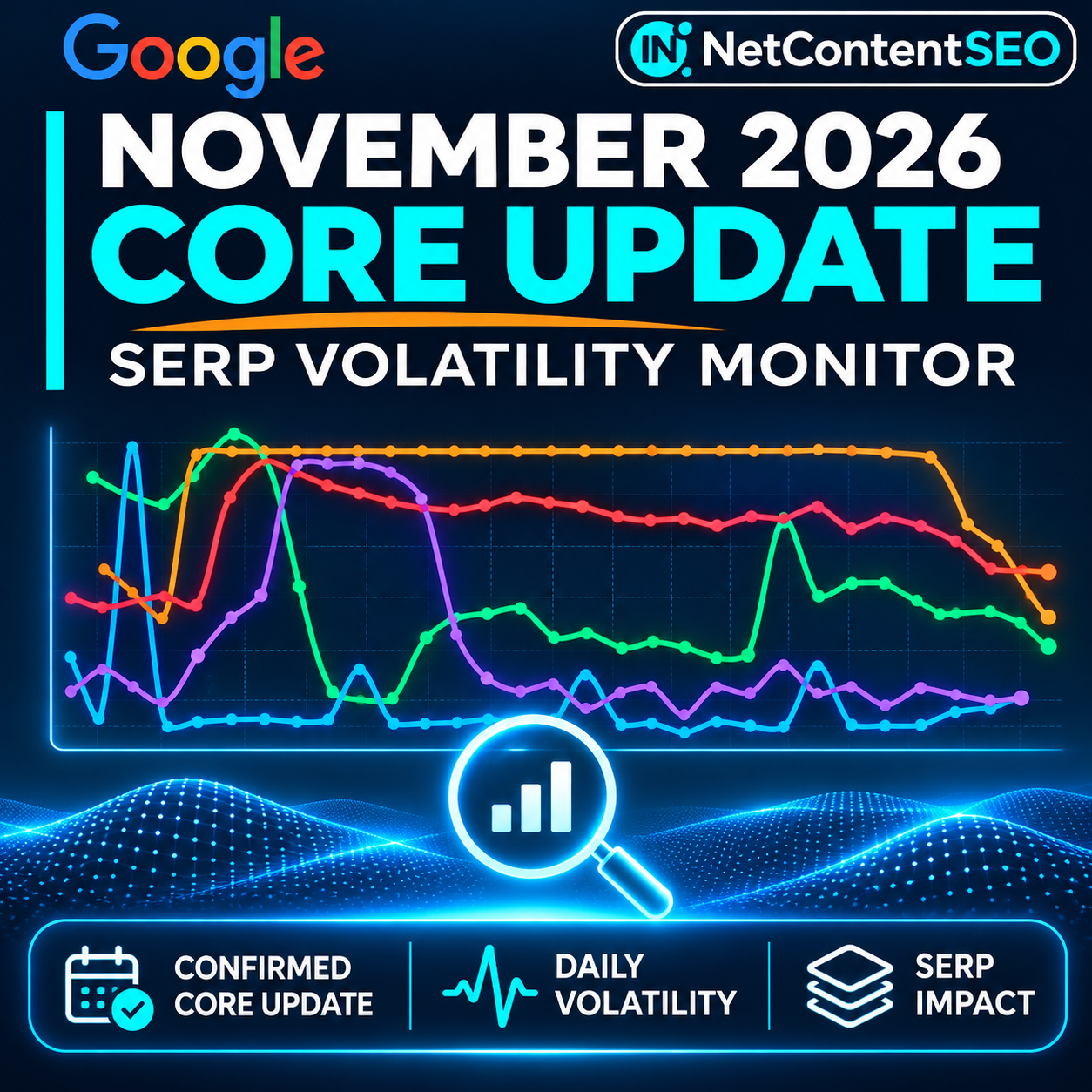

Google's November 2026 core update is still reshaping search results, but the latest ranking-volatility signals are far from uniform. The update began on November 10, according to the official Google Search Status Dashboard. As of November 22, it has not been marked complete. NetContentSEO's Search Volatility Monitor brings independent monitoring platforms into one place to help SEO professionals distinguish broader SERP turbulence from isolated spikes—and to avoid interpreting every movement as a separate Google update.
Google's November 2026 core update: what is confirmed?
Google confirmed the November 2026 core update on November 10 and described it as a regular update intended to surface more relevant and satisfying content from different kinds of sites. The expected rollout window was up to two weeks, though the actual completion date depends on Google's status reporting. As of November 22, the official Search Status Dashboard still lists the rollout without a completion timestamp. That makes it premature to treat the current ranking distribution as final.
Google has not published a detailed list of specific ranking signals changed in this update. Claims that it specifically penalizes all AI-written articles, rewards one content format or targets one particular industry would go beyond the confirmed announcement. A broad core update can affect many types of searches and sites, but individual movements require site-level investigation.
What the NetContentSEO monitor shows
The NetContentSEO Search Volatility Monitor currently presents readings from five available independent sources: Semrush Sensor, MozCast, AccuRanker Grump, Advanced Web Ranking (AWR) and Mangools. Its interactive daily chart lets visitors show or hide individual sources and inspect their trends. Each source retains its own scoring system. The dashboard's last successful collection is dated November 21, while the supplied November 22 chart screenshot shows a later visual point. Because data timestamps differ, the figures below use the website's explicitly labeled November 21 source cards rather than treating every screenshot point as a synchronized live reading.
At that snapshot, Semrush Sensor reported 4.7/10, labeled Normal; MozCast reported 122°F, labeled Stormy; AccuRanker Grump reported 11.26, labeled Cautious; and AWR reported 4.4/10, labeled Medium. Mangools' latest available reading was 1.92 on November 20, below its 3-point volatility range. These are observations from independent monitoring products, not NetContentSEO's own ranking measurements or a unified severity score.
The contrast is the story. MozCast signals a stormy environment, while Semrush, AWR and Mangools report milder conditions within their own classifications. This disagreement does not mean one provider is necessarily wrong. Each observes different keywords, countries, devices, search-result features and time windows. Their methodologies and classification thresholds are not directly interchangeable.
Why the chart's lines must not be compared as one scale
Semrush Sensor and AWR publish scores on a 0–10 scale, but that shared numeric range does not establish identical measurement methods. MozCast expresses search turbulence as a temperature in degrees Fahrenheit. AccuRanker Grump uses its own volatility index, while Mangools reports its own desktop SERP volatility measure. A value of 5 in one service is not automatically equivalent to 5 in another.
NetContentSEO therefore preserves each provider's original score and does not publish a synthetic consensus indicator without a documented normalization method. The multi-source chart is useful for examining direction, timing and whether several services register movement together. It should not be read as proof that differently scaled lines represent identical absolute volatility.
The monitor's methodology also explains that Algoroo is listed among its attributed data sources, although five source cards are currently available. Source availability can vary, and a missing reading should not be interpreted as zero volatility.
What happened during November 13–20?
Reporting by Barry Schwartz at Search Engine Roundtable described noticeable ranking changes and SEO community discussion from around November 13–14 onward. Some site owners reported gains, others declines, and the monitoring tools did not all register the same intensity. This is consistent with a broad update that affects different sets of queries and websites in different ways, though it does not prove a specific mechanism behind each movement.
A separate independent volatility aggregation published readings showing Semrush Sensor elevated on November 17 and 18, before easing on November 19–21. The precise numbers vary by provider and methodology. This broader pattern supports describing the period as unsettled, not as one uninterrupted market-wide spike of equal intensity across all tools.
It is also important to distinguish the update's confirmed start date from the date on which individual sites experienced ranking changes. A site can respond several days after the rollout begins. Conversely, an unusual chart movement that occurs during a core update is not necessarily caused by that update; normal ranking fluctuations, seasonal demand and data-collection problems can overlap.
A measurement problem: blocked and distorted automated SERPs
One reason for additional caution in November is the reliability of automated search-result collection. Search Engine Roundtable and SEO practitioners have reported that Google's anti-automation measures and deliberately distorted responses to some automated requests can interfere with rank trackers. A tool may observe an apparent SERP reshuffle because it received a different or incomplete result, not because ordinary users saw the same change.
Semrush's own November core update analysis also discusses filtering poisoned results and cross-checking fluctuations against Google Search Console. For publishers, this makes first-party data particularly important. Monitoring platforms are early-warning instruments, not a substitute for validating what happened to actual search impressions, clicks and landing pages.
How to use our Search Volatility Monitor
Open the live NetContentSEO monitor and start with the date of the Google update. Compare the shape of the individual source curves across the following days, using the legend to isolate one provider at a time. Look for sustained movements or simultaneous changes across several trackers rather than reacting to one isolated peak. Read each source's latest timestamp and severity label before drawing conclusions.
Then compare the wider market signal with your own site's Google Search Console data. Review search impressions, clicks, average position and affected queries or landing pages. Segment by country, device and page type where useful. Check whether changes began before or after November 10 and whether they persisted. A drop in traffic without a corresponding change in ranking may reflect search demand, click-through rate, SERP layout or other factors.
Because the update is still rolling out, avoid large-scale changes based only on a few days of volatile data. Once Google confirms completion, wait for enough post-rollout data to compare equivalent periods. Consider weekday patterns, seasonal demand and any reporting anomalies, especially around the approaching Black Friday period.
What should website owners investigate?
If rankings decline, first identify the pages and queries actually affected. Compare them with pages that remained stable or improved. Examine search intent, factual accuracy, original value, clarity, content freshness where relevant, user experience and technical accessibility. Do not assume that deleting content, rewriting every article or changing all title tags will reverse a broad core update.
If rankings improve, document which queries and page types benefited, but avoid attributing success to one isolated tactic without evidence. If the movement appears only in a third-party tracker and is not reflected in Search Console or representative live results, investigate measurement quality before making editorial decisions.
What about AI Overviews, AI Mode and GEO?
The November core update is a confirmed Google Search ranking update, but Google has not published a specific account of how it changes AI Overview citations or AI Mode source selection. Traditional SERP volatility can coincide with changes in AI-generated visibility, but the two are not identical. A website may retain its organic ranking while its appearance in AI-generated answers changes, or vice versa.
For GEO and AI Visibility analysis, track whether a brand or source appears in relevant AI answers, whether citations point to the intended pages and whether identifiable referrals change. Keep those observations separate from the traditional ranking data shown by the NetContentSEO monitor. The dashboard measures search-result volatility reported by third-party services; it is not currently a direct AI citation tracker.
What the monitor can—and cannot—tell us
The NetContentSEO monitor can help identify unusual periods of movement, compare the direction of several independent signals and provide context for site-level analysis. It cannot determine why a specific page lost rankings, prove a new unannounced update, predict a recovery date or guarantee that one provider's volatility reading represents every country and industry.
Its strength is transparency: original source scales, visible source attribution, collection timestamps and an explicit decision not to invent a consensus metric. That is particularly valuable during a rollout when the temptation to publish a dramatic headline can exceed the evidence available.
The November 2026 takeaway
Google's November 2026 core update is real and still in progress as of November 22. Search rankings have shifted for some websites, and monitoring platforms have detected turbulence, but the latest readings are mixed. Rather than declaring a universal SERP crisis, SEO professionals should compare multiple independent sources, verify changes against first-party data and wait for the rollout to settle before making major decisions.
Track the situation: NetContentSEO Search Volatility Monitor — live multi-source SERP data.
Sources: Google Search Status Dashboard; Search Engine Roundtable, November 16, 2026; Semrush, November 17, 2026; NetContentSEO Search Volatility Monitor.