

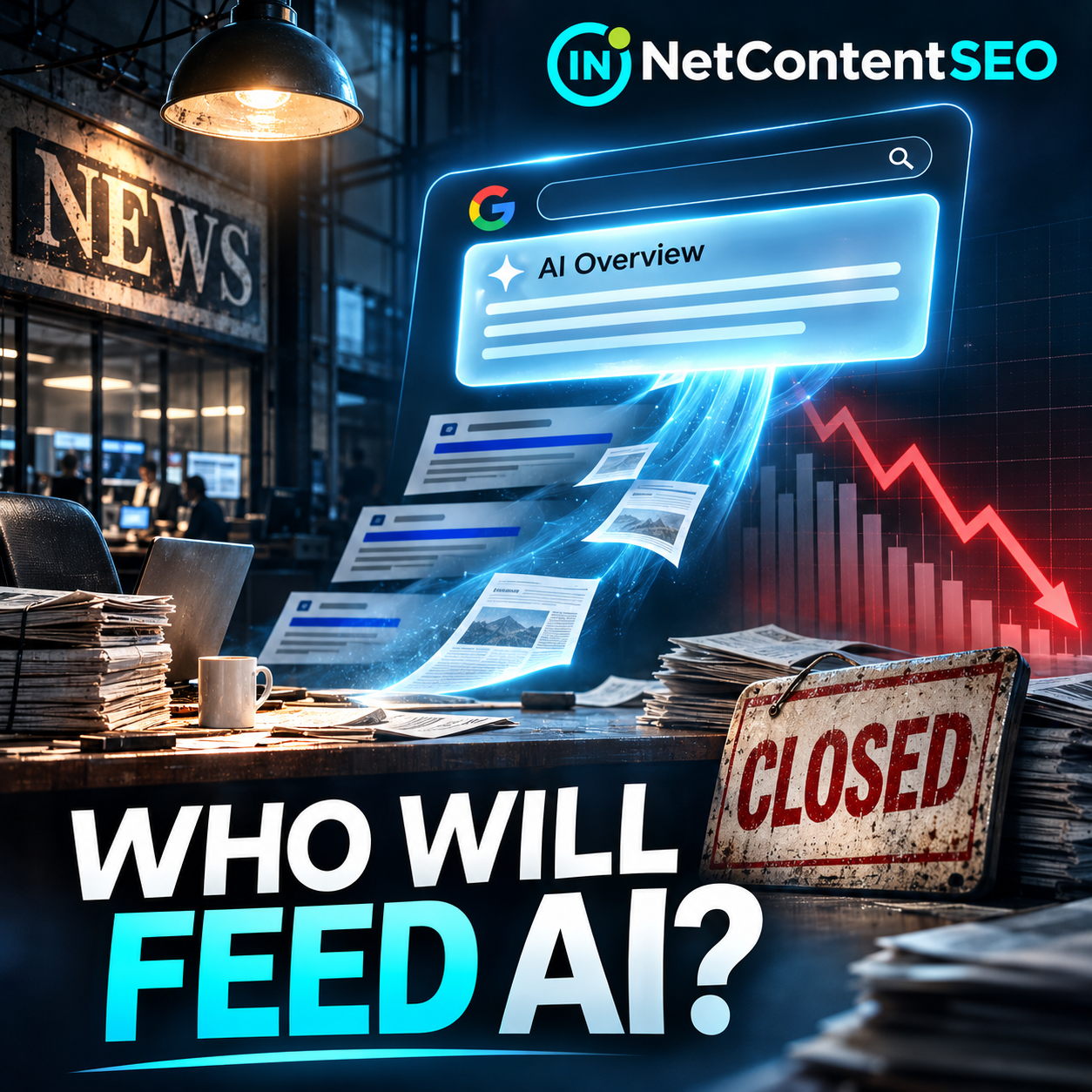

What happens to an answer engine when the websites supplying its answers can no longer afford to exist? This is becoming one of the defining questions of AI Search. Between 2025 and November 15, 2026, independent publishers have faced declining search referrals, rising uncertainty about discovery and a series of documented closures and restructurings. The evidence is significant. But the strongest investigation begins with a distinction: collapsing search traffic is measurable; a universal count of websites killed by AI is not.
NetContentSEO reviewed research from the Reuters Institute, Pew Research Center, Northwestern University's Medill Local News Initiative and Chartbeat, alongside documented publisher cases and statements by Italian technology publisher Salvatore Aranzulla. Together, they point toward a potential economic feedback loop that we call the Source Depletion Hypothesis: AI products benefit from an ecosystem of original information, while changing discovery patterns may weaken the businesses that maintain it. This is a hypothesis to test, not a proven description of every publisher's experience.
The search traffic shock is real—and disproportionately hurts small publishers
In its 2026 Journalism, Media, and Technology Trends report, the Reuters Institute cited aggregated Chartbeat data from 2,576 websites: organic Google search referrals were down 33% globally between November 2024 and November 2025, and 38% in the United States. The researchers explicitly cautioned that the proportion caused by AI Overviews could not be determined. Search algorithm updates, changes in demand, competition and publisher strategies can all affect referral volumes.
Separately, Chartbeat data reported by Axios in March 2026 showed that traditional search referrals fell over roughly two years by 60% for small publishers (1,000–10,000 daily pageviews), 47% for medium publishers (10,000–100,000) and 22% for large publishers (more than 100,000). These figures are search-referral declines, not total site-traffic losses or estimates of AI-caused losses.
Traditional search referral decline by publisher size
Source: Chartbeat data reported by Axios, March 17, 2026. Bar lengths scaled to the largest value shown. Not a causal attribution to AI.
The size gap matters economically. A larger publisher may have subscription revenue, branded audiences, newsletters, apps and direct visits. A small specialist website may depend heavily on the one search click that follows a practical question. Losing that click can reduce advertising inventory, affiliate conversions and the financial return on maintaining accurate guides.
There is a crucial counterweight: Chartbeat's sampled publishers experienced only about a 6% decline in average weekly total pageviews from 2024 to 2025, far less than the drop in search referrals. Some audiences are arriving through other channels. The evidence therefore supports a serious redistribution of discovery, not a claim that the entire web has lost 60% of its audience.
What Pew measured: an AI answer changes what happens after a search
The Pew Research Center examined browsing behavior from 900 consenting US adults, covering nearly 69,000 unique Google searches in March 2025, with results reconstructed in April. When an AI summary appeared, people clicked a traditional result in 8% of visits, compared with 15% when no AI summary appeared. Only 1% of visits to pages with AI summaries produced a click on a link within the summary. Users also ended their browsing sessions more frequently after an AI-summary page: 26% versus 16%.
Clicks on traditional Google results: Pew observed visits
Source: Pew Research Center, July 22, 2025. Bar lengths scaled to the largest value shown. Not a causal attribution to AI.
These are observed differences, not a randomized experiment proving that the AI Overview alone caused a seven-percentage-point decline. Query types differ. Pew found summaries were especially common for longer and question-form searches—precisely the kind of requests answered by guides and explainers. Still, the result captures the underlying tension: a search engine can satisfy an information need while sending fewer visitors to the page that helped supply the answer.
How many publishers actually closed in 2025 and 2026?
There is no verified worldwide database counting websites that shut down because of Google AI Overviews. Domain expirations, dormant sites, print closures, mergers and shutdowns of original online newsrooms are different events. Treating them as interchangeable would create a dramatic but misleading number.
The strongest available US local-news benchmark is Northwestern's State of Local News 2026, published October 13. It records 170 newspapers closed or merged over the preceding year, and 238 US counties without a locally based source of professional local news, up by 26. The report also identifies nearly 25 digital-only local news sites that shut down over its reporting period. The newspaper number includes mergers and is not a calendar-year count of websites disappearing.
Equally important, Northwestern documented 75 local news startups since the beginning of 2025. That does not cancel the losses—new sites are not necessarily located where coverage vanished—but it prevents an inaccurate claim that publishing is moving in only one direction. The challenge is not just the number of websites. It is whether reporting capacity survives in the communities and subjects where it is needed.
Reach: when declining referrals become a restructuring decision
In September 2026, UK publisher Reach proposed eliminating 220 editorial roles while creating around 60 new ones, a net reduction of roughly 160. Plans included the closure of three digital titles: KentLive, AberdeenLive and GalwayBeo. The plans were documented in a UK Parliament Early Day Motion. These are reported restructuring and closure plans; their precise implementation status should not be assumed from the announcement alone.
Reach's commercial performance offers a stronger economic connection than a generalized claim about AI. Its reported first-half 2026 pageviews were down around 40% year on year, while indirect digital revenue declined as referral volumes—mainly from Google—fell. In October, reports of Reach's nine-month results described digital revenue down 15% year on year. The company has emphasized a shift toward original journalism, subscriptions and more direct audience relationships.
This case supports a narrower, defensible conclusion: reduced platform referrals were a material pressure on a publisher making significant cuts. It does not establish what proportion of those cuts was caused specifically by AI Overviews rather than broader search and advertising disruption.
The Aranzulla paradox: revenue up, profit down
In a November 1, 2026 interview with Corriere della Sera, Italian technology publisher Salvatore Aranzulla said daily visitors to his site had fallen from about one million in 2024 to 500,000 at the time of the interview. He reported 2025 company revenue of approximately €8.39 million, compared with €7.9 million in 2024. Yet net profit fell from about €2.33 million to €641,430—a decline of approximately 72%.
This is a more revealing story than the headline 'AI destroyed 72% of revenue,' which would be false. Revenue reportedly increased; profit contracted. Aranzulla said the company had changed strategies and begun buying traffic, adding costs. He also argued that if chatbots answer questions using human-produced content without sending visits back, the financial incentive to produce quality information may weaken. These are his statements and reported financial figures, not independently audited financial statements in this investigation.
The distinction matters. Rising revenue with falling profit can reflect acquisition costs, other operating expenses, investment and business-mix changes. We cannot isolate the portion attributable to AI. But his experience illustrates why traffic loss is not the only metric: the cost of replacing lost organic discovery may reshape the economics of an otherwise successful information business.
The Source Depletion Hypothesis: could AI weaken its own information supply?
Consider the proposed mechanism. First, independent sites invest in original reporting, testing, research, photographs, guides and updates. Second, answer engines summarize information in the discovery interface. Third, some users get what they need without visiting the source. Fourth, if publishers cannot replace lost revenue, they may reduce coverage, stop updating old pages, consolidate or close. Finally, the information environment available to search engines and AI systems could become less current, less diverse and less independently verified.
Source Depletion Hypothesis — conceptual model, not established causation
Original reporting and specialist knowledge
↓
AI-generated answers and changed discovery
↓
Potentially fewer source visits and conversions
↓
Reduced publishing budgets and coverage
↓
Potential decline in fresh, independent information
Several links in this chain have evidence behind them: changing click behavior, referral declines and financial pressure on some publishers. The final claim—that AI systems will measurably lose access to high-quality sources as a consequence—requires longitudinal research. Training data, licensed datasets, direct partnerships, public records and new publishers could partly offset losses. The hypothesis should be investigated, not treated as a prediction already fulfilled.
What would actually prove the feedback loop?
Researchers would need to track a panel of publishers over time, separating Google organic Search, Discover, direct traffic, social referrals and chatbot citations. They would need dated evidence of content-production budgets, staffing, publication frequency, article freshness and closure decisions. A credible study would compare affected and less-affected query categories, account for core updates and seasonal demand, and test whether a reduction in independent source production subsequently changes the quality, accuracy or diversity of AI answers.
Without those controls, correlation can be mistaken for causation. An editorial site can lose search traffic because of a ranking change, a shift in audience interest, competition, an AI summary or a combination of factors. A newsroom can close because of advertising weakness, ownership decisions, rising costs or the retirement of its publisher. The AI era intersects with all of these forces but does not explain them all.
What publishers can do now—without pretending there is a simple fix
For publishers, the immediate response should begin with measurement rather than panic. Segment search performance by informational versus transactional queries and by pages that answer common questions. Compare Search Console clicks with analytics landing-page sessions, while acknowledging measurement differences. Monitor which content still produces meaningful engagement, conversions, newsletter signups or direct repeat visits.
Next, build reader relationships outside the search results page: useful newsletters, memorable brands, communities, original datasets and services worth returning to. Track costs and margins by content category, not just impressions or visibility. Maintain strong sourcing and structured, accessible pages so readers and systems can identify original work—but avoid treating AI citations as guaranteed traffic. For publishers negotiating licensing or considering crawler restrictions, evaluate legal, commercial and visibility trade-offs separately.
For AI companies and search platforms, the challenge is equally practical: citation visibility alone may not replace a sustainable commercial relationship with the creators of valuable information. Partnerships and licensing are possible responses, but they are not universal solutions for thousands of small publishers. Whether the answer ecosystem can support a diverse supply of original sources is an open economic question.
Frequently asked questions
How many websites did Google AI Overviews shut down in 2025 or 2026?
No verified global count exists. Northwestern recorded 170 US newspapers closing or merging over the year before its October 2026 report and nearly 25 digital-only local news site closures. Neither count identifies closures caused specifically by AI Overviews.
Did AI Overviews cause Google's search referrals to fall by 33%?
Reuters Institute reported the 33% global decline for a Chartbeat sample between November 2024 and November 2025, but explicitly said the share attributable to AI Overviews was unknown.
Do people click less when AI summaries appear?
Yes, in Pew's observed March 2025 sample, traditional-result clicks occurred in 8% of visits with AI summaries versus 15% without them. This observational comparison does not by itself prove causation.
Did Salvatore Aranzulla lose 72% of his revenue?
No. He reported that company revenue rose from approximately €7.9 million in 2024 to €8.39 million in 2025, while net profit fell by roughly 72%. He linked pressure on margins partly to changes in traffic acquisition strategy.
Could AI search eventually harm the sources it depends on?
It is plausible, but not yet demonstrated as a complete causal cycle. Testing the Source Depletion Hypothesis requires longitudinal evidence linking AI discovery, publisher economics, reduced original reporting and subsequent information quality.
Conclusion: the risk is not that the internet runs out of pages
The web can generate enormous volumes of text even while original reporting becomes harder to finance. That is the deeper danger. The relevant question is not how many pages an AI system can retrieve, but how much of the information behind those pages is independently researched, current and accountable. The numbers already show that discovery economics are changing, and that smaller publishers face particular pressure. The next stage of research must establish when that pressure becomes a measurable loss of original knowledge.
Methodology and sources (reviewed through November 15, 2026): Reuters Institute, Journalism, Media and Technology Trends 2026; Axios reporting Chartbeat data, March 17, 2026; Pew Research Center, July 22, 2025; Northwestern Medill, State of Local News 2026; UK Parliament, Reach Early Day Motion; Corriere della Sera, interview with Salvatore Aranzulla, November 1, 2026. Different datasets have different periods, definitions and geographic coverage; their percentages must not be combined as if they described one population.