

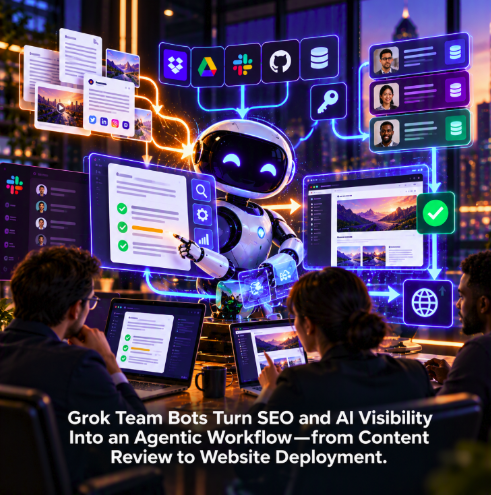
SpaceXAI is turning Grok Bot from an individual autonomous worker into shared infrastructure for teams. On September 28, 2026, the company launched Team Bots in public beta for Teams and Enterprise plans, allowing organizations to create a Grok Bot around a role or workflow and give colleagues access to the same shared expertise, tools and institutional context.
The marketing implementation is especially significant for SEO and AI visibility. SpaceXAI says its Marketing Bot can review content against brand guidance and current messaging, apply consistent SEO checks, make approved website changes and post a preview in Slack for final sign-off. In other words, the agent does not stop at suggesting an optimization. It can carry the change through the workflow until the point where a human approves deployment.
That moves AI marketing automation into a different category. The important question is no longer only whether a model can write a title tag, critique a page or suggest a content update. It is whether an agent can preserve the organization's rules, work across the applications where the team operates, modify the website and keep a human approval boundary around publication.
Team Bots combine shared expertise with individual working context
SpaceXAI describes four building blocks for a Team Bot. Context supplies files, instructions and skills such as brand guidelines or internal documentation. Plugins connect the Bot to applications including Salesforce, Notion and GitHub. Credentials allow secure access to third-party APIs that do not have a plugin. Memories retain what the Bot learns as it performs its role.
The combination is more important than any individual feature. A generic chatbot may know how SEO works, but it does not automatically know a company's messaging rules, publishing process, analytics stack or internal definition of an approved change. Team Bots are designed to assemble those elements into a persistent operational role.
This is the enterprise version of context engineering: the model's general capabilities become useful through the organization's private files, application access, procedural instructions and accumulated corrections.
Shared does not mean every user's memory becomes one pool
There is an important privacy and product-design distinction in SpaceXAI's announcement. Everyone can use the same Team Bot and its shared skills, but individual conversations remain private. The Bot maintains separate context and memories for each user while drawing on the expertise shared at the team level.
That separation addresses a common problem with collaborative agents. A useful team agent needs organizational knowledge to improve over time, but employees may also need private working sessions that should not automatically become visible to every colleague.
The design therefore creates at least two context layers: shared role knowledge and user-specific interaction state. How organizations govern what graduates from an individual's interaction into shared institutional memory will be an important operational question as these systems mature.
Slack becomes an interface to the shared agent
Team Bots can also participate directly in Slack. Each Bot receives its own handle and can be invited into a channel, where team members can ask questions, contribute context and see its responses.
This matters because it reduces the need to move work into a separate AI destination. The agent can live inside the collaboration environment where approvals, questions and project decisions already happen.
SpaceXAI's own sales example shows the intended pattern. Dedicated account Bots review company news, Gong calls, Notion documents and relevant Slack threads overnight, then post a morning briefing with changes and recommended next steps. During the day, employees continue working with the Bot in Slack, while the system remembers decisions and accumulates account context over time.
The Marketing Bot turns SEO recommendations into an executable workflow
For marketing teams, SpaceXAI says it supplied its Bot with brand guidelines, blog posts and social copy. When someone submits a draft for approval in Slack, the Bot reviews it against the organization's voice and latest messaging. Regional teams can therefore receive feedback without waiting for headquarters to complete every review cycle manually.
The workflow becomes more consequential when a website change is involved. SpaceXAI says the Marketing Bot takes website and SEO updates from review through implementation. After the content passes review, the Bot makes the change and posts a preview link in Slack for final approval. The company says this allows marketers to ship updates without filing an engineering ticket while preserving the same brand and SEO checks across regions.
This is a concrete example of agentic SEO. The AI is not merely generating advice that somebody later translates into a CMS change. It participates in the operational chain connecting diagnosis, modification, preview and human sign-off.
Human approval remains the boundary before launch
The official description is notable for where it leaves the human. SpaceXAI does not say the Marketing Bot autonomously publishes every website change. It says the agent posts a preview for final sign-off after making the approved update.
That distinction is important for production SEO. Automated edits can create consequences far beyond copy quality: broken templates, incorrect canonicals, changed structured data, accidental noindex directives, altered internal links or brand and legal problems. An agent that can edit a website should be governed more like deployment automation than a writing assistant.
The preview-and-approval step creates a useful control point. The agent can remove repetitive implementation work while a human retains authority over the state that becomes public.
AI visibility enters the agent's marketing brief
The launch also contains an explicit AI-search signal. Angela Ferrante, Head of Marketing at Amplitude, says the company is building toward Team Bots for every marketing function and wants them to help teams analyze market and customer intelligence, “show up in AI answers,” review launches and understand what is working.
That quote does not establish that Grok Team Bots possess a proprietary method for increasing AI citations or recommendations. SpaceXAI does not publish an AI-visibility ranking algorithm, benchmark or guaranteed optimization framework in the announcement. What it does show is that AI-answer visibility is becoming an explicit objective inside an agentic marketing workflow rather than a separate experimental SEO project.
This distinction matters. A Bot can automate research, auditing, content changes and measurement, but the causal relationship between any individual change and appearance inside an AI answer still needs evidence. Agentic execution can make optimization faster; it does not make uncertain ranking systems deterministic.
The new product extends Grok Bot rather than replacing it
Team Bots arrive only weeks after SpaceXAI expanded Grok Bot for enterprise use. NetContentSEO previously examined that release in Grok Bot Brings Always-On AI Agents Into Enterprise Accounts—and Expands the Security Blast Radius, focusing on the consequences of giving persistent agents authenticated access to business applications.
The September 28 launch adds a collaboration layer to that architecture. Instead of one employee delegating work to an always-on agent, a role-specific Bot can become a shared operational resource for an account, project, marketing function or analytics workflow.
That increases the potential leverage of the agent, but it also increases the importance of ownership. A Team Bot that can modify a website or call third-party APIs is no longer simply an employee productivity feature. It becomes shared automation with organizational permissions.
Credentials turn marketing agents into operational identities
SpaceXAI says Team Bots can use credentials to access third-party APIs when a plugin is unavailable. Plugins themselves can be connected individually or configured for the whole team.
For SEO teams, that creates obvious possibilities: an agent could theoretically connect publishing, analytics, monitoring and internal content systems into one workflow where the required integrations exist. The launch article specifically demonstrates website modification, Slack collaboration and shared marketing context, but it does not enumerate every SEO platform or CMS supported, so broader integration claims should be tested rather than assumed.
The governance issue is clearer. Shared credentials should be scoped to the minimum actions a Bot needs. Read-only analytics access and website publishing access have very different risk profiles. A Team Bot should not inherit broad permissions merely because a human teammate possesses them.
Persistent memory turns corrections into operating knowledge
SpaceXAI's Data Bot demonstrates another important characteristic of the architecture. The company says the Bot remembers corrections to its queries so that lessons from one interaction improve future answers. Its analytics team also gave the Bot a pre-existing library of skills for navigating more than 45,000 tables and following internal standards.
The same pattern has obvious implications for marketing. A content agent that repeatedly receives the correction “do not describe this product that way” or “use this evidence before approving that claim” becomes more valuable if the correction persists as role knowledge rather than disappearing at the end of the chat.
NetContentSEO has already examined a related feedback loop in SpaceXAI's customer-support use of Grok Bot, where agents identify documentation gaps and feed improvements back into the knowledge system they themselves retrieve from. Team Bots extend the same general idea from knowledge maintenance toward collaborative execution.
SEO work can become asynchronous
Traditional SEO workflows often contain long coordination chains. A strategist finds an issue, writes a recommendation, a content owner approves it, an engineer or CMS operator implements it, somebody checks staging and the change finally reaches production.
SpaceXAI's Marketing Bot collapses several of those transitions. The agent can retain the standards, perform the review, implement the approved change and surface a preview in the collaboration channel. Human judgment remains, but the handoffs between humans can shrink.
This may be especially valuable for distributed organizations. SpaceXAI explicitly frames the Bot as a way for regional teams to keep moving across time zones instead of waiting for a centralized approval cycle.
The agent can become part of the publishing system itself
The deeper SEO implication is that optimization logic no longer has to live only in audits, tickets and dashboards. It can live inside the agent that participates in publishing.
A Team Bot can be given the brand rules, internal documentation and skills that define what acceptable content looks like. It can observe the draft at the moment it enters the workflow, apply those checks consistently and carry approved changes into the website environment.
That changes where SEO governance happens. Instead of discovering the same preventable issues after publication, teams can encode some standards upstream in the agent responsible for moving content toward release.
But “same SEO checks” is not the same as proven SEO performance
SpaceXAI says every website change can go through the same brand and SEO checks. The announcement does not disclose exactly what those SEO checks are, how they were validated or whether they improve rankings, traffic or AI-answer inclusion.
That is an important boundary for evaluating the launch. The product demonstrates workflow automation, not a new ranking factor. Organizations still need to decide which checks are evidence-based, which require human interpretation and which metrics establish that the changes produced useful outcomes.
Automating a weak SEO rule simply makes the weak rule execute faster. The value comes from combining good standards with reliable execution and measurement.
Team Bots point toward SEO as an agent-managed operating loop
The most interesting part of the September 28 release is therefore not that Grok can review marketing copy. Many AI systems can already do that. It is that the review can sit inside a persistent workflow with shared organizational context, application access, credentials, memory, Slack collaboration, website modification and a human approval gate.
That creates the outline of an agent-managed SEO loop: observe the work, evaluate it against stored standards, make an authorized change, expose the result for approval, deploy through the existing process and retain what the team learns for the next iteration.
AI visibility can fit into the same loop as an objective to monitor and investigate, provided teams remain disciplined about what can actually be measured. The agent may help a brand research how it appears in AI answers, identify content gaps and execute improvements, but visibility still depends on external retrieval and recommendation systems the brand does not control.
Grok Team Bots make the operational shift concrete. SEO automation is moving beyond generating recommendations and toward agents that can participate directly in the systems where recommendations become website changes. For marketing organizations, the next competitive question may be less about who has access to an AI model and more about who can encode the right standards, permissions and evidence into an agent that reliably carries work from insight to approved execution.