

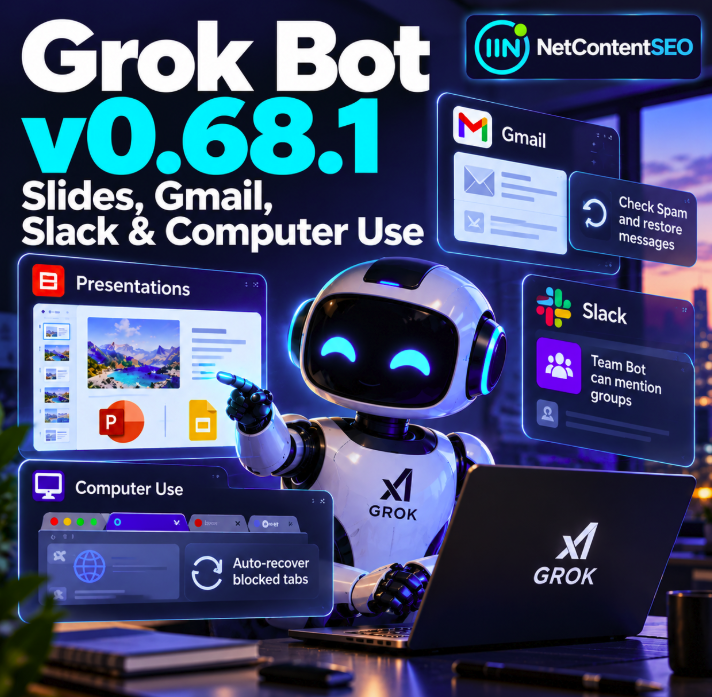
On October 7, 2026, xAI listed Grok Bot v0.68.1 with a series of upgrades spanning presentation creation, email, Slack collaboration and computer use. The update reflects a shift from conversational responses toward an assistant capable of executing workflows across multiple applications.
The release details described here follow the official xAI Grok Bot changelog as summarized in the editorial brief. The exact release hour was not specified. Features and access can vary by account, integrations and permissions.
What's new in Grok Bot v0.68.1?
- Slide decks: previews of sample slides and delivery as PowerPoint or Google Slides presentations.
- Formatted emails: creation and sending of richer email messages.
- Gmail Spam: searching for misplaced messages and restoring them from the Spam folder.
- Slack: Team Bots can mention groups in connected workspaces.
- Computer use: faster interactions and a larger 1920 × 1200 display environment.
- Browser recovery: automatic recovery of blocked or stalled tabs.
- Reliability: improvements reported for Gmail, large uploads, X and Vercel login workflows, and secure forms encountered during checkout.
These are release-note capabilities, not independently measured performance gains. No universal completion rate or speedup percentage was supplied.
Presentation creation moves beyond text outlines
Presentation support is a meaningful step toward deliverable-based AI work. Instead of only writing slide outlines, Grok Bot is described as showing example slides and exporting finished decks in familiar formats: Microsoft PowerPoint and Google Slides. For editorial, marketing and research teams, that could shorten the path from gathering information to presenting it.
Human review remains essential. A slide deck can be visually polished yet still contain inaccurate facts, weak attribution or layout errors. Teams should check the final file and verify sources before sharing it externally.
Gmail: formatted sending and Spam-folder recovery
Formatted email expands the bot's communication abilities beyond plain-text drafting. Searching Gmail Spam and restoring messages addresses a common interruption in workflows: a confirmation, invitation or requested document arrives in the wrong folder.
However, restoring a message from Spam does not establish that it is safe. Spam filtering exists for security reasons. Any agent-assisted recovery should be followed by checks of sender identity, suspicious links and attachments, particularly when the message involves authentication, payments or account changes. Before sending, verify recipients and any sensitive information included.
Slack group mentions extend team coordination
According to the update, Grok Team Bots can mention groups on Slack. That can help agents notify a team responsible for reviewing an output, approving a change or continuing a task. The practical effect depends on Slack permissions, group configuration and notification policies. The feature does not imply unrestricted access to workspace conversations or the ability to mention any group without authorization.
Faster computer use and a 1920 × 1200 workspace
Computer-use agents interact with websites and software through graphical interfaces. A larger display can expose more information at once, while quicker interactions may reduce friction in multi-step tasks. The reported 1920 × 1200 screen resolution is therefore relevant to workflows involving dashboards, documents, forms and browser navigation.
The update also describes automatic recovery of blocked browser tabs. This matters because a single stalled tab can interrupt an otherwise straightforward automation. Reliability improvements for large uploads, Gmail, X and Vercel login flows, and secure checkout forms target similarly practical failure points. None of these changes guarantees that every site, login challenge or checkout will work; sensitive actions still warrant human oversight.
Why this update matters for SEO and AI visibility
Grok Bot v0.68.1 does not establish a new search-ranking signal. Its significance for SEO and GEO is indirect: as AI assistants increasingly browse websites, retrieve information and transform it into documents or actions, publishers need to consider whether their content can be found, understood, attributed and used reliably in those workflows.
Discoverability is only the first step
Traditional search optimization often focuses on crawling, indexing, rankings and clicks. Task-oriented agents introduce additional questions: Can the agent access a source through an authorized workflow? Can it distinguish the main content from navigation or promotional clutter? Can it carry forward the source's meaning accurately when preparing a presentation or email?
These are practical research questions, not confirmed Grok Bot citation criteria. The changelog does not announce changes to Grok search indexing, web crawling or how sources are selected for AI answers.
Readable structure and attribution become useful downstream
Clear headings, explicit publication dates, visible authorship, accessible navigation and well-labeled references make editorial pages easier for people to evaluate. They may also reduce ambiguity when content is consumed by software agents. But it would be premature to claim that implementing these elements specifically increases Grok Bot citations or visibility.
Agent-compatible interfaces matter for completed tasks
Browser-driven workflows depend on stable forms, accessible controls, understandable errors and predictable page states. The browser-recovery and computer-use changes underscore that operational reliability is a separate problem from generating a good answer. Publishers and businesses can audit their own interfaces for conventional usability and accessibility without claiming an undocumented SEO boost.
What publishers and marketers should test
- Source fidelity: ask the agent to turn a source-backed article into slides, then compare every claim and citation with the original.
- Document output: inspect PowerPoint and Google Slides formatting, embedded links and image attribution.
- Email review: check recipient confirmation, message formatting and handling of Spam-folder messages.
- Workspace permissions: test Slack group mentions only in authorized channels and groups.
- Browser resilience: evaluate whether multi-step tasks recover from a blocked tab without duplicating actions.
- Human approval: keep explicit review around payments, account settings and sensitive data.
Track actual task success and source preservation rather than inferring visibility benefits from a feature announcement.
Does Grok Bot v0.68.1 change ranking, crawling or AI citations?
No such change is documented in the supplied update. The announced capabilities concern task execution and application reliability. There is no basis here to claim that websites gain ranking positions, receive more citations or face different crawling rules because of this release.
FAQ
When was Grok Bot v0.68.1 released?
The update is dated October 7, 2026. An exact release time was not provided in the editorial brief.
Can Grok Bot create PowerPoint presentations?
The release summary says it can preview sample slides and deliver presentations as PowerPoint or Google Slides files.
Can Grok Bot recover Gmail messages from Spam?
The release summary describes searching the Spam folder and restoring messages. Users should still assess whether those messages are trustworthy.
What changed in computer use?
The update reports faster computer interactions, a 1920 × 1200 screen and browser-tab recovery improvements.
Can Grok Team Bots mention Slack groups?
Yes, according to the update summary, subject to connected-workspace permissions and settings.
Does the update improve SEO rankings?
No ranking improvement is established by these release notes. Agent accessibility and source discoverability are broader areas for research.
NetContentSEO analysis
Grok Bot's latest changes reinforce a larger transition: AI assistants are becoming operational interfaces connecting browsers, documents, inboxes and workplace collaboration. For AI visibility researchers, the opportunity is to examine how accurately agents access and reuse sources across these workflows. That should be measured independently, without confusing new agent capabilities with confirmed changes in search ranking or citation systems.
Official source: xAI — Grok Bot changelog.