

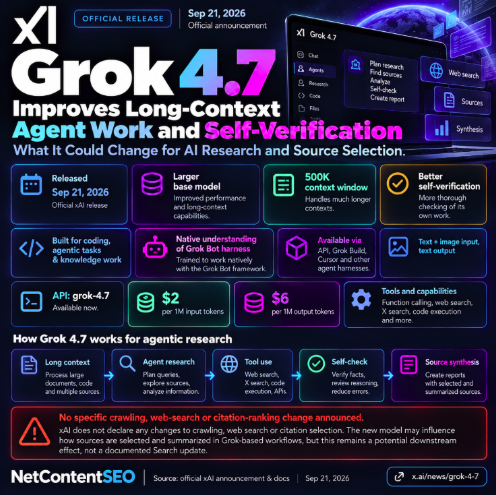
xAI released Grok 4.7 on September 21, 2026 as its new frontier model for coding, agentic tasks and knowledge work. The model uses a larger base model than Grok 4.6, manages longer contexts more effectively and was trained to check its own work more carefully.
For AI search and GEO, the release is interesting even though xAI has not announced a specific change to crawling or citation ranking: Grok 4.7 can use web search and X search as tools, so changes in reasoning and agent behavior can potentially affect how research workflows find, evaluate and synthesize sources.
A larger model trained for longer-running work
xAI says Grok 4.7 uses a new, larger base model and received a longer reinforcement-learning run on a harder task mix weighted toward work that can take hours to complete.
The API model has a 500,000-token context window, supports text and image input, and offers low, medium, high and xhigh reasoning effort.
Self-verification is a central part of the update
xAI explicitly says the model is better at verifying its own work. For agentic research, that capability can matter because an agent may need to execute multiple steps, inspect results, identify inconsistencies and revise its approach before producing a final answer.
That is different from a direct claim that Grok's factual accuracy or citation quality has improved in every search task. xAI has not published such a universal guarantee.
Grok 4.7 understands the Grok Bot harness natively
The model was also trained to understand the Grok Bot harness natively. xAI positions Grok Bot as a persistent agent environment capable of working across tools, browsers, terminals, connectors and recurring workflows.
This makes Grok 4.7 particularly relevant to workflows where research is not a single prompt but a sequence of searches, tool calls, document analysis and verification steps.
Web search and X search are available tools
xAI's Grok 4.7 documentation lists web search, X search, function calling and code execution among the model's available tools.
That creates a direct connection to source discovery. A Grok-powered agent can search the web, inspect retrieved information, combine it with a long working context and use additional reasoning steps before generating its response.
No specific search or citation-ranking update was announced
The distinction is important for SEO reporting. xAI's launch announcement focuses on the model, agentic work, coding, professional knowledge tasks and safety. It does not announce a new crawler, web index, retrieval ranking system or citation-selection algorithm.
Any change in which sources appear in Grok-powered research should therefore be measured empirically rather than assumed from the model release alone.
Pricing starts at $2 input and $6 output per million tokens
Standard Grok 4.7 API pricing starts at $2 per million input tokens and $6 per million output tokens. Cached input is $0.50 per million tokens below the long-context threshold. Requests above 200,000 prompt tokens use higher long-context pricing.
The model is available through the xAI API, Grok Build, Cursor and several model gateways.
The NetContentSEO view
For AI visibility, Grok 4.7 is worth monitoring because model changes can alter retrieval behavior even when the underlying search infrastructure is unchanged.
A model that manages longer context, works through longer agent loops and verifies intermediate work differently may formulate different searches, follow different sources or weigh retrieved evidence differently. That could ultimately change which publishers become visible inside Grok-based research workflows.
But this remains a hypothesis to test, not an announced xAI Search update. The useful next step for GEO teams is therefore comparative measurement: run stable prompt sets across model versions and observe whether cited domains, retrieval depth and source diversity change.