

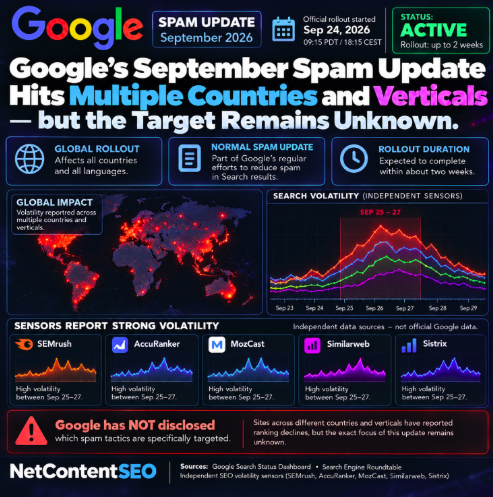

Google's September 2026 spam update is still rolling out. Google launched the update on September 24 at 09:15 PDT — 18:15 CEST — and the official Search Status Dashboard continues to mark it as Active as of October 1.
Google describes it as a normal spam update applying globally and across all languages, with rollout expected to take up to two weeks.
The rollout is still active
The Search Status Dashboard lists Ranking as the affected Google Search product and has not yet posted a completion notice. That means ranking movements observed during this period should still be interpreted while the update is in progress rather than as a settled post-update state.
Independent sensors saw a volatile September 25–27
Independent tracking showed substantial movement almost immediately after the rollout began. Search Engine Roundtable reported strong volatility beginning Friday, September 25, intensifying on September 26 and continuing through September 27.
Multiple SEO volatility tools and industry observers showed elevated movement during the period. These measurements are independent signals rather than Google data, so they can indicate unusual ranking change without identifying the underlying cause for every affected site.
Losses have been observed across countries and verticals
Industry analysis has documented significant declines across sites in multiple countries and verticals during the rollout. Glenn Gabe, for example, reported large drops across a range of sites and markets, while other observers highlighted examples involving highly templated or programmatic content.
Those examples are useful for investigation, but they should not be converted into a definitive description of the update's target.
Google has not said what specific spam tactics changed
The official announcement is deliberately broad. Google says this is a spam update but does not identify a new policy, tactic or content-production method that the September system specifically targets.
Claims that the update is specifically an “AI content update,” a programmatic SEO update or an attack on any single publishing model therefore go beyond what Google has confirmed.
Correlation during rollout is not diagnosis
Sites losing visibility during a spam update naturally want to identify a single cause. But volatility alone cannot establish whether a domain was affected by the spam system, another ranking change, competitive movement or a combination of factors.
The timing is particularly important because Search Engine Roundtable had already documented notable ranking volatility around September 23 and 24, immediately before Google confirmed the spam update.
Do not reverse-engineer from a few winners and losers
When an update is still active, isolated examples can be misleading. A site may lose one set of queries while gaining another, competitors can move simultaneously and later rollout stages can reverse early visibility changes.
For publishers, the safer approach is to document affected page groups, countries, query classes and content templates, then compare those patterns after Google confirms completion.
The NetContentSEO view
The strongest fact right now is also the simplest: Google's September spam update is global, still active and producing measurable ranking turbulence, but its specific target remains undisclosed.
That makes this a monitoring phase rather than a moment for confident causal claims. The useful work is segmentation: identify which directories, templates, countries, topics and query types moved, then determine whether a coherent pattern survives after rollout completion.
If highly templated or programmatic pages continue to show disproportionate losses after the update stabilizes, that will be worth deeper analysis. For now, those observations remain independent evidence — not an official description of what Google's spam systems changed.