

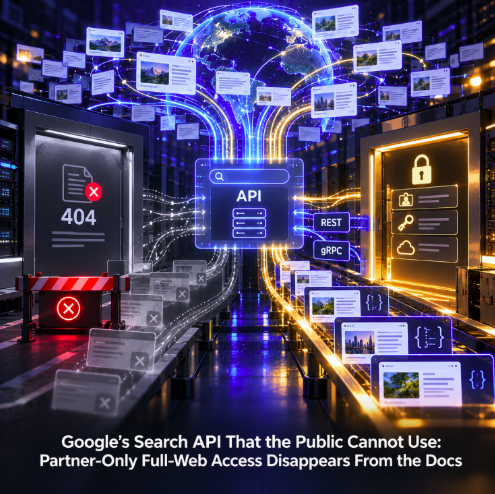

For a brief period in September, Google’s own developer site exposed an unusually detailed view of a search product most developers cannot use. The documentation described a Web Search Service API through which “programmatic partners” could retrieve Google Search results using REST or gRPC and receive structured JSON responses. By September 20, the pages had disappeared and were returning a hard 404, according to a September 28 report from Search Engine Roundtable.
The disappearance is as interesting as the documentation itself. Google did not announce a public Web Search Service API, and the material that briefly appeared never described a self-service product. Instead, access required a Google Cloud project, an API key and, critically, a designated client ID associated with a partner agreement. Reporting while the pages were still accessible found no public pricing, standard eligibility criteria or ordinary signup path.
The episode therefore should not be interpreted as Google launching and then cancelling a public Search API. What the removed pages revealed was narrower: Google had documented an official programmatic route to full-web search results for approved partners, while the broader developer market remained outside that access model.
The documentation exposed a real partner interface, not an open developer product
Search Engine Journal reviewed the documentation while it was live and reported that Google had refreshed the main Web Search Service API overview and four related pages on September 9. The service allowed partners to retrieve and display Google Search results inside websites and applications, with every request requiring a client ID tied to a partner agreement in addition to a Cloud project and API key.
The technical interface was unusually explicit. Contemporary copies and reporting describe REST and gRPC access, JSON responses, pagination and search controls including language, country, date and SafeSearch options. A request could return up to 20 results, and the documented response included result items, timing information and metadata.
That is materially different from saying Google exposed every element visible on a consumer Search results page. The documentation described structured web results; it did not promise a pixel-for-pixel representation of ads, local packs, AI features, knowledge panels or every other Google Search surface.
The decisive requirement was the partner agreement
A normal Google Cloud project and API key were not enough. The documentation required a designated client_id linked to a partner agreement. Search Engine Watch reported that the public pages did not explain which businesses qualified, what access cost or how long approval would take.
That distinction changes the meaning of the API. It was not a product that an SEO tool, independent developer or new AI assistant could simply enable from the Cloud Console. The technical documentation assumed a commercial relationship with Google already existed.
In practical terms, the scarce resource was not the endpoint. It was authorization.
Then the public documentation vanished
On September 28, Search Engine Roundtable reported that the documentation had been removed. The publication said the page appeared to have been published accidentally and noted that an archived copy remained available through the Internet Archive. It also cited an observer who said the documentation was gone by September 20 and now returned a hard 404 without a redirect or deprecation notice.
Google has not publicly explained why the pages disappeared. That leaves several interpretations possible: the material may have been published prematurely, exposed beyond its intended audience, or simply been removed while the underlying partner service continued to exist.
The removal itself does not establish that the API has been shut down. Search Engine Roundtable’s report explicitly frames it as a service that partners may still have access to even though Google does not offer it publicly.
The timing matters because Google’s public Custom Search API is approaching shutdown
The vanished documentation appeared against an important product transition. Google’s older Custom Search JSON API is closed to new customers and scheduled for discontinuation on January 1, 2027. Reporting on the Web Search Service documentation noted that Google had previously told developers needing full-web results to express interest in a separate full-web solution.
While the Web Search Service API was documented, it looked technically relevant to that need: it performed full-web searches and was restricted to partners. Yet Search Engine Journal reported that Google’s January guidance and the September API documentation did not explicitly connect the two.
That missing link is important. It would be tempting to call the partner API the official replacement for Custom Search JSON API, but Google did not publicly establish that migration path in the material reviewed by reporters.
The episode exposes two different meanings of “Search API”
Developers often use the phrase “Google Search API” to mean a self-service interface through which any qualified customer can programmatically obtain Google results. The removed Web Search Service pages described something different: an interface available after a partner relationship had already been established.
Technically, both are APIs. Economically, they create very different markets.
A public API turns access into a product with published onboarding, quotas and pricing. A partner API turns access into a negotiated capability. The latter can support large products and strategic integrations while remaining inaccessible to independent developers who want the same underlying search data.
This matters more as AI assistants depend on web retrieval
The partner model is especially relevant in an AI market where assistants, answer engines and research agents need reliable access to current web information. A product that can obtain structured search results through an authorized provider interface starts from a different infrastructure position than one that must crawl, license another index, build its own index or depend on alternative search APIs.
The removed documentation does not identify which AI companies or assistants use Web Search Service, and it would be speculative to infer specific customers from the existence of the API. Search Engine Roundtable mentioned Apple only as an assumption by its author, not as a Google-confirmed customer of this particular service.
What the documentation does establish is that Google had designed a formal mechanism through which approved programmatic partners could retrieve its search results in structured form. That capability is strategically meaningful even when the identities and commercial terms of the partners remain undisclosed.
For SEO platforms, authorized access is becoming a competitive variable
Search-result data underpins rank tracking, competitive intelligence, brand monitoring and increasingly AI-visibility analysis. When access is available only through negotiated partnerships, the ability to obtain search data becomes part of the competitive structure of the tooling market.
This does not mean independent SEO platforms lose access to Google data overnight. Search tools already use multiple collection methods and data providers. But the Web Search Service documentation shows that Google itself has at least documented an official structured path for selected partners while its broadly available Custom Search JSON API moves toward retirement.
That creates a useful distinction for buyers of search intelligence: whether a vendor is using a public API, an authorized partner feed, its own crawling infrastructure, licensed third-party data or some combination of those sources.
The vanished pages revealed important technical boundaries
Even though the documentation is no longer publicly available, reporting while it was live captured several design choices. The service supported REST and gRPC, returned standard JSON and allowed up to 20 results per request. Requests included end-user context, including an IP address used for regional routing and abuse prevention, according to reporting based on the documentation.
Those details suggest an interface designed for products serving real end users rather than a generic bulk export of Google’s index. The requirement to provide user context also indicates that the result set could be generated with location and abuse controls in mind.
Again, the important boundary is what was not documented publicly: partner qualifications, pricing, daily or monthly quotas and the contractual rights governing reuse of the returned results.
Google removed the documentation, not the evidence that privileged access exists
The most defensible conclusion from the episode is not that Google accidentally revealed a secret public API. It is that public documentation briefly exposed the mechanics of a partner-only search interface and then disappeared.
For ordinary developers, the endpoint was never truly open. A Cloud project and API key could satisfy the technical prerequisites, but the partner-linked client ID remained the gate. For approved partners, the documentation showed a direct, structured way to request Google Search results without reconstructing a SERP through scraping.
That asymmetry is the real story. As search results become input not only for websites and search tools but also for AI assistants and autonomous research systems, access to reliable retrieval infrastructure is becoming a strategic asset in its own right.
The Search API Google does not offer publicly is a reminder to separate capability from availability
The Web Search Service episode illustrates a recurring problem in platform analysis: discovering that a capability exists is not the same as discovering a product anyone can buy.
Google’s briefly public documentation showed that full-web search results could be delivered to programmatic partners through a structured API. It did not show a public signup path, standard pricing or universal developer access. And after the documentation was removed, even that limited public window closed.
For publishers, SEO platforms and AI companies, the implication is less about one vanished developer page than about the infrastructure underneath modern discovery. Search visibility may look open on the web, but programmatic access to the systems that retrieve and organize that web can be governed by a very different set of gates.