

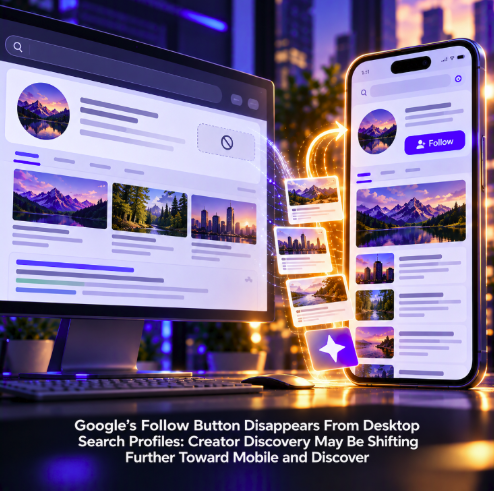

Google appears to have removed the Follow button from Search profiles in desktop search results while leaving the same action available on mobile. The change was first flagged on September 25 and independently reproduced by Search Engine Roundtable, which found a Search profile on desktop without the Follow control while the mobile result continued to show it. Google has not announced that the desktop removal is permanent. Search Engine Roundtable documented the desktop/mobile difference on September 28.
The timing makes the test particularly notable. Less than two weeks earlier, Google announced a fresh expansion of Search profiles for publishers, including multi-account management, improved article presentation and a lower eligibility threshold of 10,000 followers across YouTube, Instagram, X or TikTok. Google’s September 16 announcement described Search profiles as a way for publishers to highlight their content and connect with audiences on Google.
The disappearance of Follow on desktop therefore does not look like evidence that Google is abandoning Search profiles. The more defensible interpretation is narrower: Google may be changing where it wants the follow action to occur, with mobile Search and Discover remaining more tightly connected to the personalized content loop.
The observed change is specific to the desktop Follow control
The September 25 observation came from Damien Andell, who reported that Google had removed the Follow button from desktop Search while retaining it on mobile Knowledge Panels. Search Engine Roundtable subsequently reproduced the difference using a creator search: the desktop result exposed the Search profile but no Follow button, while mobile still offered Follow.
That distinction matters because the Search profile itself has not disappeared from desktop. Google’s current help documentation still says users can find Search profiles by searching for a creator or brand on google.com from either a computer or mobile device, and the desktop result can provide a route to view the Search profile.
What appears to have changed is the conversion action attached to that discovery surface. Desktop users can still encounter and inspect the profile, but the direct Follow control seen previously is no longer consistently present.
Google has not confirmed a permanent removal
There is no Google announcement saying Follow has been permanently retired from desktop Search profiles. The evidence currently supports describing the change as a verified interface observation rather than a completed product deprecation.
Google frequently tests different Search presentations, and interface availability can vary by account, market, device and experiment assignment. Without an official statement, it would be premature to conclude that the desktop control cannot return or that every desktop user sees the same treatment.
Publishers should therefore monitor the behavior rather than remove Search-profile work from their discovery strategy on the basis of one interface change.
Following a Search profile is fundamentally a Discover signal
The strategic significance becomes clearer when looking at what Follow actually does. When Google introduced Search profiles in June, it said users could follow sources from their profiles so they would be more likely to see content from those sources in Discover, the personalized feed available through the Google app.
Google’s current Search-profile documentation repeats that connection. It says changes to a Search profile do not affect ranking in Google Search or Discover, but if someone follows a profile, that person may see more of its content in the personalized feed.
Google Search Central goes further in its documentation for Search-profile badges: when readers follow a Search profile, content linked to that profile—including material from Instagram, TikTok, YouTube, X, Facebook and the publisher’s own website—has a greater chance of appearing to that audience in Google’s personalized feed.
Follow is therefore not best understood as a conventional Search ranking feature. It is a relationship signal feeding a personalized discovery system.
Mobile is the natural home of that personalized loop
Discover itself is fundamentally mobile-oriented. Google’s official documentation says people access Discover through the Google app, through google.com on a phone or tablet and, on some Android devices, by swiping from the home screen.
That makes the continued presence of Follow on mobile structurally logical. A user discovers a creator in mobile Search, follows the Search profile and can subsequently encounter that creator’s content in a mobile personalized feed without needing to perform another query.
The desktop path is less direct because Discover is not a conventional desktop Search destination. If Google is intentionally reducing the prominence of Follow on desktop, the decision could reflect where the downstream value of following is strongest rather than a retreat from creator profiles themselves.
Search profiles are becoming more important at the same time
Any interpretation needs to account for Google’s September 16 product expansion. Google added the ability for publishers managing several brands to claim and manage multiple Search profiles from a single login. It also redesigned article presentation with improved thumbnails and longer headlines and lowered the eligibility threshold for more U.S. publishers and creators to 10,000 followers across supported social platforms.
Google’s creator site still positions Search profiles as an official presence on Google for creators, brands and publishers, bringing together social accounts, websites, posts and links in one customizable destination.
The platform is therefore expanding publisher access and profile-management functionality while apparently narrowing one desktop interaction. Those developments are compatible if Search profiles increasingly serve two roles: an entity/content hub across Search and a follow-to-Discover acquisition surface concentrated on mobile.
Creator discovery may be splitting into desktop identity and mobile retention
One useful way to interpret the current interface is to separate discovery from retention. Desktop Search can still expose the creator’s profile, content and identity. Mobile can perform the same discovery while also offering an immediate Follow action that affects future personalized content exposure.
If the desktop removal persists, that would make the two surfaces less symmetrical. Desktop Search would remain useful for verifying and exploring a creator or publisher, while mobile Search would carry an additional audience-retention mechanism.
This is a hypothesis about product direction rather than a Google-confirmed strategy. The observed interface alone does not prove that Google intends to shift creator discovery toward mobile. What makes the hypothesis plausible is the documented connection between following a Search profile and receiving more content in Discover.
Publishers should measure Follow as an audience-acquisition event
For publishers, the most useful metric is not simply whether the button exists. The question is whether Search-profile discovery turns anonymous searchers into people more likely to encounter the publisher again.
Google provides Search-profile Insights that include top-performing content, total clicks, total impressions and audience reach by country. The documentation says those insights can be filtered across Google platforms such as Search, the personalized feed and connected social accounts.
That creates an opportunity to compare the surfaces rather than treating the profile as one undifferentiated channel. Publishers can monitor whether Search-profile visibility grows on mobile, whether Discover exposure changes as the follower base develops and whether particular content formats produce stronger recurring reach.
The website can still send readers directly to the Search profile
Google also provides publishers with a Search-profile badge that can be added to their own websites. Search Central explicitly recommends the badge as a way to help audiences find the publisher’s profile and explains the relationship between following and future visibility in the personalized feed.
This becomes more relevant if desktop SERPs no longer present Follow directly. A publisher does not have to rely exclusively on the Knowledge Panel or Search result as the acquisition path; owned pages can route engaged readers to the profile where the relationship can continue.
That does not mean publishers should aggressively divert website users back into Google. The value depends on the audience strategy. For organizations already dependent on Discover, however, the profile badge becomes a measurable mechanism for turning existing readers into potential repeat Discover viewers.
Following does not boost Search rankings
There is an important boundary to preserve. Google explicitly says editing a Search profile does not affect content ranking in Google Search or the personalized feed. Following can influence the likelihood that a follower sees more content from that source in the personalized feed, but that is not the same as an organic Search ranking boost.
Publishers should therefore avoid treating follower acquisition as an SEO authority signal unless Google provides evidence for such a relationship. The documented benefit is audience personalization, not a general ranking advantage.
The practical opportunity is a mobile-versus-desktop experiment
Because Google has not confirmed the desktop change, publishers can treat the current period as an observational experiment. Important brand and creator queries can be checked across signed-in desktop and mobile sessions, recording whether the Search profile appears, whether Follow is available and how prominently recent articles and social posts are displayed.
The results can then be compared with Search-profile Insights and Discover performance. If Follow remains absent on desktop but follower growth and personalized-feed reach continue to rise, that would support the idea that mobile is carrying most of the relationship-building function. If the button returns, the episode may prove to have been only a temporary interface test.
The larger story is the convergence of Search identity and personalized discovery
Google launched Search profiles as a way for publishers and creators to consolidate articles, videos, social posts and links into a single presence. Three months later, it expanded eligibility and management features. At the same time, the Follow mechanism connects that identity layer directly to Discover.
The disappearance of Follow from desktop therefore matters less as a missing button than as a clue about where Google sees the recurring audience relationship happening. Search can introduce the source; the Search profile can establish identity; Follow can turn that source into an interest; and Discover can surface its content later without a new query.
For now, only one part of that chain has visibly changed: the Follow control is no longer appearing in the observed desktop Search-profile presentation while it remains available on mobile. Until Google confirms a permanent change, that is the factual boundary. But for publishers building Search profiles, it is enough reason to start measuring desktop and mobile discovery as different acquisition surfaces rather than assuming they perform the same job.