

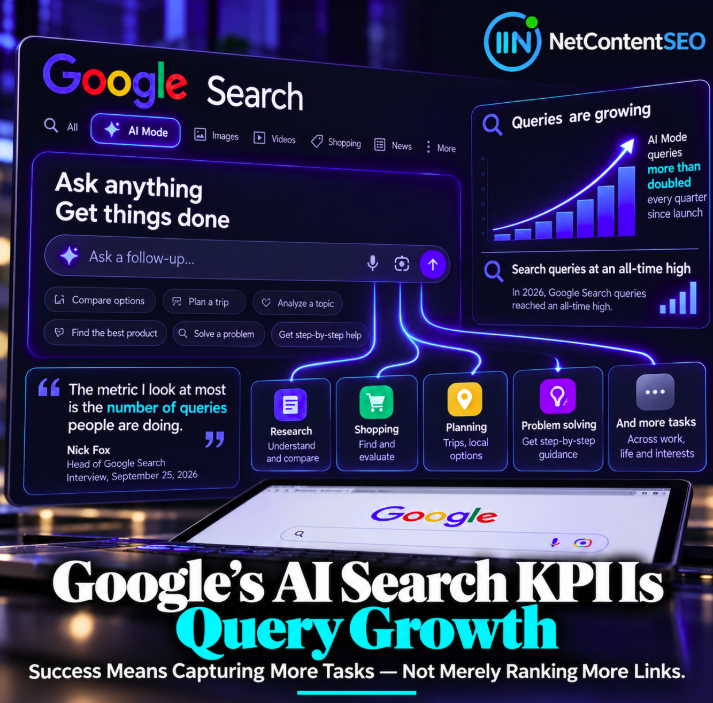

Google's preferred measure of AI Search success is surprisingly simple: are people asking Google more questions?
In an interview published September 25, 2026, Nick Fox, Google's SVP of Knowledge & Information and the executive responsible for Search, was asked which single metric would show five years from now that Google's AI strategy had worked.
Fox said the metric he watches most is the number of queries people are doing.
His explanation reveals something larger about Google's AI Search strategy. A query is no longer merely a request for a ranked list of links. Google increasingly treats it as a task, problem, question or topic that a user is entrusting to Search.
Query volume is Google's clearest success signal
Fox explained that query count matters because, when defined appropriately, it represents how many things users bring to Google and ask it to help with.
If that number rises, Google interprets it as evidence that Search is helping with a larger share of users' needs.
This is a very different lens from publisher-side metrics such as organic clicks, impressions or referral sessions.
Google is measuring how much user activity begins — and increasingly continues — inside Search.
AI changes what counts as a search
Traditional web search encouraged concise queries because users learned to communicate with a keyword-based retrieval system.
Fox says queries are now much longer than they used to be, often spanning multiple sentences.
Users can describe a problem in natural language, add context and continue asking follow-up questions.
That means one information need that once produced a short query followed by a website visit can now become a multi-turn Search session.
Follow-up questions expand the query opportunity
Fox described users going five or ten questions deep in a conversation and returning to ongoing Search threads later.
For Google, those follow-ups represent additional opportunities to solve problems inside its product.
Google's own 2026 Search announcements reinforce the strategy. In May, the company said AI Mode queries had more than doubled every quarter since launch and that overall Search queries had reached an all-time high.
Google has repeatedly framed this growth as evidence that AI is expanding Search rather than replacing it.
AI Mode is designed around tasks, not ten blue links
The evolution is visible in Google's product design.
AI Mode can research topics, compare products, plan activities, interpret images and files, maintain conversational context and increasingly perform agentic tasks.
Google has also introduced information agents and described Search experiences that can create persistent tools and trackers for ongoing activities.
The unit of competition is therefore shifting from “which search engine returns the best links?” toward “which assistant can handle the greatest number of user tasks?”
That creates a new competitive battlefield
Google is no longer competing only with Bing or other traditional search engines for query share.
Users can now take informational, commercial and problem-solving tasks to ChatGPT, Claude, Perplexity, Gemini and specialized AI products.
Seen through that lens, query growth is strategically important because every task brought to Google is a task that did not begin somewhere else.
AI Search is therefore partly a battle for task capture.
The metric also explains Google's push into conversational search
If more queries are the goal, reducing the friction of asking another question becomes critical.
Google now lets users move from AI Overviews into conversational AI Mode and continue asking follow-ups while preserving context.
The user does not need to reformulate every information need into a new keyword query.
Search can become an ongoing interaction rather than a sequence of isolated SERPs.
Longer queries create more context
Google says AI Mode queries are, on average, substantially longer than traditional Search queries.
That matters because richer queries expose more intent.
A user searching for “running shoes” communicates relatively little. A user describing terrain, injury concerns, preferred cushioning, budget and training distance provides a much richer decision context.
For Google's AI systems — and potentially its advertising systems — that context creates opportunities to produce more tailored answers and recommendations.
Query growth does not equal publisher traffic growth
This is where Google's success metric diverges sharply from the publisher perspective.
More queries can be good for Google even when users need fewer external clicks to complete a task.
A conversational session can generate several queries while the user remains inside AI Mode throughout the interaction.
Fox has separately argued that Google's AI experiences continue to send substantial traffic to the web and has rejected the idea that AI Search simply eliminates clicks.
But query volume and publisher referrals are fundamentally different metrics. Growth in one does not prove growth in the other.
SEO can no longer interpret search demand only as keywords
If Google's own strategic unit is expanding from queries toward tasks and problems, SEO measurement needs a corresponding conceptual shift.
The opportunity is no longer limited to ranking for a fixed set of short keywords.
Brands need to understand the broader tasks for which customers might ask an AI system for help: comparing alternatives, troubleshooting, planning, choosing, verifying, learning and purchasing.
Those task spaces can generate many conversational queries around one underlying need.
Visibility across a task journey matters
In classic SEO, a team might monitor whether a page ranks for “best CRM software.”
In AI Search, the journey can expand into a sequence: which CRM suits a five-person sales team, which integrates with an existing stack, what it costs, how difficult migration is, which alternatives support a particular workflow and what current users report.
A brand may be visible in one answer and disappear from the next.
That makes prompt-set and journey-level monitoring increasingly useful alongside keyword rankings.
Google's metric also helps explain query fan-out
Modern AI retrieval can internally break a complex request into multiple searches to gather supporting information.
Those machine-generated retrieval operations should not automatically be confused with user queries, but they illustrate the broader transformation of Search: one user request can trigger far more retrieval work than one classic keyword search.
For publishers, this creates more potential retrieval surfaces but also makes traditional rank-position thinking less complete.
Success for Google and success for publishers are not identical
Google can celebrate rising query volume because it indicates increasing product usage.
A publisher still needs to measure whether that usage produces citations, brand mentions, qualified visits, leads, sales, subscriptions or other business outcomes.
That distinction is increasingly important in AI Search reporting.
“Search usage is growing” is not equivalent to “organic traffic to every website is growing.”
The new SEO question: which tasks does your brand deserve to participate in?
The strategic response is not to manufacture thousands of pages for every conceivable conversational prompt.
It is to identify the meaningful customer tasks where the brand has genuine expertise, evidence, products or services to contribute.
Content can then support the full decision journey with original information, clear entities, useful comparisons, credible authorship and facts that retrieval systems can confidently reuse.
NetContentSEO take
Nick Fox's preferred KPI makes Google's AI Search strategy unusually clear.
Google wants users to bring more of their questions, problems and tasks to Search. AI Mode expands the range and depth of those interactions, turning one search need into an ongoing conversation.
For SEO, that means the competitive unit is gradually moving beyond the keyword and even beyond the click.
The question is becoming: when users delegate a task to an AI search system, does your brand become part of the answer?
Google measures success by capturing more queries. Brands will need to measure whether they capture meaningful visibility and demand inside those expanding task journeys.