

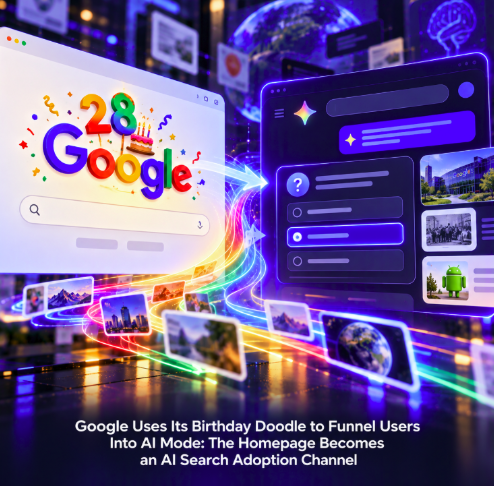

Google used one of the most visible pieces of real estate on the web to introduce users to AI Search in a deliberately low-friction way. Its 28th birthday Doodle, launched on September 27, celebrates the company with a nostalgic early-era logo and invites people to learn about Google’s history, culture and memorable moments through a birthday trivia quiz. Google’s official Doodle page confirms both the anniversary treatment and the quiz. Google’s official 28th birthday Doodle page describes the experience as a trivia journey through the company’s history.
The strategically interesting part happens after the click. Search Engine Roundtable documented that clicking the birthday Doodle sends users into AI Mode, where the trivia becomes a conversational Search experience covering Google lore, historical quirks and birthday traditions.
This is more than a birthday easter egg. It is a concrete example of Google using its own homepage distribution to place people inside AI Mode without first asking them to understand what AI Mode is, find a dedicated tab or formulate a complex prompt. The product demonstration is embedded in an activity users already understand: take a quiz.
The Doodle turns AI Mode onboarding into entertainment
AI products often face an adoption problem that has little to do with model quality. Users need to know that the feature exists, understand what it can do and develop the habit of interacting with it differently from a traditional search box.
The birthday quiz compresses those steps. The Doodle supplies the topic, the click supplies the entry point and the quiz supplies the conversational structure. A user does not need to arrive with a prompt strategy. The interface teaches the interaction by letting the user participate.
That is a different onboarding mechanism from a product announcement or an explanatory banner. Instead of describing conversational Search, Google makes the conversation itself the destination.
Google’s homepage is an unusually powerful distribution surface
Doodles have always been able to transform the Google logo into a gateway to another experience. Google’s own Doodle library describes them as celebrations of culture, places and holidays and regularly uses interactive formats, games and educational experiences.
The 28th birthday treatment applies that familiar interaction pattern to AI Mode. Users already know that a Doodle can be clicked. The novelty is what Google places behind the click: not simply a results page about the anniversary, but an AI-driven conversational experience.
That makes the homepage itself part of the AI Search adoption funnel. Discovery happens before the user has expressed any intention to try AI Mode.
The quiz is a product demonstration disguised as company trivia
The content is deliberately accessible. Search Engine Roundtable reports that the AI Mode experience invites users into a trivia quiz about Google’s company lore, historical quirks and birthday traditions.
That subject matter reduces the cost of experimentation. A user is not being asked to trust AI Mode with an important purchase, medical question or complex research task on first contact. The stakes are low, the answers are playful and the interaction can be abandoned at any point.
From a product-adoption perspective, this matters because the first successful conversational interaction can establish a mental model for later use. Once someone understands that Search can ask questions, maintain context and continue a dialogue, the same interaction pattern becomes easier to apply to other topics.
Google has already been removing the boundary between Search and AI Mode
The birthday activation fits a much larger product strategy. In January, Google described a more seamless Search experience in which users could move from an AI Overview into a back-and-forth conversation in AI Mode while preserving context. Google said its tests showed that people preferred an experience that flowed naturally into conversation. Google’s January Search update explicitly framed AI Overview and AI Mode as parts of one continuous experience.
At Google I/O in May, the company pushed that convergence further. Google said AI Mode had surpassed one billion monthly users and that query volume in the experience was more than doubling every quarter. It also introduced an AI-reimagined Search box and made it easier to continue from an AI Overview into AI Mode. Google’s I/O Search announcement described the goal as combining the strengths of a search engine with conversational AI.
The Doodle campaign should therefore be read as distribution for an established strategic direction, not as an isolated experiment with a birthday quiz.
AI Mode adoption is increasingly happening inside existing Search habits
Early generative-search products often required users to choose a separate experimental interface. Google’s current direction reduces that requirement. AI Overviews can lead into AI Mode, the Search box itself is becoming more AI-native, and now a homepage Doodle can place users directly into a conversational task.
This matters because product adoption is easier when it piggybacks on existing behavior. Google does not need every user to decide independently that today is the day to learn AI Mode. It can expose the interaction at moments when the user is already on Search.
The birthday Doodle is a particularly clear example because the acquisition path begins before a query. The user can enter AI Mode by interacting with Google’s branding itself.
The activation changes what a Doodle can do for Search
Traditionally, a homepage Doodle could generate searches about the person, event or anniversary it celebrated. An interactive Doodle could also keep users inside a game or educational experience. The 2026 birthday treatment adds another possibility: the Doodle can act as an onboarding surface for a core Search interface.
That creates a reusable pattern. A cultural event, scientific anniversary, sports tournament or educational moment could theoretically become a structured entry point into an AI Search experience where users ask follow-up questions and explore the topic conversationally.
Google has not announced that it will systematically use Doodles this way, so that broader application remains a strategic possibility rather than a confirmed roadmap. The birthday example nevertheless demonstrates that the distribution mechanism works at the product level.
The metric that matters is not simply Doodle clicks
If the goal is AI Mode adoption, a click on the Doodle is only the first event. The more useful funnel would measure how many users enter the quiz, answer the first question, continue through multiple conversational turns, explore supporting links and later return to AI Mode outside the birthday experience.
Google has not published those conversion or retention figures for the birthday Doodle. It would therefore be speculative to claim that the promotion has already changed AI Mode usage.
What can be observed is the structure of the funnel: high-visibility homepage placement leads into a guided conversational experience, reducing the number of decisions required before a user experiences AI Mode.
For publishers, the adoption mechanism matters because behavior changes distribution
AI Mode growth is not only a Google product story. As more users become comfortable with conversational Search, publishers increasingly compete for visibility inside answers, supporting links and follow-up journeys rather than only within a conventional list of results.
Google said at I/O that AI Mode had exceeded one billion monthly users and that people using AI features in Search tend to search more. It also said Search queries had reached an all-time high in the preceding quarter. Those are Google’s own aggregate product metrics and do not tell an individual publisher how much traffic AI Mode will send, but they show why adoption initiatives deserve attention.
The Doodle activation potentially accelerates familiarity with the conversational pattern itself: ask, receive an answer, continue with context and explore supporting material. That interaction can change which kinds of content become useful inputs and destinations in the Search journey.
Homepage distribution gives Google an adoption advantage
Standalone AI search products must persuade users to visit a new destination, install an application or consciously replace an existing search habit. Google can introduce AI Mode inside a product people already use and through surfaces it controls end to end.
The birthday Doodle illustrates that advantage unusually clearly. Google owns the homepage, the Doodle, the Search interface, AI Mode and the transition between them. There is no external acquisition step between promotion and product experience.
That does not guarantee long-term adoption. Users still have to find the conversational interface useful enough to return. But it substantially lowers the discovery cost.
The Doodle is a small campaign with a larger Search lesson
Google’s 28th birthday quiz is temporary by design. The company’s official Doodle page dates the birthday Doodle to September 27, 2026 and presents it as part of the anniversary celebration.
Its significance is therefore not that Google has permanently replaced the homepage with an AI Mode launcher. It is that the company has demonstrated another route by which traditional Search surfaces can teach users to behave conversationally.
AI Mode adoption no longer depends solely on people seeking out AI Mode. Google can bring AI Mode to moments that already attract attention, then use a guided experience to teach the interaction. On its 28th birthday, the Doodle became not only a celebration of Google’s Search history, but also a doorway into the Search behavior Google is trying to make familiar next.