

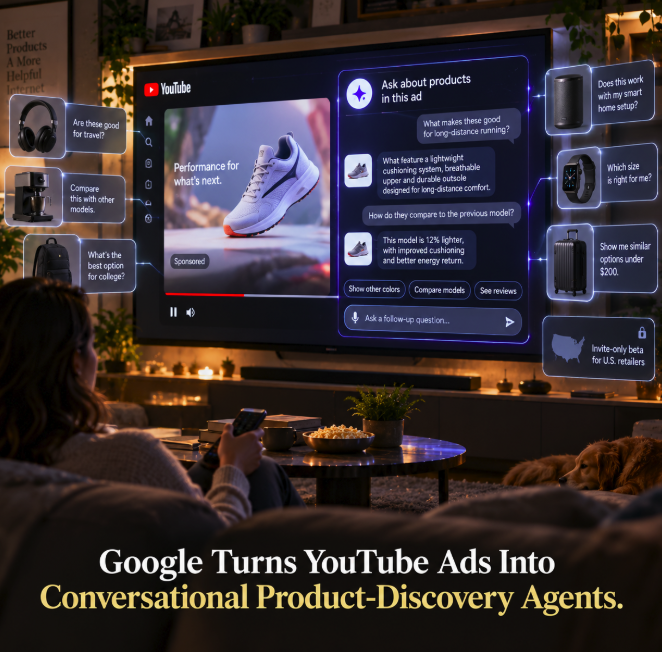

Google is turning some YouTube ads into interactive product-research environments. The company is inviting eligible U.S. retailers into a beta that embeds Business Agent directly inside YouTube ads, allowing viewers to research products, ask complex questions and receive tailored guidance without leaving the YouTube context.
Google announced the beta in its September 16 agentic commerce update for retailers. The feature extends Business Agent beyond Search and into a paid video environment, creating an ad experience that can continue the shopper's research instead of simply asking for a click to a retailer's website.
The distinction matters. A conventional product ad communicates a fixed message and sends an interested user elsewhere for more information. Business Agent can turn the ad itself into a conversational discovery surface.
Business Agent is moving from Search into YouTube advertising
Google introduced Business Agent in Search earlier in 2026 as a branded AI sales assistant. Eligible U.S. retailers can use it to answer product questions in a conversational experience while representing their brand.
In Google's original Business Agent announcement, the company described the feature as a way for shoppers to chat directly with brands in Search and receive product assistance while researching a purchase. Retailers were also promised greater customization, retailer-data training, customer insights, related-product offers and, eventually, direct purchasing capabilities within the conversation.
The new YouTube beta takes that same agentic concept and places it inside an advertising surface. Google says that once an eligible retailer signs up, Business Agent is embedded directly in its YouTube ads.
The viewer can ask complex product questions without leaving YouTube
The core interaction is not merely a predefined FAQ widget. Google says viewers can conduct self-driven research, ask complex product questions and receive tailored guidance while remaining in their YouTube context.
That changes what can happen between seeing an advertisement and visiting a merchant. A shopper watching a product video may have questions that the creative itself does not answer: which model fits a particular use case, whether a feature works with another device, how two products compare or which configuration better matches a specific need.
Instead of forcing that research into a separate browser tab, search query or merchant site, the Business Agent can potentially address it where the initial interest occurred.
The ad becomes a discovery interface, not just a traffic source
This is the strategically important shift for marketers. Digital advertising has traditionally been optimized around the transition from impression to click and then from landing page to conversion. An agent inside the ad introduces another possible stage: impression → conversation → qualified product interest → purchase path.
The click is no longer necessarily the first meaningful action after exposure. A user can interact with the brand's product knowledge before leaving the platform.
That does not eliminate the merchant website or landing page. Google has not said that every Business Agent interaction ends in an on-platform transaction, and the feature is currently a beta rather than a universal YouTube ad format. But it creates a new place where product evaluation can occur.
Google is connecting video inspiration with conversational research
YouTube has long occupied a strong position in product research because shoppers use reviews, demonstrations, comparisons and creator videos to understand products visually. Google's July 2026 Demand Gen update said that 94% of surveyed holiday shoppers who used YouTube reported taking further steps toward a purchase after watching related video content.
Business Agent attempts to shorten the distance between that inspiration and the next research step. A shopper who becomes interested while watching a video can ask a product question immediately rather than translating that interest into a new search session.
Google describes the goal as moving shoppers from inspiration toward being purchase-ready. The important technical mechanism is conversational continuity: the research layer is attached to the advertising experience itself.
This is currently an invite-only U.S. retailer beta
The rollout remains limited. Google says it is inviting retailers to participate in the Business Agent for YouTube ads beta in the United States. The announcement does not describe the feature as generally available, and it does not announce availability for retailers outside the U.S.
That boundary is important because the broader agentic-commerce stack is expanding at different speeds across Google's products and markets. Some Merchant Center AI reporting features are now generally available in five countries, while Business Agent inside YouTube ads remains an early U.S. beta.
Marketers should therefore treat the feature as a directional product signal rather than assume it is already available inside ordinary YouTube campaigns.
Google is building an agentic commerce stack across discovery, advertising and checkout
The YouTube experiment is easier to understand when placed beside Google's other 2026 commerce releases. The company has been connecting AI-assisted product discovery, Merchant Center data, Universal Commerce Protocol infrastructure and checkout across its ecosystem.
In May, Google announced that Universal Cart would work across merchants and services including Search, Gemini and eventually YouTube and Gmail. It also said UCP-powered checkout would come to YouTube in the U.S. and that Shopping ads on YouTube using product feeds in Demand Gen campaigns would gain UCP-powered purchasing capabilities.
The September Business Agent beta fills another part of that sequence. YouTube can inspire the shopper, the embedded agent can answer questions, product infrastructure can supply commerce information and UCP can increasingly support the transition toward checkout.
Product information now has to support a conversation
For retailers, a conversational ad changes the information requirement behind the creative. A fixed video can be carefully scripted around a handful of selling points. An agent has to respond to questions the advertiser did not explicitly script into the video.
That makes product-data depth more important. Google is simultaneously encouraging retailers to submit conversational product attributes through Merchant Center — information designed to describe products in ways that better match how people naturally ask questions.
In the same September announcement, Google said conversational attributes submitted during testing with lululemon were incorporated in 50% of relevant product recommendations in AI Mode. That figure concerns the AI Mode test, not the YouTube Business Agent beta, so it should not be treated as evidence of YouTube ad performance. But it illustrates the broader infrastructure Google is building: richer merchant-supplied product context for conversational discovery.
AI visibility is moving into paid video environments
For NetContentSEO, Business Agent inside YouTube ads expands the definition of AI visibility again. A brand's product information can now potentially be interpreted and delivered not only in AI Mode, AI Overviews or a branded Search agent, but inside an advertising interaction attached to video.
This is paid visibility rather than organic retrieval, and the distinction should remain explicit. The advertiser is participating through a YouTube ad beta. But the quality of the experience depends on more than traditional ad creative because the user can interrogate the product through an AI interface.
That introduces a content question alongside the media-buying question: does the retailer provide enough accurate, structured and conversationally useful product information for the agent to handle the questions buyers actually ask?
The landing page may no longer carry the entire evaluation burden
In conventional performance advertising, the landing page often performs most of the detailed explanatory work after the ad captures attention. Conversational ads can move part of that work upstream.
A shopper may be able to resolve compatibility, comparison or feature questions before deciding whether to continue toward the merchant. In theory, that could make the eventual visit more qualified because the user has already completed part of the evaluation process.
Google has not published performance data for the YouTube Business Agent beta, so it would be premature to claim that the feature improves conversion rates or traffic quality. The confirmed change is functional: product research can happen directly within the ad experience.
Measurement will need to account for conversations, not just clicks
If conversational advertising expands, traditional click-centric reporting will describe only part of the funnel. A viewer could have a meaningful interaction with a retailer's agent, ask several questions and become more informed without immediately clicking away from YouTube.
Google has not yet detailed a complete measurement framework for the beta in its public announcement. Retailers participating in the test will therefore be worth watching for evidence of how Google exposes agent interactions, product questions and downstream commerce outcomes.
The larger measurement challenge is already visible: when an advertisement becomes an interactive research tool, engagement is no longer synonymous with a click.
Google is reducing the boundary between advertising and product assistance
Business Agent does not make a YouTube ad organic content, and it does not turn every advertisement into an autonomous purchasing agent. The current beta is narrower: eligible U.S. retailers can embed a branded conversational assistant in YouTube ads so viewers can conduct product research and receive tailored guidance without leaving the platform.
Even within those limits, the format changes the role of the advertisement. The ad is no longer only a message placed next to content. It can become a temporary product-discovery environment where the consumer asks the questions.
Google is effectively testing a conversational layer between video inspiration and commerce. If Business Agent expands beyond the current U.S. beta, YouTube advertising could increasingly compete not only for attention and clicks, but for the product-research conversation itself.