

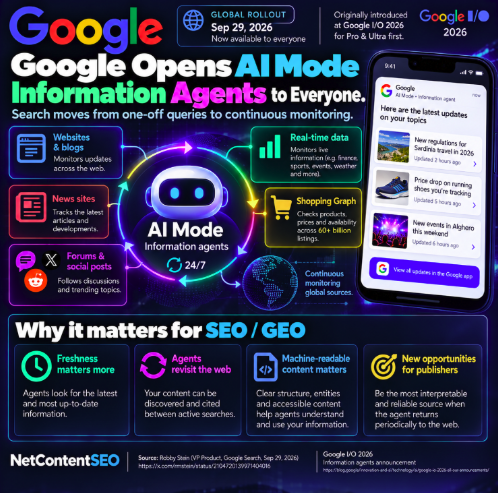

Google Search is moving beyond the idea that every information need begins with a new query. Google is expanding AI Mode Information Agents, background agents designed to continuously monitor information and notify users when something relevant changes.
The feature was introduced at Google I/O 2026, where Google described Information Agents as personalized Search agents that operate in the background 24/7. They were initially scheduled to roll out first to Google AI Pro and Ultra subscribers.
Search becomes persistent instead of episodic
Traditional search is usually reactive: a user has a need, enters a query and receives results at that moment. Information Agents introduce a different model. A user defines an ongoing information need once, and Search can continue monitoring it over time.
At I/O, Google said users would be able to create and manage multiple Information Agents directly inside Search, each focused on a topic, task or project.
Agents continuously monitor the web
Google says Information Agents can look across the web, including blogs, news sites and social posts, while also using Google's freshest real-time information for areas such as finance, shopping and sports.
Instead of simply returning a static list of results, the agent synthesizes relevant changes and can send updates when new information matches the user's requirements.
Shopping brings an enormous live dataset into the loop
Commerce is particularly important to the agentic model. Google says its Shopping Graph contains more than 60 billion product listings, providing a continuously changing dataset of products, prices and availability that its AI shopping experiences can use.
This means persistent Search agents can potentially monitor not only newly published web pages but also changes in structured commercial information.
Freshness becomes a recurring visibility opportunity
For SEO and GEO, persistent monitoring changes the timing of discovery. A publisher no longer needs to be useful only at the instant a person manually searches.
If an Information Agent repeatedly revisits an information need, newly published or updated content can potentially become relevant between active user searches. The visibility opportunity therefore extends across the lifetime of the monitoring task.
Machine-readable information becomes increasingly important
Google has not announced a separate ranking system specifically for Information Agents, so publishers should not treat any individual optimization tactic as a confirmed agent-ranking factor.
But the product design reinforces familiar technical priorities: accessible pages, clear entities, accurate structured information, crawlable updates and content whose freshness can be understood reliably by automated systems.
From ranking for a query to being selected when something changes
The strategic shift is subtle but significant. In conventional SEO, publishers compete to be selected when the user searches. Persistent agents create situations where systems may need to determine which source best represents a meaningful new development when the user is not actively searching at all.
That is especially relevant to news publishers, ecommerce sites, travel inventory, local events, financial information and any vertical where facts, availability or prices change frequently.
The NetContentSEO view
Information Agents push Google Search toward a continuous retrieval model. Search is no longer only a destination users visit; it can become an ongoing process operating on their behalf.
For publishers, the emerging GEO question becomes: when an agent returns to the web looking for what changed, is your content fresh, accessible, interpretable and authoritative enough to become one of the sources it uses?
Google has not disclosed the exact source-selection mechanics for Information Agents, so those effects need empirical testing. But the product direction is clear: discovery is becoming persistent, agentic and increasingly detached from the moment of a manually typed query.