

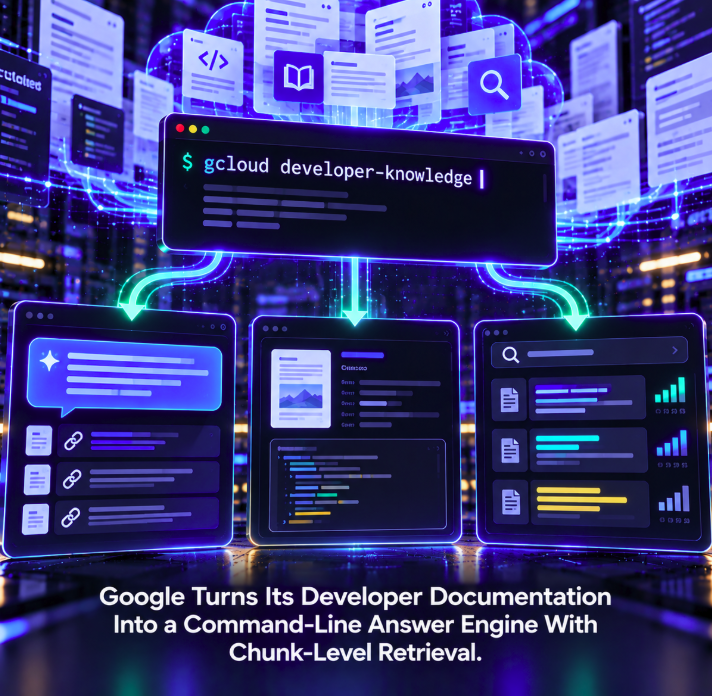

Google has turned its official developer documentation into something developers can query directly from the command line as both a search corpus and a grounded answer engine. On September 22, the company moved the gcloud developer-knowledge command family into general availability, giving the Google Cloud CLI native commands for generating answers, retrieving documents and searching individual documentation chunks.
The GA release is recorded in Google’s official Developer Knowledge release notes. It exposes three distinct operations: gcloud developer-knowledge answer-query for generated answers based on developer documentation, gcloud developer-knowledge documents describe for document metadata and content views, and gcloud developer-knowledge documents search-chunks for retrieving passages relevant to a query.
The distinction between those commands is what makes the release more than another AI assistant embedded in a developer tool. Google is exposing different layers of its documentation retrieval stack directly in the terminal, allowing a developer—or an agent operating through the CLI—to choose between a synthesized answer, a specific source document and the underlying passages that matched the query.
The CLI can now return a grounded answer with its source evidence
Google’s Developer Knowledge gcloud quickstart shows answer-query taking a natural-language question and returning a generated response in YAML. The output is not limited to answer text. It also includes citations and references that map portions of the generated response back to source documentation chunks.
Those references expose the documentation used to produce the answer, including source content and metadata such as the document title and public URI. Google describes the underlying AnswerQuery process as grounded generation: the response is composed from the Developer Knowledge corpus and accompanied by citations to the relevant documentation pages.
That changes the CLI from a command reference into an interface for asking questions about the platform itself. A developer can request guidance such as how to create a Cloud Storage bucket and receive a natural-language answer without first opening a browser, while retaining a path back to the official evidence supporting the response.
Developers can bypass generation and search the chunks directly
The more technically interesting command is documents search-chunks. Rather than asking Google to synthesize an answer, developers can search the documentation corpus for the passages most relevant to a query. Google returns the matched content along with the parent document, chunk identifier and a relevance score.
The current documentation says each result can include the text snippet, document metadata, the chunk ID, the resource name of its parent document and a relevanceScore. Google added relevance scores to the generally available v1 API in August, with values between 0.0 and 1.0 indicating how relevant a chunk is to an AnswerQuery or SearchDocumentChunks request.
This creates a useful separation between retrieval and generation. A developer looking for an exact flag, method name, IAM permission or configuration detail does not necessarily need a model to paraphrase the documentation. The CLI can retrieve the relevant passage itself, preserving the wording and context of the official source.
A retrieved chunk can lead directly to the complete Markdown document
Chunk search is not a dead end. Results contain a parent document resource name, which can be passed to gcloud developer-knowledge documents describe. With the appropriate content view, the command can return the complete Markdown representation of the documentation page along with metadata such as title, description, data source, update time, content length and public URI.
The resulting workflow is therefore progressive. A developer can begin with a query, inspect a highly relevant passage, then fetch the full source document when more surrounding context is required. Alternatively, the developer can start with answer-query and follow its citations back to the underlying evidence.
That is much closer to a programmable retrieval pipeline than a conventional documentation search box. Search, evidence inspection and full-document retrieval are exposed as discrete command-line operations that can be chained into scripts or agent workflows.
Google recommends different retrieval modes for different questions
Google’s AnswerQuery documentation explicitly distinguishes when generated answers and direct chunk search are appropriate. AnswerQuery is positioned for broader how-to questions, comparisons and step-by-step guidance where a complete summary with links to sources is useful. SearchDocumentChunks is recommended for precise lookups such as CLI flags, code syntax, parameter names and IAM permissions.
This distinction is important because retrieval quality is partly a routing problem. Asking a generative endpoint for an exact identifier introduces an unnecessary synthesis step, while asking a raw passage retriever to construct a multi-step explanation pushes work back onto the user or calling agent.
By exposing both modes in gcloud, Google lets the terminal workflow preserve that choice instead of forcing every documentation question through the same interface.
The September 22 GA was the end of a rapid CLI rollout
The command family moved quickly through Google’s release channels. Alpha commands appeared on August 18, followed by the beta component on September 9. On September 22, the non-beta gcloud developer-knowledge commands became generally available.
The CLI itself sits on top of a Developer Knowledge platform that matured earlier in the year. Google made the Developer Knowledge API and MCP server generally available on April 16, describing them as interfaces that allow AI-powered development tools to search and retrieve official Google developer documentation. The AnswerQuery endpoint subsequently reached GA in July.
Seen in that sequence, the new commands are not a standalone AI feature added to gcloud. They are another client for an increasingly structured documentation service that Google exposes through REST, MCP and now a production command-line interface.
The command line is becoming an AI retrieval surface
Documentation has traditionally entered terminal workflows indirectly. Developers read a web page, copy a command and return to the shell, or use built-in help output that describes a known command locally. Developer Knowledge collapses part of that loop by making the broader official documentation corpus queryable from the same environment where the resulting command may be executed.
This is particularly useful for coding agents. An agent with permission to invoke gcloud can retrieve a passage, inspect a full document or request a grounded answer as part of a larger task. The terminal becomes not just an execution interface but a knowledge interface.
Google reinforced that direction three days later by releasing the open-source retrieving-developer-knowledge agent skill, which NetContentSEO covered in our analysis of Google’s reusable documentation-retrieval workflow. That skill teaches compatible coding assistants how to choose the appropriate Developer Knowledge MCP operation and fall back to REST when MCP is unavailable. The September 22 CLI release gives the same underlying knowledge system another execution surface.
Chunk-level retrieval exposes the evidence layer that answer engines usually hide
The most significant design choice may be Google’s willingness to expose retrieval beneath the generated answer. Many AI products show users a synthesis and a collection of links while hiding the intermediate evidence selection that produced them. Developer Knowledge allows developers to work directly with matched chunks and their relevance scores.
That is useful for debugging. If an answer is incomplete, a developer can search the corpus and inspect whether the expected passage is retrievable. If the right chunk appears but the generated response mishandles it, the problem is downstream of retrieval. If the expected material never appears in chunk search, the investigation moves toward corpus coverage, query formulation or retrieval relevance.
The same logic has become central to AI-search optimization more broadly. NetContentSEO has repeatedly distinguished source retrieval from visible citation because a page cannot influence a grounded answer if it never enters the evidence pool. Google’s CLI now makes that separation tangible inside its own developer-documentation system.
Official documentation becomes machine-consumable infrastructure
The larger shift is that Google is no longer treating developer documentation only as pages meant to be navigated by humans. Developer Knowledge represents those pages as documents and chunks with structured metadata, relevance scores, update timestamps and machine-addressable resource names. Generated answers can cite those chunks, while clients can retrieve the evidence directly.
That creates a new role for documentation quality. A page must still be accurate and useful to a human reader, but its content is increasingly consumed through retrieval systems that select passages rather than entire pages. Clear local context, precise terminology and well-maintained source material become important not only for search discoverability but for machine grounding.
The CLI release makes this architecture visible to developers without requiring them to build against the REST API themselves. After enabling Developer Knowledge for a Google Cloud project, the same retrieval and grounded-answer capabilities can be invoked as ordinary gcloud commands.
Google is separating answers, evidence and source documents into callable primitives
That separation is the most important part of the September 22 release. answer-query asks Google to synthesize documentation into an answer. search-chunks exposes the retrieved evidence. documents describe retrieves the source document and its metadata. Each is a different operation, and each can be used independently.
For developers, this provides more control over when to trust synthesis and when to inspect primary material. For agents, it creates composable primitives that can be selected according to the task. And for Google, it turns a large body of official documentation into an infrastructure layer that can serve browsers, APIs, MCP clients, coding assistants and shell workflows from the same maintained corpus.
The result is more consequential than putting an AI chatbot in a terminal. Google has made the evidence pipeline itself callable. Developers can ask for the answer, retrieve the chunk that supports it, or fetch the full source—and they can now do all three without leaving gcloud.