

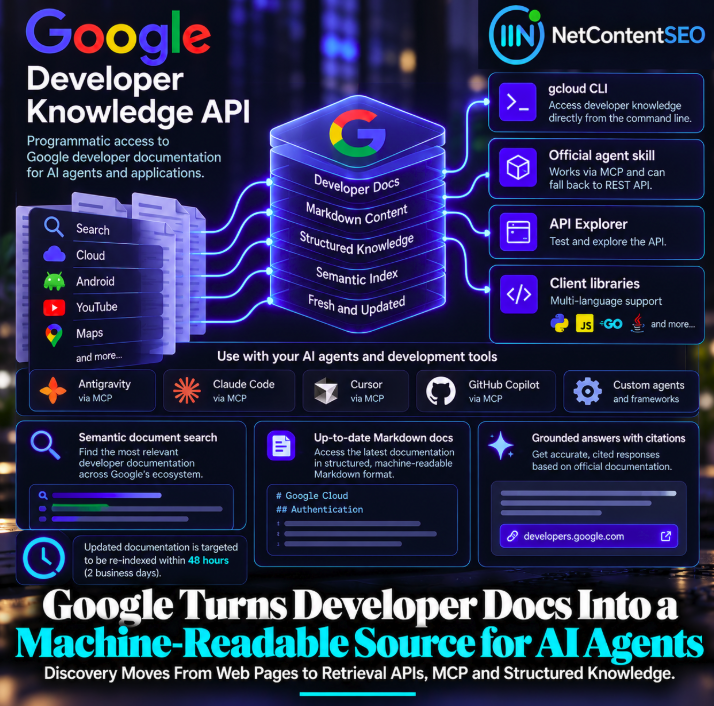

Google is making its developer documentation increasingly accessible as structured knowledge for machines, not just pages for humans.
On October 7, 2026, Google highlighted an expanded Developer Knowledge API ecosystem that gives AI agents, coding assistants and developer tools programmatic access to official Google documentation through multiple interfaces.
The important change is not the invention of the API or MCP server themselves. The ecosystem already existed. The October announcement brings together newer access surfaces including the gcloud CLI, an official agent skill, API Explorer and multi-language client libraries.
A canonical programmatic source of Google developer documentation
Google describes the Developer Knowledge API as an official programmatic source of truth for documentation covering Google Cloud, Firebase, Android and other developer ecosystems.
Instead of scraping web pages or relying on an LLM's training cutoff, an application can query Google's structured documentation corpus directly.
The API returns documentation in Markdown, making the content easier for agents and developer tools to consume than arbitrary rendered web pages.
Semantic retrieval replaces brittle documentation scraping
The API supports semantic document search rather than requiring developers to reproduce Google's website navigation or scrape HTML.
Applications can search document chunks, retrieve full documents and ask questions grounded in the indexed corpus.
This creates a dedicated retrieval layer between Google's documentation and the AI systems that need to reason over it.
The MCP server exposes three core tools
Google's Developer Knowledge MCP server currently provides three central operations.
search_documents finds relevant documentation excerpts. get_documents retrieves full Markdown documents. answer_query generates a structured answer based on the Developer Knowledge corpus.
An AI coding assistant can therefore choose between retrieval and direct grounded question answering without scraping developers.google.com itself.
The official agent skill teaches assistants how to retrieve correctly
Google's retrieving-developer-knowledge skill adds instructions for AI agents using the system.
The skill tells an assistant when to use broad grounded question answering and when to perform targeted document search for details such as CLI flags, IAM permissions or code syntax.
It also instructs agents to verify that retrieval succeeded before answering, reducing the risk that an authentication or quota failure is mistaken for missing documentation.
The skill can fall back from MCP to REST
The agent skill is not tied exclusively to a working MCP connection.
Google documents a REST fallback path for environments where MCP is unavailable or fails.
This is strategically important because it separates the retrieval behavior from one transport protocol: the agent's goal is to reach authoritative knowledge, whether through MCP or the underlying API.
Google documents integrations with major coding agents
The official setup documentation provides installation paths for Google Antigravity, Claude Code, Cursor and Codex, while the open Agent Skills format can also be used by other compatible assistants.
The MCP server itself can be configured in additional remote-MCP clients and custom development environments.
That gives Google one documentation corpus that can serve many competing AI coding interfaces.
gcloud turns the knowledge corpus into a command-line resource
The gcloud developer-knowledge command surface reached general availability on September 22, according to Google's release notes.
That means developers and automated workflows can access Developer Knowledge directly from the command line rather than writing a custom REST client first.
The October ecosystem announcement places this CLI access alongside MCP, agent skills and software libraries as parallel ways to reach the same documentation layer.
Client libraries make production integration easier
Google also provides official client-library workflows for the Developer Knowledge API.
These use standard Google authentication mechanisms such as Application Default Credentials and make it easier to integrate retrieval into production software without manually constructing HTTP requests.
The API itself also supports API-key authentication for direct REST usage.
API Explorer lowers the barrier to testing retrieval
The addition of API Explorer gives developers an interactive way to inspect methods and test requests before integrating them into an application.
Together, the interfaces now span command-line use, interactive experimentation, AI-agent access and conventional application development.
Google aims to re-index documentation within 48 hours
Freshness is one of the core reasons for creating a dedicated retrieval API.
Google says its goal is to re-index new or updated documentation within 48 hours of publication, making it available within two business days.
This is a target rather than a guarantee that every documentation change becomes queryable exactly 48 hours later.
Fresh documentation attacks the training-cutoff problem
A coding model can know an older version of an API extremely well and still produce the wrong answer after a product changes.
Retrieving current documentation at task time reduces dependence on what the model happened to learn during pretraining.
The model becomes a reasoning layer over current external knowledge rather than the sole repository of technical facts.
Grounded answers can preserve provenance
Google's question-answering method is designed to generate responses from the Developer Knowledge corpus with citations to supporting documentation.
This changes the trust model for developer assistance.
Instead of asking only whether the model sounds correct, a developer can inspect which official document supports the answer.
The corpus is curated, not the entire public web
The Developer Knowledge API does not simply index everything Google publishes.
Google maintains a corpus reference defining the supported documentation sources. Current coverage includes numerous Google developer properties as well as documentation for ecosystems such as Flutter, Firebase, Fuchsia, Gemini CLI, Genkit, Go, Maps Platform, TensorFlow and web.dev.
Google explicitly notes that sources outside the corpus, including unrelated GitHub repositories, blogs and YouTube content, are not automatically included.
Machine-readable discoverability becomes a product decision
For years, documentation discoverability largely meant making a page crawlable, indexable and easy to find in a web search engine.
The Developer Knowledge architecture adds another path.
Google can expose documentation through a structured corpus, semantic search API and MCP tools specifically designed for agents.
An AI assistant may therefore reach the canonical documentation without navigating a conventional search results page at all.
This is retrieval infrastructure, not a Google Search ranking update
The Developer Knowledge API should not be confused with Google's public web-search ranking systems.
There is no indication that adopting MCP or exposing an API gives an ordinary website a ranking advantage in Google Search.
The relevance for SEO and GEO is architectural: it demonstrates how a major publisher can create a first-party machine-readable retrieval channel for AI systems.
The canonical-source problem changes for agents
On the open web, an agent may encounter official documentation, Stack Overflow answers, blog posts, scraped copies and outdated tutorials discussing the same API.
A first-party retrieval endpoint gives the agent a way to deliberately prefer the publisher's canonical knowledge base.
That can reduce ambiguity over which source should be trusted when technical details conflict.
MCP is becoming a distribution layer for knowledge
MCP is often discussed as a way for agents to take actions in external systems.
Google's implementation shows the other side of the protocol: knowledge distribution.
The server exposes search, retrieval and grounded-answer tools so an agent can obtain authoritative context on demand.
For publishers, this suggests that future discoverability may involve both content pages and callable knowledge interfaces.
Structured content can bypass the page-rendering layer
Google converts source documentation into Markdown for API retrieval.
That strips away much of the navigation, presentation and front-end complexity that exists for human visitors.
The agent receives content in a format optimized for machine processing rather than needing to infer the important information from a rendered page.
What publishers can learn from Google's approach
Most publishers do not need to build a Developer Knowledge API tomorrow.
But the design exposes several useful principles for AI discoverability: maintain a clearly defined canonical corpus, expose clean structured content, preserve stable document identities, provide semantic retrieval, keep the corpus fresh and retain source attribution.
Those principles can apply to product documentation, support centers, research libraries, technical specifications and other knowledge-heavy websites.
From SEO to retrieval architecture
Traditional technical SEO focuses on helping search crawlers discover and interpret pages.
Agent-oriented retrieval adds a parallel engineering question: how can a machine access the underlying knowledge directly and reliably?
APIs, feeds, MCP servers, structured data and machine-readable documents can all become parts of that answer.
NetContentSEO take
Google is demonstrating a future in which authoritative discoverability does not stop at the web page.
The Developer Knowledge ecosystem turns official documentation into a canonical retrieval service that agents can search semantically, retrieve as Markdown and use for grounded answers with citations.
The new CLI, agent skill, API Explorer and client libraries expand the number of ways machines can reach that knowledge.
For GEO, the lesson is bigger than developer documentation: when AI agents become an important audience, publishers may need to think about retrieval architecture as a distribution channel alongside crawling, indexing and ranking.