

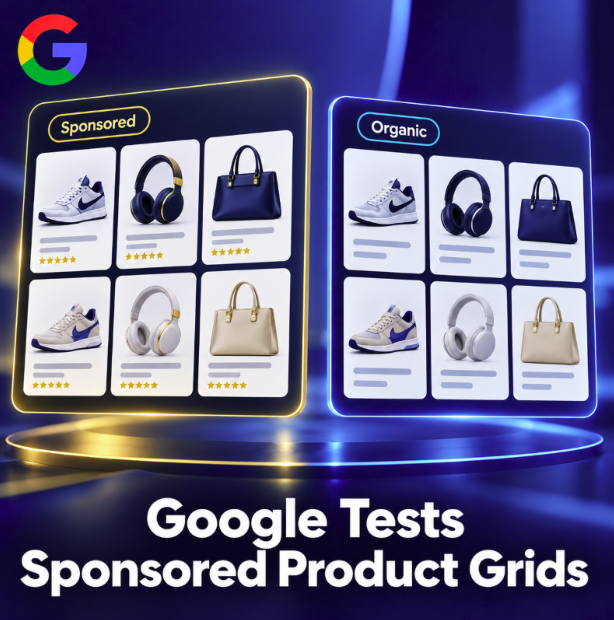

Google is testing a sponsored shopping format that looks more like the product grids associated with free listings. The observed layout replaces the familiar advertising carousel with a grid headed “Sponsored products.” For ecommerce teams, the question is whether a shared visual format changes how shoppers notice and compare paid and unpaid product results.
What the reported test shows
Search Engine Roundtable documented the test on September 30, 2026, citing an observation by Brodie Clark and reproducing examples of the grid alongside conventional sponsored carousels. Clark expressed concern that the similar appearance could confuse users and predicted higher click-through rates for the advertising unit.
Those are practitioner assessments, not measured outcomes. The report does not establish a general rollout, quantify user confusion or provide click-through data. The observed block retains a “Sponsored products” heading, so the evidence supports visual convergence between formats rather than the disappearance of advertising disclosure.
Why a familiar grid could affect attention
Our editorial interpretation is that presentation can influence how a shopper scans a results page. If paid products use the same card arrangement as free listings, the visual distinction may depend more heavily on the section heading and its surrounding context. That is a hypothesis about attention, not proof that users fail to recognize an advertisement.
For a merchant, product order is only one part of exposure. The number of nearby alternatives, card size and position of the module can shape the comparison environment. A different layout could affect performance without requiring a change to the ordering of free results. This report does not demonstrate that such an effect has occurred.
A possible pressure on free-listing clicks
The concern for shopping SEO is whether a paid grid attracts attention that would otherwise have gone to free listings. That is a plausible question to investigate, but a screenshot cannot establish displaced clicks. Shoppers might compare both sections, click different products or leave without selecting either.
Teams examining a change in free-listing performance should capture the page layout for comparable queries and devices. Note where sponsored and free modules appear, which products are visible and whether a shopper must scroll to reach the unpaid section. Compare those observations with traffic and commercial outcomes over a consistent period.
Keep paid and organic measurement distinct
A merchant appearing in both sections should retain separate records for paid and free exposure. Similar cards do not make the underlying acquisition channels interchangeable. A rise in advertising clicks alongside a decline in free traffic also does not, on its own, prove that the new format caused a transfer between them.
Consider changes in demand, competing offers and the merchant’s own campaigns before assigning cause. Where the layout is observed repeatedly, it can become a useful variable in the investigation. Where it appears only once, treat it as a documented example rather than the explanation for a wider performance trend.
The broader relevance to AI commerce
This is a shopping interface test, not evidence of a change to AI-generated recommendations. Its relevance to AI commerce is an editorial inference: teams assessing product discovery need to understand both why an item was selected and how it was presented. Paid placement, free inclusion and an assistant’s recommendation remain different outcomes even when their visual treatments converge.
The immediate takeaway is to monitor shopping exposure beyond position alone. The reported sponsored grid warrants attention, while claims of higher ad CTR, lower free-listing CTR or confused users still require evidence.