

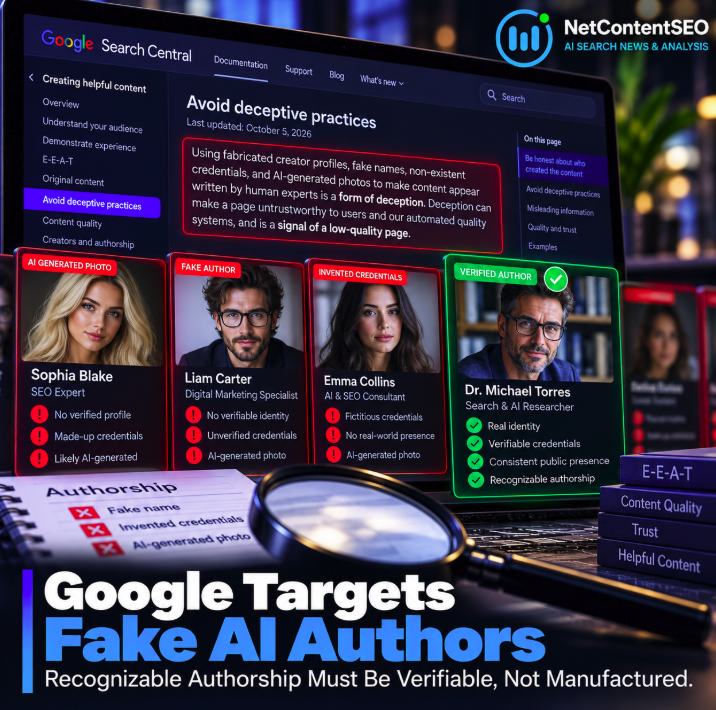

Google has made its position on fabricated authorship unusually explicit: inventing people to make content appear as though it was created by human experts is deception, and that deception can make a page untrustworthy to both users and Google's automated quality systems.
The clarification appears in Google's updated Creating helpful, reliable, people-first content documentation, inside the “Who” section of its Who, How and Why framework.
Google explicitly names AI-generated headshots and fake credentials
Google's new wording goes beyond a generic recommendation to add author biographies.
It specifically warns against fabricated creator profiles, including AI-generated headshots, made-up names and false credentials used to make content appear as if it had been written by human experts.
Google describes this practice as a form of deception and says deception makes a page untrustworthy to users and automated quality systems. It also explicitly calls it a signal of a low-quality page.
The issue is deception, not simply the use of AI
This distinction is essential.
Google is not saying that an AI-generated image is automatically a ranking problem, nor that AI-assisted content is inherently low quality. Google's separate guidance on generative AI says AI can be useful for research, structure and content production when the resulting material is accurate, relevant and valuable.
The problem arises when AI is used to manufacture evidence of human expertise that does not exist.
An artificial portrait presented as a real journalist, a fictional doctor attached to health advice or an invented SEO consultant with fabricated credentials creates a false provenance signal.
Google wants accurate answers to “Who created this?”
Google's people-first guidance asks publishers whether it is self-evident who authored their content, whether pages carry bylines where readers would expect them, and whether those bylines lead to useful information about the creators and their areas of expertise.
Google says publishers are likely aligned with E-E-A-T concepts when they clearly indicate who created the content, and it strongly encourages accurate authorship information.
The important word is accurate.
Recognizable Authorship becomes more important
For publishers, this strengthens the case for what NetContentSEO describes as Recognizable Authorship: authorship should connect a piece of content to a creator whose identity, expertise and body of work can be independently understood.
A real author page can link to previous work, professional profiles, relevant projects, research, interviews and other evidence that forms a consistent entity over time.
A fictional persona can imitate the visual appearance of that structure, but it cannot easily reproduce the underlying real-world evidence without creating additional deception.
A polished author box is not evidence of expertise
The web has made author modules increasingly sophisticated. A page can display a portrait, biography, job title, credentials, social links and structured data while still representing a person who does not exist.
Google's clarification effectively separates authorship presentation from authorship authenticity.
Adding more author markup cannot solve a trust problem created by false identity information. In fact, using structured data or profile pages to reinforce invented credentials may deepen the inconsistency between what a site claims and what can actually be verified.
AI transparency belongs in the “How” layer
Google's framework also addresses how content is created.
For content produced substantially through automation or generative AI, Google suggests considering whether the use of automation is self-evident, whether background about the process would help readers and why automation was useful.
This creates a useful separation between two questions: Who is responsible for the content? and How was the content produced?
A genuine human author can use AI assistance without becoming a fictional author. Conversely, creating a synthetic identity and presenting it as a real expert is deceptive regardless of whether the article itself was manually written.
This matters for YMYL and expertise-heavy topics
The risk becomes particularly obvious in areas where readers rely on professional expertise.
Inventing a physician, financial adviser, lawyer or technical specialist can falsely imply qualifications that materially affect how a reader evaluates advice.
Google's documentation does not say that every author must hold formal credentials. It says publishers should not fabricate credentials or creator identities to manufacture the appearance of expertise.
Audit author entities, not just article content
SEO audits increasingly need to examine the identity layer of a publication.
Publishers should verify that author names correspond to real people or clearly disclosed organizational identities, biographies are factual, claimed credentials can be supported, profile photographs are not being used deceptively, and author pages connect logically to a genuine body of work.
Sites that created fictional “experts” as a shortcut to E-E-A-T signals should reconsider that strategy.
The NetContentSEO takeaway
Google's clarification supports a broader shift in search quality: trust cannot be manufactured simply by reproducing the visual signals associated with expertise.
Bylines, author pages, profile images and credentials matter only when the identity behind them is truthful.
That has implications beyond conventional SEO. AI search and citation systems also need to decide which sources and creators are credible enough to retrieve, summarize and cite.
Recognizable Authorship therefore should not mean creating an author entity that looks convincing. It should mean creating a consistent, truthful and verifiable relationship between person, expertise, content and evidence.