

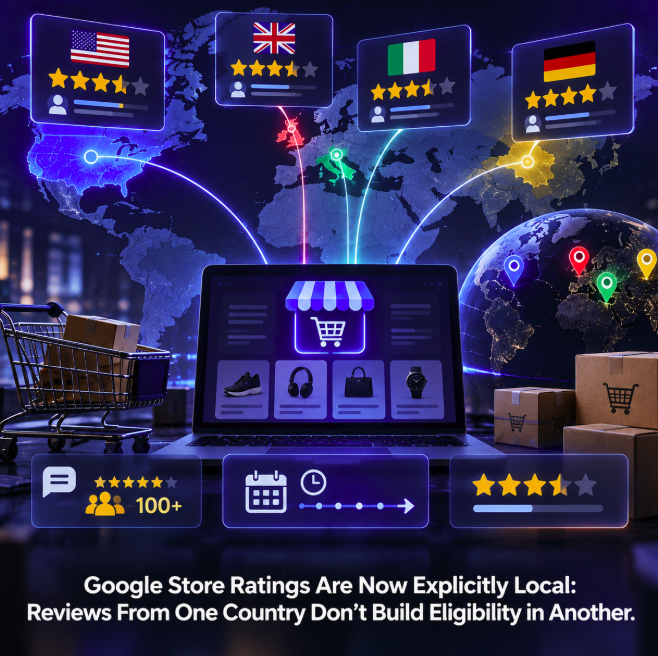

Google has made the requirements behind Store Ratings considerably more explicit, and the most important clarification for international ecommerce businesses is geographic: reviews are not treated as one global pool. Customer feedback from a particular country contributes to a merchant’s Store Rating in that country, meaning a strong review base in the United States does not automatically establish the same eligibility in Germany, Italy, the United Kingdom or another market.
The documentation change was highlighted on September 22 by Search Engine Roundtable, which spotted a newly added requirements section in Google Merchant Center Help. The updated official Google Store Ratings documentation now spells out several benchmarks that merchants and paid-search teams can use when diagnosing why ratings do or do not appear.
Google says merchants generally need at least 100 eligible, unique reviews to enable a reliable Store Rating, while noting that the exact volume can vary according to its confidence systems. For paid text and Shopping advertising, Google documents a 3.5-out-of-5 average threshold. It also describes a rolling 24-month review window and explicitly states that Store Ratings are geo-segmented rather than globally aggregated.
The 100-review figure is a benchmark, not an absolute rule
The most tempting number in the update is 100, but merchants should read it carefully. Google says a merchant “generally” needs at least 100 eligible and unique reviews for it to calculate a reliable rating. The company also says the exact volume can occasionally vary depending on its confidence algorithms, making 100 a standard qualification benchmark rather than a guaranteed switch that activates Store Ratings on review number 100.
Google’s Ads documentation uses similarly qualified language. It says most merchants can obtain a rating after collecting 100 or more eligible reviews, provided Google has received enough unique country-specific feedback to calculate a rating reliably. Google or its partners may also conduct research evaluations of a merchant’s site, providing another path through which a rating can be established.
This distinction matters operationally. Ecommerce teams should not treat 100 as a contractual threshold and assume something is broken if stars fail to appear immediately after reaching it. Review eligibility, source quality, geographic distribution, domain matching and Google’s confidence in the available data all remain relevant.
A 3.5-star threshold applies to paid ad visibility
Google’s updated Merchant Center overview says stores need an average composite score of at least 3.5 stars out of five for paid text and Shopping ads. If the average falls below that threshold, the star-rating asset can stop displaying alongside paid advertising until performance improves.
There is an important nuance: this does not mean every Google surface requires 3.5 stars. Google Ads Help specifies that unpaid listings can show Store Ratings when the average is below 3.5. Merchants should therefore distinguish eligibility for paid rating assets from the broader existence of a Store Rating.
That distinction is especially relevant when diagnosing inconsistent appearances across Search, Shopping and free surfaces. A merchant can have review data associated with its domain without the rating appearing in every auction or format. Google also notes that having a Store Rating does not guarantee it will show with an ad because auction dynamics and other factors affect display.
The 24-month window makes review collection an ongoing requirement
Google’s documentation now describes a rolling 24-month window for the reviews used to maintain current Store Ratings eligibility in advertising. Older feedback ages out of that window, which means merchants cannot simply build a large review base once and assume that historical volume will support rating visibility indefinitely.
This turns review acquisition into a maintenance problem as much as an acquisition problem. A store that collected hundreds of reviews during an aggressive campaign two years ago but receives very little recent feedback can gradually lose qualifying volume as those reviews move outside the relevant period.
For ecommerce teams, the practical metric is therefore not lifetime review count but the flow of eligible recent reviews. The same logic applies to average score: a rolling dataset means the rating can change as older positive or negative reviews disappear and newer experiences receive greater representation.
The biggest clarification is that Store Ratings are country-specific
The geographic rule has the largest strategic consequence for international retailers. Google says Store Ratings are calculated separately for each country rather than combined into a single worldwide score. Reviews from customers in one country influence the merchant’s rating in that country.
A retailer expanding from the United States into Europe therefore cannot assume that thousands of U.S. reviews will immediately establish Store Rating eligibility in each new market. The business may have substantial global reputation data while still lacking enough qualifying local feedback for Google to calculate a confident rating in a specific country.
The same issue applies in reverse. A merchant with an excellent review program in the United Kingdom may still need to develop sufficient eligible feedback from U.S. customers before expecting comparable Store Rating coverage there. International review strategy becomes market-specific rather than merely domain-specific.
Google even provides a country parameter for checking Store Rating pages. Merchants using one domain across multiple countries can modify the country code in the Store Ratings URL to inspect different national versions, reinforcing the fact that the same domain can have different rating states across markets.
International ecommerce teams should segment review reporting by market
The documentation makes a globally aggregated review dashboard less useful for diagnosing Google visibility. A company might report 10,000 reviews worldwide and still fail to answer the question that matters for Store Ratings: how many recent, eligible reviews does Google associate with each target country?
Paid-search and ecommerce teams should therefore monitor review volume, average rating and recency at country level. They should also confirm that the domain and store name represented in review sources match the information registered in Merchant Center, because Google lists mismatches as a common reason ratings fail to appear.
For brands using third-party review aggregators, another consideration is whether the partner shares eligible review data with Google. Google says Store Ratings can draw from Google Customer Reviews and approved third-party aggregators, with internal logic used to weight different sources when calculating the resulting score.
Store Ratings are becoming a clearer operational SEO and PPC signal
Although Store Ratings are most directly relevant to Merchant Center and advertising, the clarification belongs to a wider trend in Google’s commerce ecosystem: trust and merchant-quality information are becoming more structured and more visible across shopping surfaces. Review data can appear in ads, unpaid formats, store pages and other Google experiences, making accurate merchant identity and customer-feedback pipelines increasingly important.
Google says Store Ratings in text ads produce an average 2% improvement in click-through rate, citing its own internal data. That does not mean every merchant will see the same lift, but it explains why eligibility matters commercially: stars and review counts can change how a store appears at the moment a user evaluates competing advertisers.
The new documentation also makes troubleshooting less ambiguous. Rather than thinking of Store Ratings as a single reputation score attached permanently to a domain, merchants should think of them as a dynamic, market-specific system based on eligible recent feedback and Google’s confidence in the data.
A global brand needs a local review strategy
The central lesson from Google’s clarification is straightforward. A merchant can have a strong international reputation and still lack sufficient Store Rating data in a particular market. Global review volume does not automatically transfer eligibility across borders.
For businesses expanding internationally, review collection should therefore be planned alongside localization, Merchant Center setup, product feeds and paid-media strategy. The relevant questions are not only “How many reviews do we have?” and “What is our average rating?” but “How many eligible reviews do we have in this country, how recent are they, and does Google have enough confidence to calculate the rating here?”
Google has not turned 100 reviews into an inflexible universal rule, and the 3.5-star requirement should not be generalized to every unpaid surface. But by documenting the typical review volume, paid-ad rating threshold, rolling timeframe and country-specific calculation more clearly, Google has made one thing unmistakable: Store Ratings are local reputation signals, even when the retailer itself operates globally.