


Google’s search results showed a conspicuous burst of volatility on September 25, with several independent ranking sensors moving sharply at the same time. The timing is difficult to ignore: the movement arrived one day after Google began rolling out its September 2026 spam update, a global ranking update that the company says may take up to two weeks to complete.
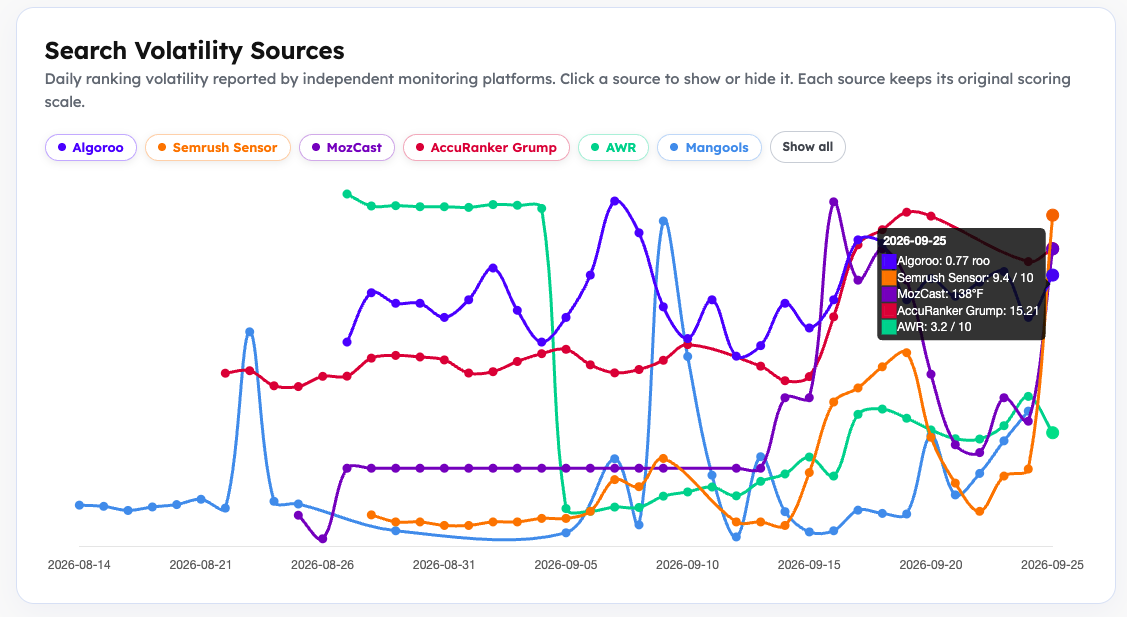
The latest snapshot from the NetContentSEO Search Volatility Monitor shows a broad but uneven reaction across the monitored ecosystem. On September 25, Semrush Sensor reached 9.4/10, MozCast registered 138°F and AccuRanker Grump stood at 15.21. Algoroo was much calmer at 0.77 roo, while Advanced Web Ranking reported 3.2/10. The important signal is therefore not that every tracker reached an equivalent alarm level—they use different scales and datasets—but that several major monitoring systems recorded pronounced movement on the same date.
Semrush, MozCast and AccuRanker are showing substantial turbulence
Semrush Sensor’s 9.4/10 reading is the most visually dramatic signal in the September 25 snapshot. MozCast’s 138°F also places its observed Google results in highly turbulent territory, while AccuRanker’s 15.21 reading remains elevated. The simultaneous movement strengthens the case that September 25 was not simply an isolated anomaly inside one monitoring platform.
At the same time, the disagreement among trackers matters. Algoroo’s 0.77 reading is comparatively quiet, and AWR’s 3.2/10 does not mirror the extreme spike visible in Semrush. That is exactly why NetContentSEO keeps each source on its original scoring scale rather than combining raw numbers into a misleading universal score. Each tracker watches a different keyword sample and can differ by geography, device mix, update frequency, SERP features and collection methodology.
This divergence also echoes a measurement problem we recently examined in our analysis of the widening gap between rank trackers and the SERPs seen by human users. A volatility sensor is an observation system, not a direct feed from Google’s ranking infrastructure. Agreement across multiple systems is useful evidence of broader movement, but disagreement can be just as informative because it may point to changes concentrated in particular query sets, markets or collection environments.
The spike arrived immediately after Google launched its September spam update
The timing gives this volatility episode additional significance. Google’s Search Status Dashboard records the September 2026 spam update as beginning at 09:15 PDT on September 24. Google says the update applies globally and to all languages and may require up to two weeks to complete. As of September 25, the rollout remained active.
That makes the September 25 sensor movement consistent with the period in which Google is actively changing ranking systems. It does not, however, prove that every spike on every tracker was caused by the spam update. Volatility data measures changes in observed rankings; it does not expose the mechanism responsible for those changes. The correct interpretation is therefore narrower: substantial SERP movement is being detected by multiple independent sources while a confirmed Google ranking update is rolling out.
The distinction is especially important because Google has not disclosed a detailed list of techniques or site categories specifically targeted by this release. The official announcement confirms the scope and rollout window, but not a new set of update-specific ranking factors. Trying to map a single day of gains or losses to a particular SEO tactic would go beyond the available evidence.
The shape of the chart suggests the market was already unsettled
September 25 also should not be read in isolation. The NetContentSEO chart shows meaningful movement across several trackers during the preceding days, including earlier peaks that did not occur simultaneously. By the final date in the current snapshot, however, several lines turn upward together, creating a more notable cross-sensor event than a spike confined to one provider.
This is a useful example of why daily volatility monitoring benefits from a multi-source view. A single sensor can produce a dramatic reading because its own keyword universe happens to be affected. When several independent trackers move in roughly the same period, confidence increases that something broader is happening in the search environment—even if the magnitude and timing differ.
We saw the opposite situation earlier this month. In our September 5 volatility analysis, the available sensors were divided, with some showing meaningful movement while others remained calm. The September 25 picture is different: disagreement has not disappeared, but several prominent systems are now showing elevated readings at the same time.
What SEO teams should do with the September 25 signal
For publishers and SEO teams, the most useful response is not an immediate site-wide rewrite. The spam update is still rolling out, and Google has explicitly allowed a two-week deployment window. Rankings observed during that period may continue to change as the update propagates. Acting on one day of movement can make it difficult to distinguish the effects of Google’s update from the effects of changes made to the site itself.
Instead, teams should preserve a dated record of what changed. Search Console impressions, clicks, average positions, affected queries and landing pages can be compared with the volatility timeline. Segmenting by directory, template, topic and country can reveal whether a decline or gain is broad or concentrated. For ecommerce and large publishing sites, this level of segmentation is particularly important because a domain-level graph can hide sharply different outcomes across sections.
Third-party rankings should also be triangulated with real-user Search Console data. If a tracker reports a major fall while impressions and clicks remain stable, the discrepancy itself deserves investigation before content is changed. If multiple trackers, Search Console and business metrics all move in the same direction, the evidence for a material visibility shift becomes much stronger.
A strong early signal, but the rollout has only begun
The September 25 readings are notable because they combine two things SEO teams rarely get at exactly the same moment: a confirmed Google ranking update and a visible cross-sensor volatility event. Semrush, MozCast and AccuRanker are all showing substantial turbulence, while other trackers remain more restrained. That makes this a meaningful signal, but not yet a final diagnosis of the September spam update’s impact.
The next several days will be more revealing than any single reading. If elevated volatility persists or spreads across more independent sensors, the evidence for a broad ranking reshuffle will strengthen. If the spike fades quickly, September 25 may prove to have captured an intense but short phase of the rollout. NetContentSEO will continue tracking the movement through the Search Volatility Monitor as Google’s September 2026 spam update progresses.